
Frameless Shower Enclosure Installation
Frameless Shower Doors — Custom Built for Your DFW Bathroom
Every frameless enclosure starts with a precision measurement and ends with glass custom-ordered to that exact opening — including our signature mitered corners.
A frameless shower door transforms a bathroom. No chunky aluminum rails, no water-trapping channels, no dated look — just a continuous sheet of tempered glass that makes your entire shower feel bigger, brighter, and more modern. It's the single upgrade that photographers reach for first when staging a high-end home.
At Infinity Glass & Glazing, we've been building frameless shower enclosures across the DFW metroplex for over 30 years. Every panel is custom-ordered to the measurements we take in your bathroom — including the precision mitered corners most Texas competitors don't offer at all. That means tighter tolerances and a finished product we stand behind completely.
Whether you're replacing an old sliding door in Frisco, installing a walk-in panel in a new Prosper build, or customizing a corner enclosure for a master suite remodel in Southlake, our team measures your space precisely, orders the glass to fit, and installs it with the kind of care that only comes from doing this every day for three decades.
Why Choose Us
What Sets Our Frameless Shower Door Installation Apart
Custom-Ordered to Fit
Every panel is ordered to the exact measurements taken in your bathroom — never a stock size trimmed down to almost fit.
Precision Laser Measurement
Our technicians measure your exact opening before anything is ordered. Glass is built to your space, guaranteed to fit.
Mitered Corners Standard
Our signature 45° mitered corner joins are standard on every corner enclosure — not an upgrade. Cleaner, tighter, and more durable than butt joints.
Premium Hardware Selection
Brushed nickel, chrome, matte black, and oil-rubbed bronze finishes. Commercial-grade hinges and handles rated for decades of daily use.
Tempered Safety Glass
All glass is fully tempered to ANSI Z97.1 standards. Available in 3/8" and 1/2" thicknesses, clear or low-iron.
30+ Years of DFW Experience
Over 7,000 installations across the DFW metroplex. We've worked in every neighborhood, with every tile type, in every bathroom configuration.
What Makes a Frameless Shower Door Different?
Standard framed shower doors use aluminum rails around the perimeter of every glass panel. The frame provides structural support, but it also collects soap scum, traps moisture, and gives the enclosure a visual weight that cuts across the room.
Frameless enclosures use thick tempered glass — typically 3/8" or 1/2" — that's strong enough to stand on its own. Hinges, handles, and clips attach directly to the glass with no surrounding frame. The result is a clean, uninterrupted view from floor to ceiling that makes any bathroom feel like a spa.
Semi-frameless designs land in between: glass panels hang from a top rail without bottom or side framing, giving a cleaner look than fully framed doors at a more accessible price than fully frameless. Our team will walk you through both options and help you find the right fit for your budget and your space.
Our Signature: Precision Mitered Corners
When two glass panels meet at a corner, most companies use a butt joint — one panel pressed flat against the edge of the other, with silicone filling the gap. It works, but the seam is visible and the silicone is the first thing to yellow or pull away over time.
We do it differently. Our mitered corners are cut at a precise 45-degree angle on each panel so they meet flush, like the corners of a picture frame. The result is a seamless, gap-free joint that looks sharper and seals tighter than a standard butt joint. It takes a more exacting spec and tighter tolerances to produce — but it's our standard, not an upgrade.
This is one of the primary reasons customers drive from McKinney, Allen, and Plano to our showroom in Corinth rather than calling the nearest installer. You can see the difference before you even step inside.
Glass Thickness, Coatings & Temper Options
All of our shower glass is fully tempered safety glass — required by Texas building code and far stronger than annealed glass. When tempered glass breaks, it fragments into small, blunt pieces rather than sharp shards.
For frameless enclosures, we most commonly use 3/8" clear tempered for single doors and panels, and 1/2" for corner and walk-in configurations where additional rigidity matters. Both meet ANSI Z97.1 and CPSC 16 CFR 1201 safety standards.
We also offer low-iron ("ultra-clear") glass for clients who want the truest transparency — standard clear glass has a slight green tint from the iron in the sand, which is most visible on thicker panels. Low-iron eliminates that tint completely. And for added convenience, we can apply a factory-grade hydrophobic coating that causes water to bead and roll off, significantly reducing the frequency of cleaning.
Hardware Finishes for Every Bathroom Style
The hardware — hinges, handles, towel bars, and clips — is where frameless doors become distinctly yours. We carry a curated selection of hardware in four premium finishes: brushed nickel, chrome, matte black, and oil-rubbed bronze.
Browse the full selection on our Services page hardware explorer. If you're designing around a fixture package, bring a photo or the finish name and we'll match it. All hardware is commercial-grade, designed for daily use without corroding or loosening over time.
What to Expect: Our Process from Quote to Installation
We start with a free in-home or in-showroom consultation. Bring your bathroom measurements if you have them, or we'll schedule a precision laser measurement at your home — it takes about 20 minutes and gives us the exact dimensions we need for a perfect fit.
From there, we produce shop drawings showing your enclosure configuration, glass thickness, hardware selection, and all dimensions. You review and approve before anything is ordered. Once approved, your glass typically arrives in 1–2 weeks, and installation is usually a half-day job.
We handle the cleanup, we test the seals and hardware operation before we leave, and we walk you through care and maintenance. If anything isn't right after install, we come back — simple as that.
Our Process
From First Call to Finished Install
Free Consultation
Call, text, or use our contact form to schedule. We discuss your space, style preferences, hardware options, and budget range.
Precision Measurement
We visit your home with laser measuring tools and capture every dimension of your shower opening to 1/16" accuracy.
Custom-Ordered to Fit
Your panels are custom-ordered to the exact specifications from your measurement. Typically 1–2 weeks.
Professional Installation
Our crew installs your enclosure, tests all hardware and seals, and cleans up before leaving. Most installs are completed in a half day.
From the Shop
A Recent Frameless Shower Door Installation Project
“Donavon Wheeler runs every frameless shower door project from spec to install personally — multi-panel work in luxury DFW master baths is exactly where the precision-mitered corner detail pays for itself.”
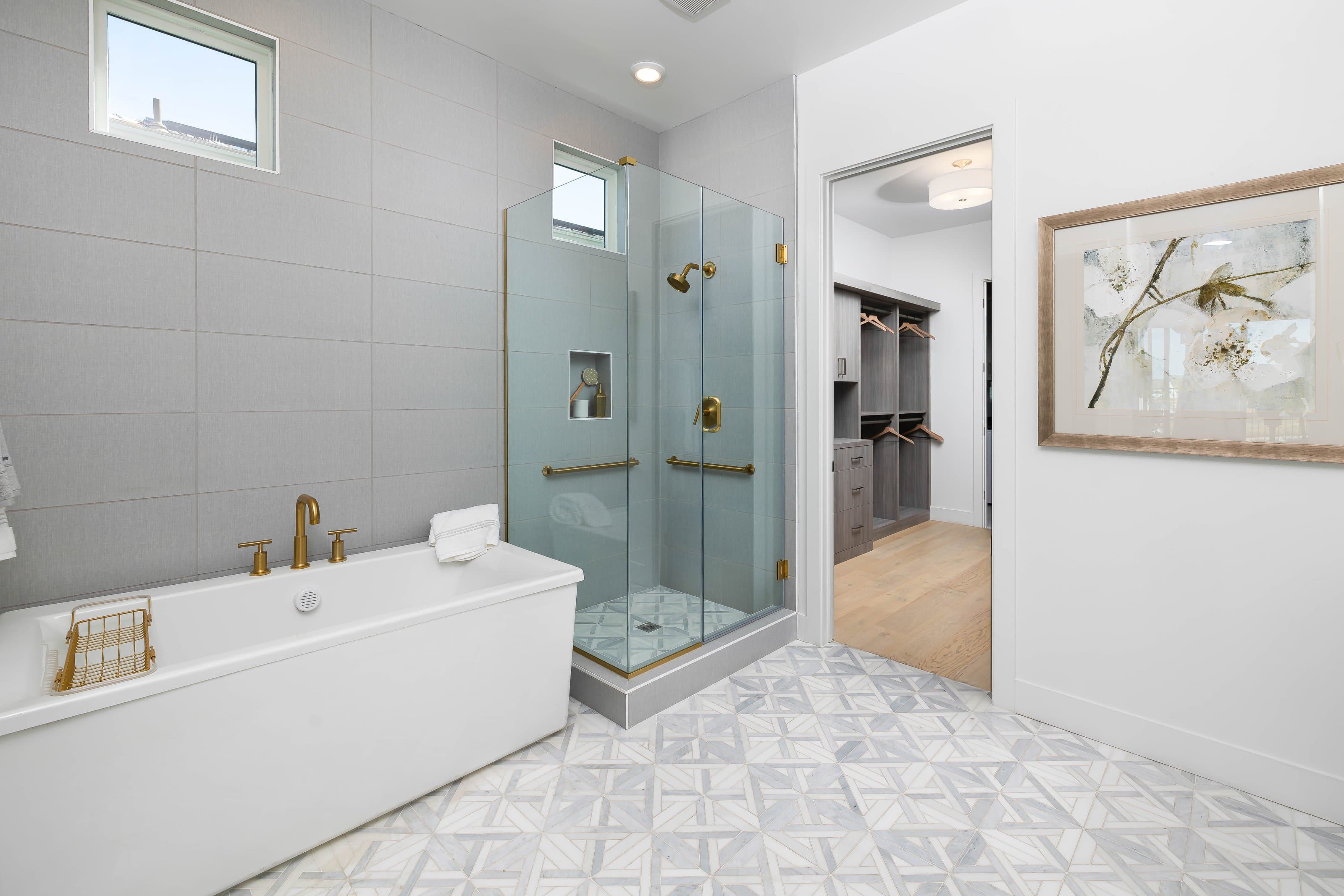
In March 2026 we built and installed a 3-panel frameless walk-in enclosure for a Phillips Creek Ranch primary bath in Frisco — 1/2-inch low-iron glass, brushed nickel hinges and clips, two precision-mitered corners. Measured Monday morning, shop drawings approved Wednesday, glass arrived the following week. Install was a full day on-site. Final price landed at $4,400 — typical for a 3-panel Frisco luxury bath.
All frameless shower door glass meets the 2024 IRC 308 safety glass standard — tempered glass tagged to the spec per the National Glass Association (NGA) handling protocols.
FAQ
Common Questions
How much does a frameless shower door cost in DFW?
Frameless shower doors typically range from $900 to $3,500+ depending on the configuration, glass thickness, and hardware. A simple single swing door on a 36" opening with standard hardware usually lands in the $900–$1,400 range. A full corner enclosure with 1/2" glass, mitered corners, and premium hardware runs $2,200–$3,500+. We provide itemized quotes after your measurement so there are no surprises.
How long does installation take?
From your initial call to completed installation, most projects take 2–3 weeks. The measurement visit takes about 20 minutes. Your glass typically arrives in 7–10 business days. Installation day is usually 3–5 hours for a standard enclosure.
Do frameless shower doors leak?
Properly installed frameless doors don't leak with normal shower use. Water management comes from correct installation — proper seal placement, appropriate glass pitch, and the right hardware alignment. We've been doing this for 30+ years and we stand behind our installs. If you experience any water intrusion issues after our installation, we come back and fix it.
What glass thickness do you recommend?
For single swing doors and panels, 3/8" tempered glass is the industry standard and what we use most often. For corner enclosures with long unsupported spans, or for clients who prefer the substantial feel of heavier glass, we recommend 1/2". We'll give you our recommendation based on your specific layout during the consultation.
Do you serve my area?
We serve the entire DFW metroplex from our location in Corinth, TX — including Dallas, Fort Worth, Frisco, McKinney, Allen, Prosper, Southlake, Plano, Lewisville, Flower Mound, Denton, and 40+ additional cities. If you're within about 50 miles of Corinth, we can help.
In Your City
Frameless Shower Door Installation in Specific DFW Cities
See city-specific details — pricing, neighborhoods, and project examples — for frameless shower door installation in the cities below.
Learn More
Related Guides from Our Blog
Ready for a Free Estimate in DFW?
Call us directly or request a quote online. Same-day estimates available for DFW and surrounding areas.