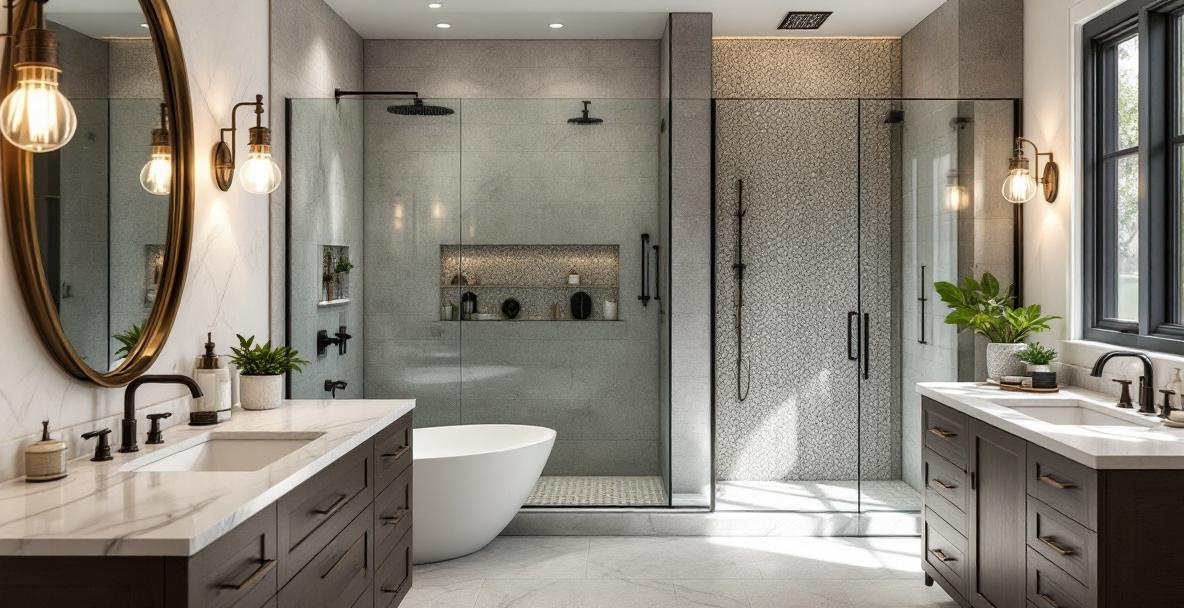
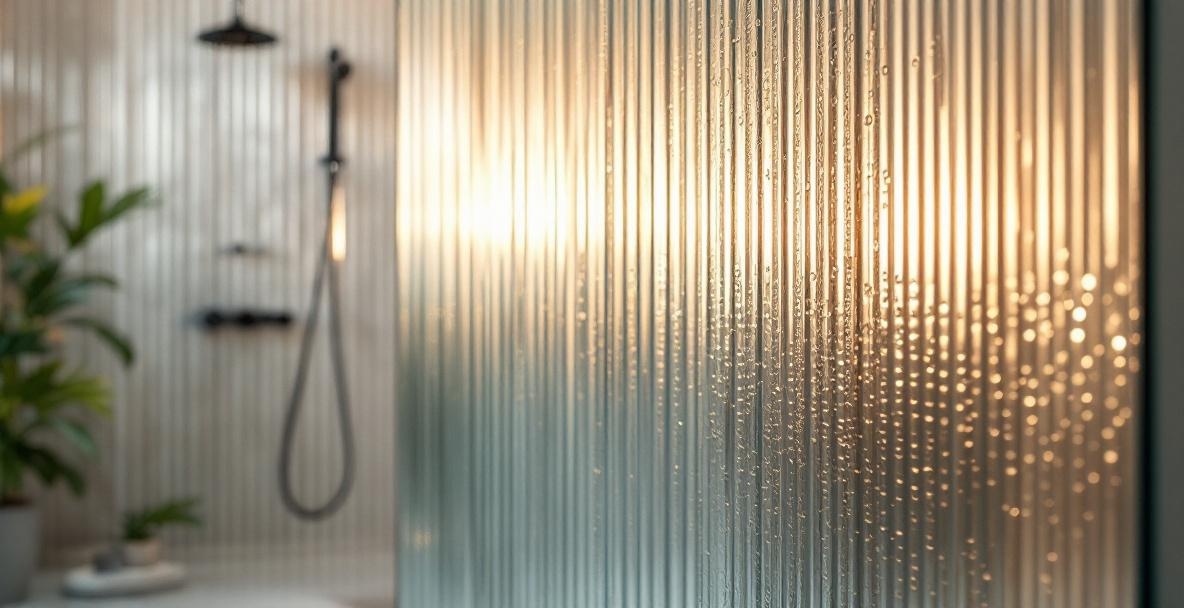
Reeded glass shower panels feature parallel vertical channels pressed or cast into the glass surface, creating a distinctive ribbed texture that diffuses light, provides moderate privacy, and adds architectural detail to any shower enclosure. Originally used in cabinet doors and room dividers, reeded glass is now one of the fastest-growing design choices in DFW bathroom remodels.
If you have been browsing bathroom inspiration on Pinterest or Houzz lately, you have almost certainly encountered reeded glass — the ribbed, channel-textured glass that gives shower enclosures a distinctly architectural quality. Unlike smooth clear glass or flat frosted glass, reeded glass has physical dimension: the channels are pressed into the glass surface during manufacturing, creating a pattern of parallel ridges and grooves that you can feel as well as see. The result is a panel that plays with light in a way no other glass type does.
One distinction worth drawing early: reeded texture is cast into the glass across the whole sheet, so the pattern is uniform and not something you specify by area. If you want the privacy treatment confined to part of the panel — a band at seated height, a border, a motif — that is custom etched glass rather than reeded, and it is applied after the panel is made rather than during manufacture.
What Is Reeded Glass and Why Is It Trending in Bathrooms?
Reeded glass — also called fluted glass — is a type of patterned architectural glass with a series of parallel rounded channels running vertically (or occasionally horizontally) across the surface. The channels are formed by pressing molten glass through a patterned roller during the float glass manufacturing process, creating a consistent, repeating texture that is part of the glass itself rather than applied to the surface.
Fluted and reeded glass searches on Pinterest increased 340% between 2023 and 2025 (Pinterest Trends 2025), reflecting a broader design movement toward textured, tactile materials in interior spaces. This trend is driven partly by a reaction against the all-smooth, all-clear aesthetic that dominated bathroom design for the previous decade, and partly by a renewed interest in materials that have visual depth and craft quality.
In bathrooms specifically, reeded glass gained traction through its use in other furniture and architectural applications — cabinet fronts, closet doors, room dividers — and then migrated into shower enclosures as designers and homeowners began looking for ways to bring that same tactile quality into the wet zone.
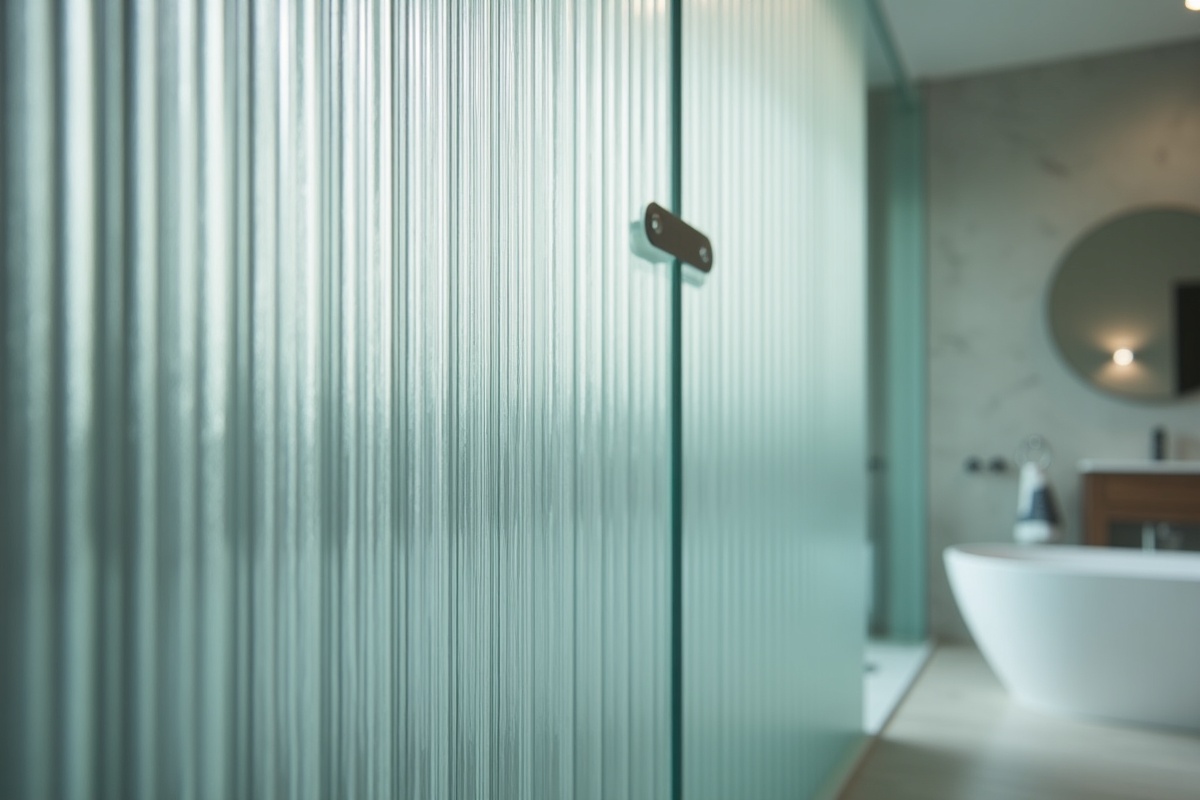
Reeded glass is one option within a broader privacy glass range that also covers acid-etched and sandblasted panels.
How Do Reeded Glass Shower Panels Differ from Frosted or Clear Glass?
The key distinction between reeded glass and other privacy glass types is that the privacy and texture effects in reeded glass come from physical surface geometry rather than surface treatment.
Clear glass: smooth, transparent, transmits light and image with no distortion. Frosted glass: chemically or mechanically roughened surface that scatters light diffusely, creating soft, even privacy with no pattern. Reeded glass: physically formed channels that refract and redirect light in a structured, repeating pattern, creating privacy with visible geometric rhythm.
The visual effect of reeded glass from outside the shower is distinct from frosted glass. Rather than the uniform, soft blur of frosted glass, reeded glass creates a shifting, prismatic quality — details are obscured by the channel pattern rather than by diffusion. Depending on the reed size and spacing, you may see color and movement through the glass, but specific shapes and details are not identifiable.
Reeded glass is also tactile in a way frosted glass is not. The channels are physically raised and recessed, giving the panel a three-dimensional quality that reads differently in different lighting conditions and from different angles.
What Privacy Level Does Reeded Glass Provide?
Reeded glass provides moderate privacy — typically categorized as 40 to 70% obscurity depending on the reed size and spacing. Wider, deeper channels with more spacing provide less privacy because there is more glass area between the channels that transmits light directly. Finer, more tightly spaced reeds provide more obscurity.
For comparison:
- Clear glass: 0% obscurity
- Light frosted glass: 25-40% obscurity
- Reeded glass (standard): 40-70% obscurity
- Heavy frosted glass: 80-90% obscurity
This means reeded glass is not a substitute for frosted glass in applications where maximum privacy is the primary goal. It is a design-forward choice that provides sufficient privacy for most shower applications — you can tell someone is in the shower, but clothing, features, and details are not visible — while adding significantly more visual interest than frosted glass.
If privacy is your top priority and you like the idea of reeded glass, look for a finer reed pattern with tighter channel spacing. Ask your glass supplier for a sample held against a light source so you can assess the actual privacy level before ordering.
How Much Do Reeded Glass Shower Panels Cost?
Textured glass adds a 15 to 30% premium over standard clear tempered glass in material cost (HomeGuide 2025). For a full shower enclosure, the total project cost increase is typically $300 to $800 above a comparable clear glass installation.
340%
increase in Pinterest searches for fluted and reeded glass from 2023-2025 (Pinterest Trends 2025)
Reeded glass pricing in the DFW market:
- Single frameless shower door with reeded glass: $900 to $1,800 installed
- Full frameless enclosure (door + fixed panels) with reeded glass: $2,200 to $4,500 installed
- Custom frameless enclosure with mixed reeded and clear panels: $2,500 to $5,500 installed
The architectural glass segment is growing at 9.1% annually driven by design trends like this one (Grand View Research 2025), which is beginning to make specialty textures like reeded glass more widely available and modestly less expensive as supply scales up. However, reeded glass remains a specialty product that not all glass suppliers stock, which can affect lead times in some markets.
Reeded Glass Design Ideas for DFW Master Bathrooms
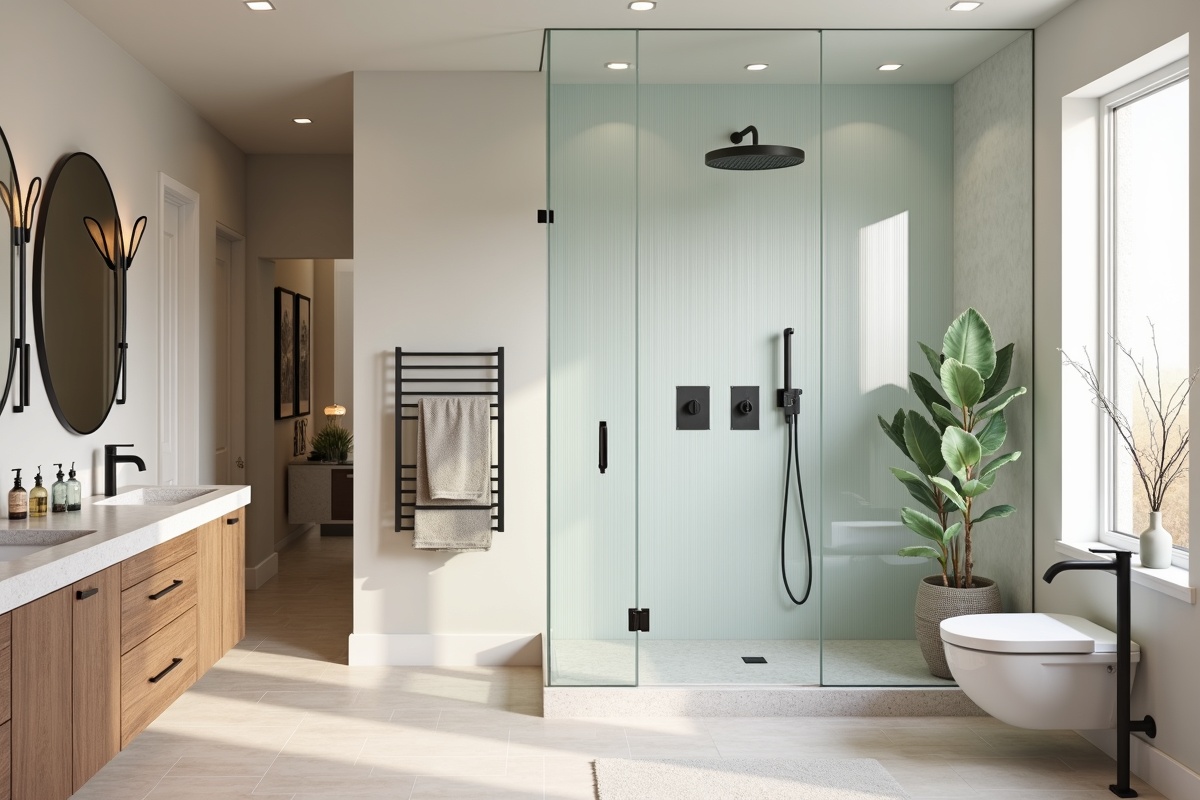
Reeded glass works best when treated as a deliberate design element rather than just a privacy solution. The most successful applications in DFW master baths include:
Full-panel reeded fixed walls with clear door: Using reeded glass on the stationary side panels while keeping the door in clear glass gives the enclosure visual texture while maintaining easy entry and a practical cleaning surface on the door.
Floor-to-ceiling single reeded panel: In walk-in shower designs without a door, a single floor-to-ceiling reeded panel provides privacy and functions as a dramatic architectural element. Paired with a linear drain and minimal hardware, this is one of the cleanest expressions of the trend.
Mixed-panel design: Alternating reeded and clear glass panels in a multi-panel enclosure creates rhythm and pattern. This works best in larger showers where the alternation has room to breathe.
Complementary design pairings: Reeded glass pairs naturally with warm-toned materials — white oak or walnut vanities, unlacquered brass or brushed gold hardware, warm-white or greige tile. The channel texture echoes the grain lines in wood and the texture of honed stone, creating a cohesive material story throughout the space.
What Are the Maintenance Requirements for Textured Glass?
Reeded glass presents the most significant cleaning consideration of any textured glass type because the channels create narrow valleys where water can collect, dry, and leave mineral deposits. In DFW's hard water environment, this matters.
The cleaning approach for reeded glass shower panels:
- Squeegee after every shower — use a soft silicone squeegee and work with the direction of the channels, not across them
- Apply a daily shower spray to inhibit mineral buildup in the channels
- Deep clean monthly using a soft brush (a soft-bristle toothbrush works well for the channel grooves) with a diluted vinegar solution or calcium lime remover
- Avoid abrasive scrub pads that can scratch the glass surface inside the channels
Standard flat squeegees do not effectively clear water from the channel valleys. A rounded or flexible squeegee blade works better on reeded glass. Some installers recommend a small handheld brush kept in the shower specifically for wiping the channels after each use.
A professionally applied hydrophobic coating at installation — applied by the glass shop before installation — significantly reduces how aggressively mineral deposits adhere to the channel surfaces. This is worth requesting for any reeded glass installation in a hard water area.
Can Reeded Glass Be Combined with Frameless Hardware?
Yes, with an important caveat: reeded glass panels require point-fixed clamp hardware that engages the flat areas of the glass (the ridges between channels), not the channel valleys. Standard U-channel frameless hardware engages the glass edge uniformly and works without modification. Point clamps need to be positioned at the glass flats.
Most experienced frameless shower hardware suppliers and glass installers are familiar with this requirement. When specifying reeded glass for a frameless enclosure, confirm with your installer that the clamp hardware is rated for use with textured glass and will be positioned correctly. The door hinges attach to the smooth glass edge, which is unaffected by the channel texture.
Reeded glass is not suitable for framed shower door systems (where the glass slides in a metal channel), because the channel texture prevents the glass from sliding smoothly within a track. Frameless or semi-frameless installations are the correct application.
If you have decided the look is right and want the panel measured and fitted, that is what our reeded glass shower doors service covers — including which way the ribs run and which face is turned away from the spray, the two decisions that are fixed at order time and cannot be changed afterwards.
Is reeded glass harder to clean than smooth glass?
Yes, somewhat. The physical channels in reeded glass create grooves where water and mineral deposits collect. In DFW hard water conditions, these grooves need regular attention. Daily squeegeeing along the channel direction and monthly cleaning with a soft brush and mild acid cleaner keeps the glass looking good. Applying a hydrophobic protective coating at installation reduces how aggressively deposits adhere to the surface.
Can you get custom reeded patterns for shower panels?
Standard reeded glass comes in a limited range of channel widths and spacings determined by the manufacturer. Fully custom channel patterns require specialty fabrication and are significantly more expensive. Most DFW homeowners choose from available stock patterns — typically a fine reed (narrow channels, close spacing) or a standard reed (wider channels, more spacing). Your glass installer can show samples of available patterns.
Does reeded glass work in small bathrooms?
Yes, though the visual effect works differently in tight spaces. In a small bathroom, a full reeded panel can feel heavy if it dominates the sightline. A better approach in a compact space is to use reeded glass on one fixed panel while keeping the door clear, or to use a fine-reed pattern that reads as texture rather than structure from a short viewing distance.
Is reeded glass as strong as standard tempered glass?
Yes. Reeded glass is tempered using the same heat-treating process as standard smooth tempered glass. The channel texture is formed before tempering and does not affect the structural integrity of the panel. Properly tempered reeded glass meets the same ANSI safety standards as standard shower glass and breaks into small, blunt pieces rather than large shards if broken.
How does reeded glass affect bathroom lighting?
Reeded glass diffuses light rather than transmitting it directly, which softens and scatters natural and artificial light passing through the panel. In a bathroom with a window adjacent to the shower, reeded glass creates a soft, dappled light quality inside the shower. In bathrooms where the shower light is enclosed within the enclosure, reeded glass softens the light cast into the main bathroom space. The overall effect is typically warmer and softer than clear glass — a quality that suits spa-inspired bathroom designs particularly well.
Also see our bathroom inspiration guide bathroom remodel shower ideas for 2026 and our overview of 2026 bathroom glass trends.
Infinity Glass & Glazing supplies and installs reeded glass shower panels throughout DFW, including Corinth, Lewisville, Flower Mound, and surrounding communities. We can source reeded glass in multiple channel widths and pair it with any frameless hardware finish. Contact us for a free estimate.
Related reading: