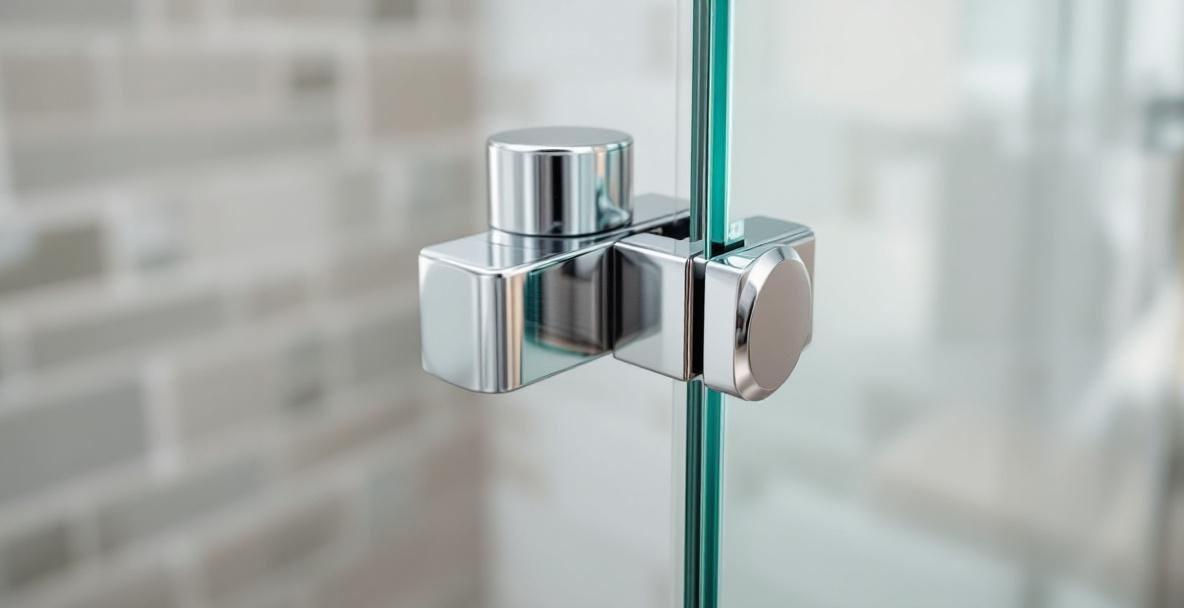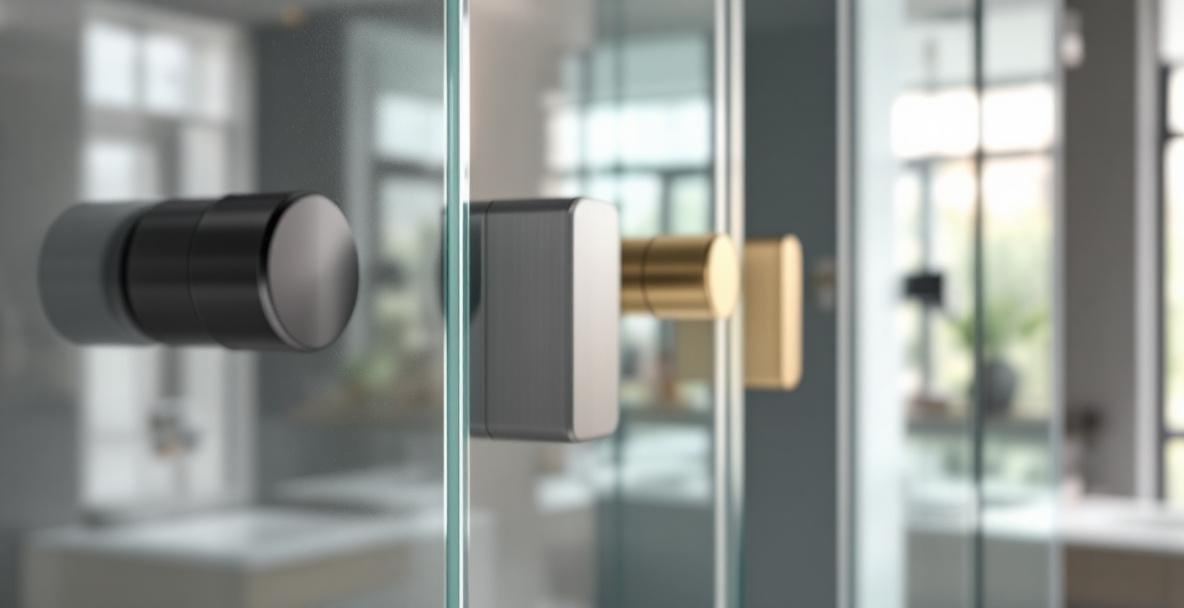
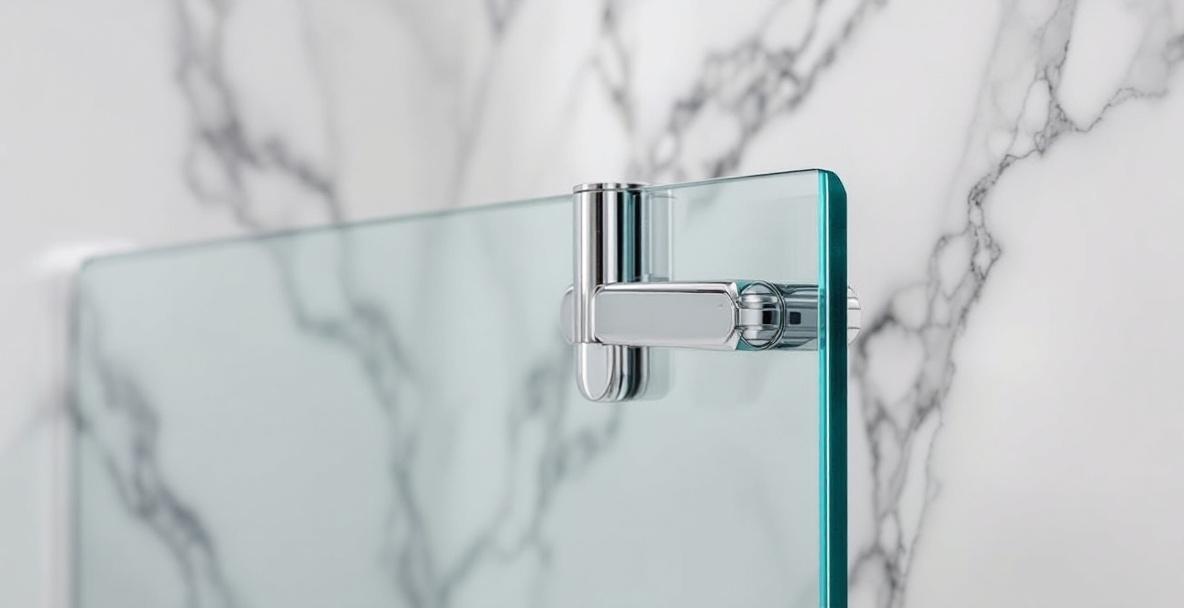
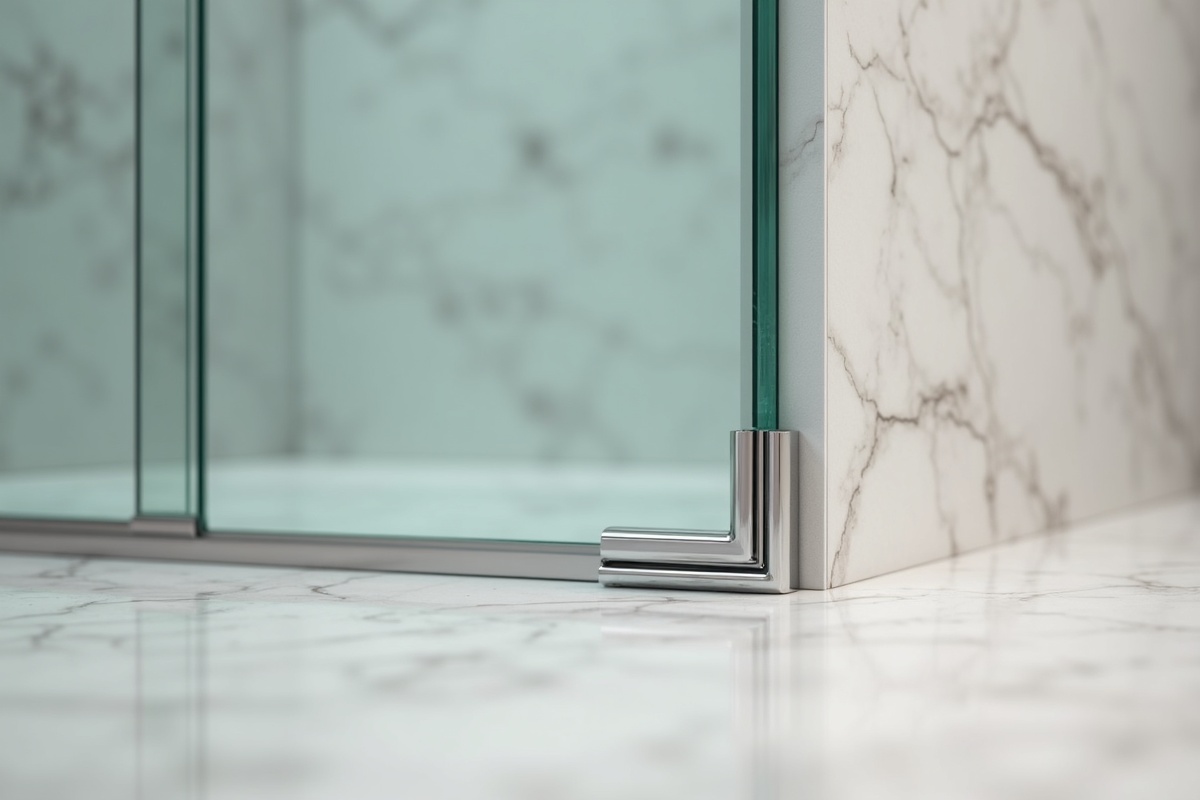
Clamp-mount systems use individual point hardware (clips or clamps) drilled through the glass or clamping its edges — creating a minimal, floating glass appearance. Channel-mount (U-channel) systems use a continuous metal track bonded or fastened to the wall that captures the glass edge along its full length. Clamp-mount adds $50–$150 per panel for precision drilling (Hillcrest Glass) but delivers the cleaner aesthetic. U-channels provide superior continuous edge support but introduce a visible metal element.
For homeowners deep enough into a frameless shower project to be comparing hardware systems, this question matters more than it might seem. The mounting system you choose determines what the finished shower looks like, how easy it is to clean, how well it seals, how much it costs, and how long it lasts. Hardware is one spec inside the larger enclosure decision — configuration, glass thickness, and corner treatment are covered on our frameless shower door installation page. Here's the complete comparison.
What Is the Difference Between Clamp and Channel Mount?
Clamp-mount hardware grips the glass at 2–3 discrete points per panel — using either through-hole clips (which require precision-drilled holes in the glass) or surface clamps (which grip the glass edge without drilling). U-channel or channel-mount systems use a continuous metal extrusion bonded to the wall that captures the full bottom or side edge of the glass panel. The fundamental difference is continuous vs. point support — and everything that follows from that distinction.
Clamp-mount in detail: Glass clamps come in two primary forms:
- Through-hole clips: Require precision holes drilled through the tempered glass at the factory. A bolt or pin passes through the hole and clamps a decorative cover plate on each side. This is the cleanest-looking option — hardware is visible only at the discrete bolt location.
- Surface clamps (edge clamps): Grip the glass edge without drilling. The clamp is a U-shaped fitting that compresses against both faces of the glass at the edge. Visible from the side but not through the glass face.
Both types mount to the wall or floor via a base plate that's fastened to the tile or substrate behind it.
Channel mount (U-channel) in detail: A U-channel is an extruded metal profile — typically aluminum in a finished metal coating or stainless steel — shaped like a U. It's fastened to the wall or floor, the glass panel is inserted into the channel opening, and the gap between the glass and channel walls is filled with clear silicone. The glass is captured along its entire edge. No holes in the glass are required.
| Factor | Clamp Mount | U-Channel Mount | |
| Glass drilling required | Through-hole type: yes | No | |
| Hardware visibility | Point hardware only — minimal | Continuous metal rail — more visible | |
| Glass edge support | 2–3 points per panel | Continuous along full edge | |
| Added cost per panel | $50–$150 for precision drilling | Channel material cost: $30–$80/ft | |
| Water seal quality | Point seals at hardware; edges open | Silicone fill along full edge — better seal | |
| Cleaning difficulty | Simple — discrete hardware only | Channel interior accumulates debris | |
| Best glass thickness | 3/8 in. and 1/2 in. (structural at point) | 3/8 in. minimum; works with thinner glass too | |
| Frameless market growth | 7.4% CAGR (Verified Market Reports) | 7.4% CAGR (same market) |
7.4% CAGR
annual growth rate of the frameless shower door market — driven by demand for minimal hardware like clamp-mount systems (Verified Market Reports)
How Each Affects the Frameless Look
The defining visual of a frameless shower is uninterrupted glass — as little visible hardware as possible. Clamp-mount hardware achieves this more completely than U-channels because a U-channel is, by definition, a continuous visible metal element running along the glass edge. In a truly frameless aesthetic, every piece of metal you can see is a compromise of the pure glass look.
Clamp mount for the purist frameless look: Through-hole clamps are the most architecturally minimal option available. The hardware appears as small decorative discs on the glass surface — visible, but discrete. From a distance or in photography, the glass reads as floating. This is the hardware preferred for high-end DFW master bathrooms where the frameless aesthetic is the design goal (Houzz 2025).
The surface-clamp variant is slightly more visible (the clamp protrudes from the glass edge) but still minimal compared to a U-channel. Surface clamps are often used on glass panels where drilling would be impractical — very small panels, panels adjacent to steam controls, or panels where the drilling position would be awkward.
There is one place where the hardware question disappears entirely. Where two panels meet at a corner, both clamp and channel systems need something in the joint — a post, a clip, or a channel. Grinding both edges to 45 degrees removes that need, and the panels carry the corner themselves. That is the approach behind a mitered corner shower enclosure, and it is worth deciding on before you specify corner hardware at all.
U-channel for structural support: A U-channel along the bottom of a fixed glass panel is visible as a metal rail at floor level. On the wall side, it's a metal strip between the tile and glass edge. Neither is invisible — but both are industry-standard practice and look clean and intentional when properly specified and installed.
Many premium frameless installations combine systems: U-channels at the floor (where they're less visible and provide important structural base support) with clamp hardware at the wall and top (where the visual impact is greater). This hybrid approach uses each system where it performs best.
Water Sealing: Which Performs Better?
U-channel systems provide superior water sealing along the glass edge because the silicone fill is continuous — no gaps between support points. Clamp-mount systems seal at the hardware points, but the glass edges between clamps are typically sealed with a bead of silicone applied during installation. Both can be waterproof when properly installed, but continuous sealing is inherently more reliable than point sealing.
Sealing with clamp mount: After the clamps are installed, a professional runs a silicone bead along the glass edges that contact the wall and floor — filling the gap between the glass and tile surface. This silicone must be continuous (no gaps, no holidays) and properly tooled to create a reliable seal. Done correctly, clamp-mount installations are waterproof. Done incorrectly or with lapses in the silicone bead, water can work through at any gap point.
Sealing with U-channel: The U-channel itself is fastened to the wall or floor, then the glass is inserted and the interior gaps are filled with silicone from both exposed sides of the channel opening. Because the silicone is protected inside the channel and applied along the full glass edge, it's more consistently sealed than field-applied silicone beads — and more protected from the repeated thermal cycling that can cause surface-applied silicone to pull away from the tile or glass.
The maintenance factor: When seals eventually need replacement (every 3–5 years in a well-maintained shower), U-channel seals are more difficult to access and replace than field-applied clamp-mount silicone. With clamp-mount systems, the silicone bead is on the surface and straightforward to remove and reapply. U-channel silicone requires partial disassembly of the channel or careful removal of the old silicone from inside the channel — more labor but the same end result.
Cleaning and Maintenance Differences
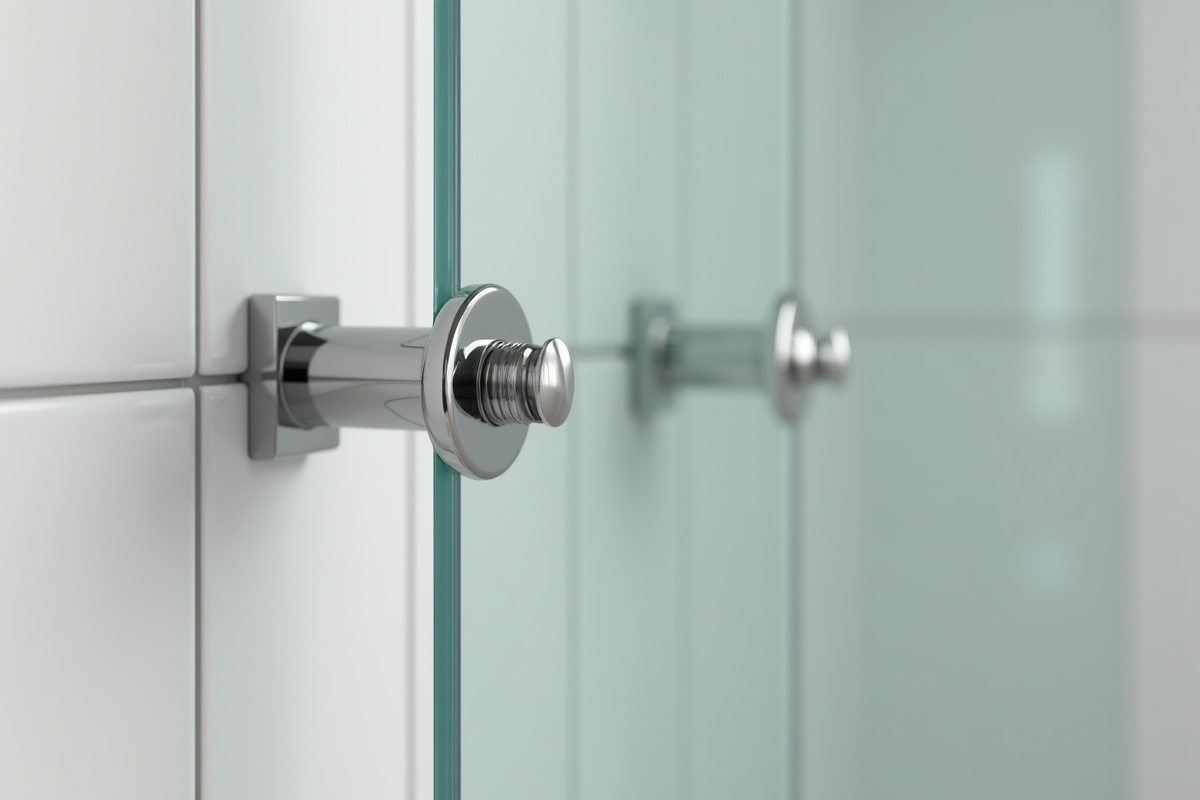
Clamp-mount cleaning: The hardware itself (clamp discs, cover plates, or edge clamps) wipes clean with a damp cloth. There are no internal channels, no crevices that accumulate soap scum or mineral deposits beyond what the glass surfaces themselves accumulate. In DFW's hard water environment, mineral deposits on the hardware can be addressed with diluted white vinegar — the same treatment used on the glass.
U-channel cleaning: The inside of a U-channel accumulates whatever the shower produces: soap residue, mineral deposits, hair, skin cells, and anything else that flows along the glass surface and collects where the glass meets the channel. The narrow interior of the channel is difficult to clean with standard tools — a small brush (a toothbrush works) is needed to get into the channel opening. In DFW's hard water environment, mineral deposits inside a U-channel can be particularly stubborn.
This maintenance difference is real and underappreciated when homeowners are selecting hardware. If low-maintenance cleaning is a priority, clamp-mount hardware is meaningfully easier to keep clean over years of use.
When U-channels are specified at the floor (their most structurally appropriate location), cleaning access matters most there — floor-level channels collect the most debris. Ask your installer about channel designs with removable sections or open-bottom configurations that allow more complete cleaning access.
Cost Comparison
Clamp-mount cost factors:
- Through-hole drilling: $50–$150 per panel added to glass fabrication cost (Hillcrest Glass). This precision drilling must be done at the factory before tempering — a mistake means the panel is scrapped.
- Clamp hardware sets: $40–$200 per clamp depending on style and finish. A standard fixed panel might use 2–4 clamps; a door uses hinges (not clamps) plus a handle.
- Installation labor: Similar to channel mount — the precision work happens in fabrication, not on-site
U-channel cost factors:
- Channel material: $30–$80 per linear foot depending on style and finish
- A standard shower panel might use 2–6 feet of channel; a full enclosure might use 12–20 feet total
- Installation: Channel must be fastened level and plumb before glass is set — no more complex than clamp installation, but the silicone fill requires careful application and cure time
Who costs more overall: For standard applications, the costs are comparable — through-hole drilling for clamp mount vs. channel material costs roughly balance out. Where clamp mount becomes more expensive is on large fixed panels with many drilling points, or specialty hardware in premium finishes (matte black, brushed gold). U-channels in a basic aluminum finish are very cost-effective but may not match premium hardware finishes without anodizing or powder coating.
When to Use a Hybrid Approach
Most professional frameless installations don't use only one system — they combine both where each performs best:
Bottom of fixed panels: U-channel. The floor-level channel provides the widest base support, keeps the glass aligned, and is less visually impactful because it reads as part of the threshold rather than "hardware." The channel interior is at floor level, where mineral deposits are less prominent than at eye level.
Wall sides of fixed panels: Either clamp or channel, depending on aesthetic preference. Clamps at wall junctions look cleaner but require the drilling. Channels at wall junctions are standard practice and look intentional when specified in a matching finish.
Overhead (if a header bar is used): Clamp-style clips are standard — the header bar spans the opening and is attached to both walls, with the door glass or panel supported from the bar via clips.
Door itself: Always hinge-mount — not clamps or channel. The door panel pivots on hinges; the handle and any latch are the only other hardware. This is consistent across both mounting system approaches.
Hardware preference also varies by market. In our install schedule, frameless shower doors in Southlake and McKinney lean heavily toward through-hole clamps for the minimal look, while Lewisville remodels split more evenly between clamp and channel — usually a budget call rather than an aesthetic one.
Which Is More Durable Long-Term?
Both systems are durable when properly installed. The failure modes differ:
Clamp-mount failure modes:
- Through-hole stress: If the glass moves more than the clamp allows (from thermal expansion or physical force), stress can concentrate at the drilled holes. Quality through-hole hardware includes rubber or nylon bushings that cushion the glass and distribute stress — without these, hole-edge cracking is a risk.
- Hardware loosening: The clamp base plates are fastened into tile and substrate. If the anchor points aren't into solid material (stud, concrete, or solid substrate behind the tile), the hardware can work loose over time.
- Surface clamp slippage: Edge clamps that grip only by compression can migrate if the set screws aren't properly tightened and periodically checked.
U-channel failure modes:
- Channel delamination: If the channel isn't properly adhered or fastened to the substrate, it can pull away from the wall or floor — particularly in floor channels where movement is most common.
- Silicone degradation: The silicone inside the channel eventually hardens and cracks (typically 7–10+ years). Replacement requires the glass to be removed, old silicone cleaned out, and new silicone applied before reinstallation.
- Finish corrosion: Aluminum channels in wet environments can show finish degradation if the anodizing or coating wears through. Stainless steel channels are more durable but cost more.
The durability verdict: Both systems last 15–25+ years when professionally installed with quality materials (NAHB 2026). The primary determinant of longevity is installation quality — specifically, whether the hardware is anchored into solid substrate and whether the silicone work is complete and continuous.
Does clamp-mounted glass wobble more than channel?
Clamp-mounted fixed panels can have slightly more micro-movement than channel-mounted panels because they're supported at discrete points rather than continuously. This isn't structural wobble — properly installed clamp-mount hardware is rigid — but the contact feel when you touch the glass may be slightly different from a continuously supported panel. For hinged doors (which use hinges, not clamps), door movement is determined entirely by hinge quality and installation, not by the fixed panel mounting system.
Can you switch from channel to clamp mount?
Yes, with the caveat that through-hole clamp systems require holes drilled in the glass — which means existing glass panels cannot be converted to through-hole clamp mount without replacing the glass. Surface clamps (edge clamps that grip without drilling) can be installed on existing panels if the current hardware is removed and the glass edge is accessible. Converting from clamp to channel mount is more straightforward — channels can be added without modifying the glass itself.
Which works better with 1/2-inch glass?
Both systems work with 1/2-inch glass, but clamp-mount hardware is often preferred for 1/2-inch panels because the additional glass weight (1/2-inch glass is approximately 33% heavier than 3/8-inch) benefits from the positive grip of through-hole hardware. U-channels also work with 1/2-inch glass, but the channel dimensions must accommodate the thicker glass — confirm compatibility with your fabricator before specifying. If you have not settled the thickness yet, decide that first: 3/8 vs 1/2-inch frameless shower glass is driven by panel dimensions, and it determines which mounting hardware is even on the table.
Do clips require drilling through the glass?
Only through-hole clips require drilling. Surface clamps and edge clamps grip the glass edge or face without any holes in the glass. Through-hole drilling must be done before tempering — the drill location is specified during fabrication and cannot be added after the glass is tempered. Surface and edge clamps can be applied to already-tempered glass, which makes them useful for adding hardware to existing panels or for situations where the drilling position can't be determined until installation.
What finishes are available for each system?
Both clamp and U-channel hardware are available in the standard finish range: chrome, brushed nickel, matte black, brushed gold, oil-rubbed bronze, and satin brass. Specialty finishes (custom powder coating, PVD coatings) are available from some manufacturers for both systems. The key is matching the hardware finish across all elements — clamps, hinges, handles, and towel bars should all be the same finish. If you're deciding between the two most common options, our chrome vs. brushed nickel comparison covers how each wears and which bathroom fixtures they pair with. Infinity Glass & Glazing works with hardware suppliers across the full finish range and can confirm specific finish availability before fabrication.
Also see our frameless shower door hardware options guide and our shower door hardware finishes guide.
Infinity Glass & Glazing specs frameless shower glass from our Corinth office and can detail either clamp-mount or channel-mount hardware — or a hybrid approach — based on your shower design, aesthetic goals, and budget. Serving DFW including Lewisville, Flower Mound, Denton, Frisco, Southlake, McKinney, and Keller. Contact us for a free estimate.
Related reading: