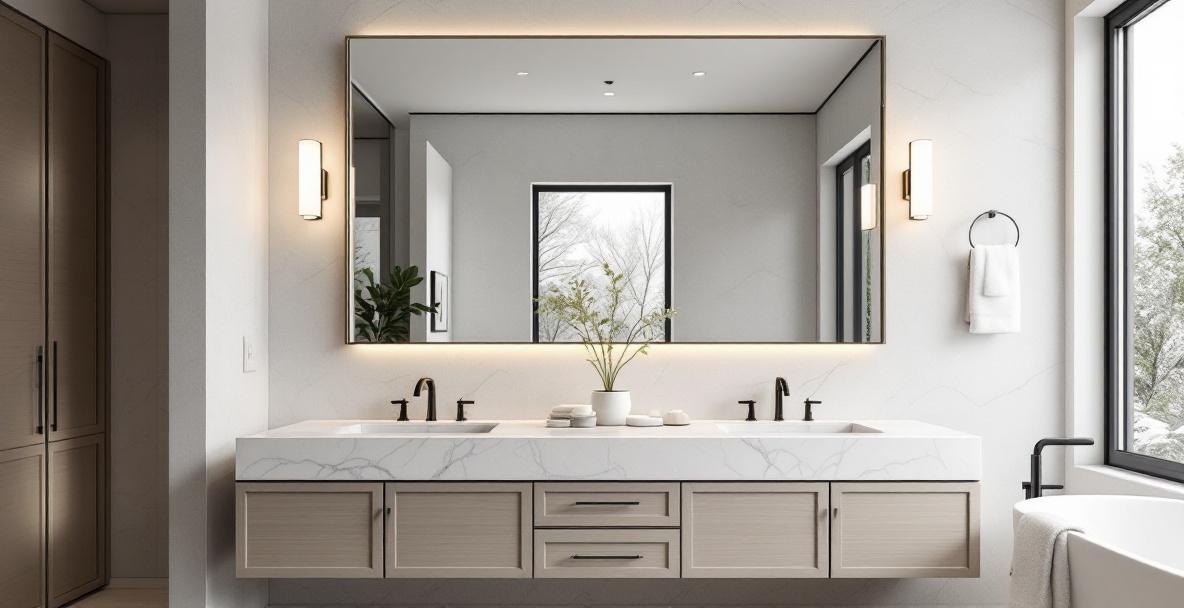
Custom mirror shapes are mirrors cut to non-rectangular forms — circles, arches, hexagons, ovals, irregular geometric shapes, and specialty cutouts — fabricated using CNC water-jet and diamond-wheel cutting equipment with precision to within 1/16 inch. In Texas, Infinity Glass & Glazing fabricates and installs specialty-shaped mirrors in any size from 12 x 12 inches up to 84 x 130 inches, with polished, beveled, or custom edge treatments and optional antique, tinted, or clear glass backings.
Rectangular mirrors are still the default — but the fastest-growing category in Texas bathroom and interior design is custom-shaped. Arch-top mirrors, circles, hexagons, and irregular geometric forms turn a standard vanity wall or entry wall into a design feature. Houzz data shows arch mirror popularity jumped 180% from 2022-2025 (Houzz 2025) — a trend that's driven a wave of custom-shape orders in Dallas, Austin, Houston, and Fort Worth homes.
This guide covers which shapes are commonly fabricated, how the cutting process works, the most popular shapes in Texas bathrooms, sizing and mounting for circles and arches, pricing by complexity, and which edge finishes work best for specialty cuts.
What Custom Mirror Shapes Can Be Cut for Texas Homeowners?
Essentially any shape can be cut into mirror glass as long as the cut lines don't create sharp internal angles tighter than roughly 15 degrees (which stress the glass during cutting) and the overall size stays within fabrication maximums of about 84 x 130 inches for a single piece (GlassBuild 2025). The most common custom shape categories:
Round and oval — full circles, half-circles (D-shaped), ovals, and ellipses. Popular over vanities, entry consoles, and as accent wall mirrors.
Arched — rectangular bodies with an arched or cathedral top. The trending shape in Texas master bathrooms. Variations include half-arch, full-arch, and cathedral peaks.
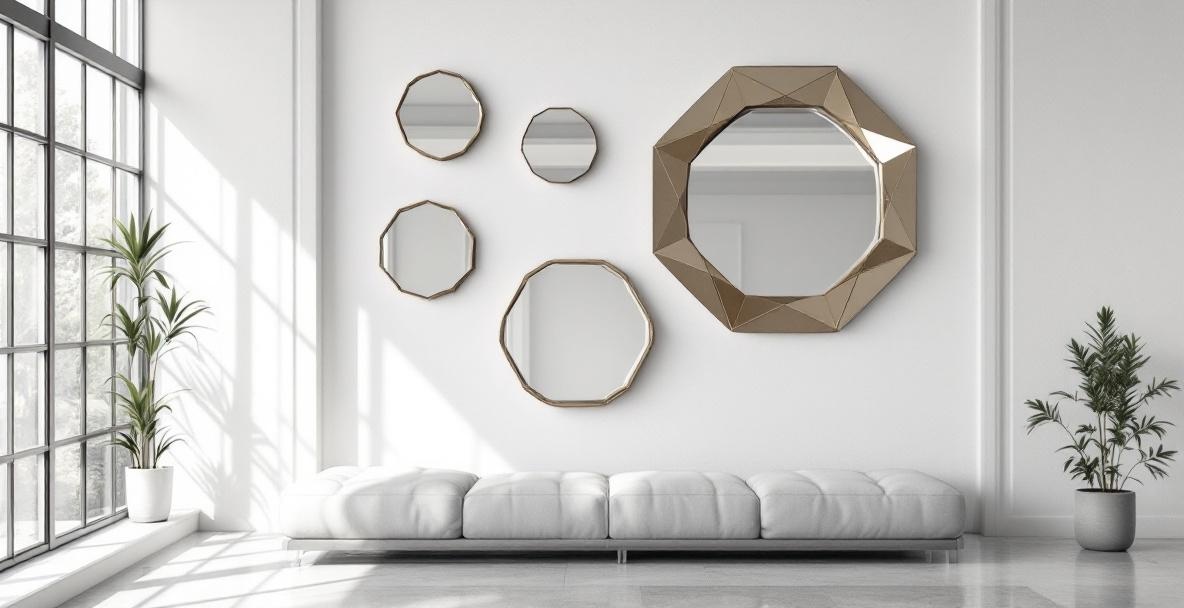
Geometric — hexagons, octagons, diamonds, pentagons, and other straight-edge polygons. Work well for modern and transitional interiors.
Irregular and freeform — curved, wave-edged, organic shapes cut from a custom CAD pattern. Used for statement pieces in modern homes.
Cutouts and notches — rectangular mirrors with corner clips, plug cutouts, pipe notches, or medicine cabinet access cutouts.
180%
increase in arch mirror popularity on Houzz from 2022-2025
How Are Custom Mirror Shapes Fabricated?
Custom mirror shapes are cut from standard mirror stock using one of three main methods: CNC water-jet cutting, diamond-wheel scoring and breaking, and router-bit edging. The chosen method depends on the shape's complexity, the mirror thickness, and the edge finish required.
CNC water-jet cutting uses a high-pressure water stream mixed with abrasive to cut precise shapes from any thickness of mirror glass. This is the preferred method for intricate shapes, curves, and internal cutouts. Typical precision is +/- 1/16 inch — tight enough to fit into custom frames or specific architectural openings.
Diamond-wheel scoring and breaking is used for straight-line and large-radius curves. A diamond blade scores the mirror's surface, and the piece is then broken cleanly along the score line. This is fast and economical for simple shapes like circles, ovals, and basic polygons.
Router-bit edging follows the cut stage and is how the final edge treatment is applied — polished, beveled, seamed, or custom ogee. Specialty shapes always require edge work because cut edges are raw and sharp.
- 1
Design and CAD Template
The shape is drawn in CAD or provided by the client as a template. Dimensions, edge treatment, and any cutouts are confirmed before cutting starts. - 2
Cut Raw Mirror Blank
The mirror is cut to rough shape using CNC water-jet for complex shapes or diamond-wheel for simpler curves and straight edges. - 3
Edge Finishing
Cut edges are ground, polished, beveled, or shaped per the spec. This is what separates custom work from a DIY cut — the edge finish is where the price goes. - 4
Quality Inspection
Every custom piece is inspected for edge chips, visible surface defects, and dimensional accuracy against the original template. - 5
Protective Packaging and Delivery
Custom mirrors ship with corner protectors and edge guards for the trip to the install site. Oversized pieces are crated.
Fabrication lead time is typically 2-4 weeks in the Texas market for standard custom shapes, up to 6 weeks for highly complex freeform patterns or specialty glass (antique, tinted, laminated).
Arch Mirrors: The Most Popular Custom Shape in Texas Bathrooms
Arch mirrors — rectangular with a rounded or peaked top — are the runaway top custom shape in Texas luxury bathrooms. They work with modern, transitional, Mediterranean, and Tuscan-style homes equally well, and pair especially nicely with the curved doorways common in San Antonio and Austin home designs.
Three main arch variations:
Full arch (Roman) — a symmetrical half-circle top forming a true semicircle. Most formal and traditional.
Soft arch (segmental) — a shallow curve at the top, gentler than a full arch. Most versatile across styles and most popular in Texas new-builds.
Cathedral (pointed arch) — peaked top like a Gothic window. Statement piece; works in large master bathrooms and entries.
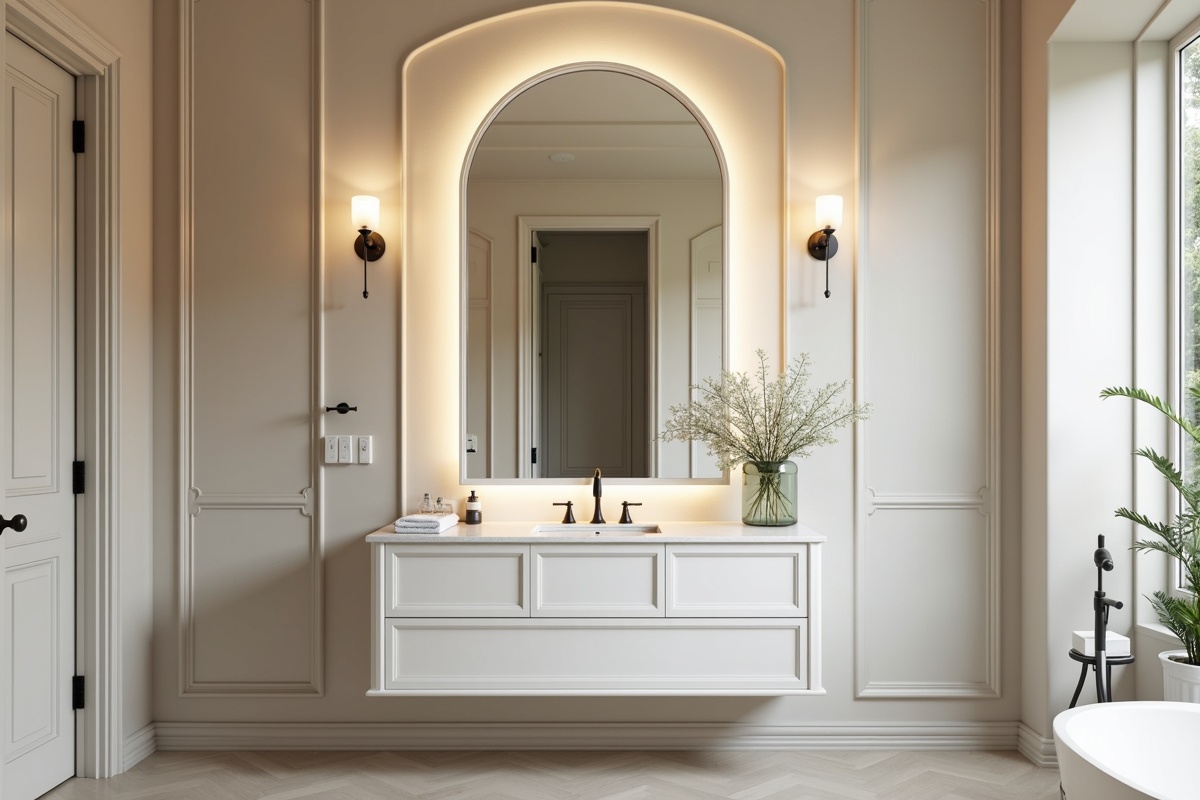
Sizing for arched mirrors in Texas bathrooms:
- Single 30-36 in. vanity: arch mirror 22-28 in. wide, 32-40 in. tall
- Single 48 in. vanity: arch mirror 28-34 in. wide, 36-44 in. tall
- Double 60-72 in. vanity: two arch mirrors 22-26 in. wide each, or one wide arch 48-56 in. tall
- Entry foyer statement mirror: arched 32-40 in. wide, 60-84 in. tall
Circle and Round Mirrors: Sizing and Installation Tips
Round mirrors have been a design staple since mid-century — they're still one of the most requested custom shapes in Texas. A round mirror softens the hard rectangular lines of a vanity, countertop, or entry console, and reflects light more evenly than a rectangular mirror.
Sizing guidelines:
- Single vanity round mirror: 24-30 inch diameter works for most Texas single vanities 30-48 inches wide
- Double vanity, two round mirrors: 22-26 inch diameter each, centered over each sink
- Oversized statement round: 36-48 inches in large bathrooms and entry halls
- Accent or secondary round: 18-24 inches as a pair or group
Mounting round mirrors needs attention. Without a frame, round mirrors use French cleats or dedicated round-mirror hanging clips (not standard D-rings which create uneven pressure). For heavier rounds above 24 inches, stud anchoring is essential — 1/4-inch thick, 30-inch round mirror weighs about 10 lbs, but larger rounds escalate quickly.
Hexagonal and Geometric Mirror Shapes for Modern Interiors
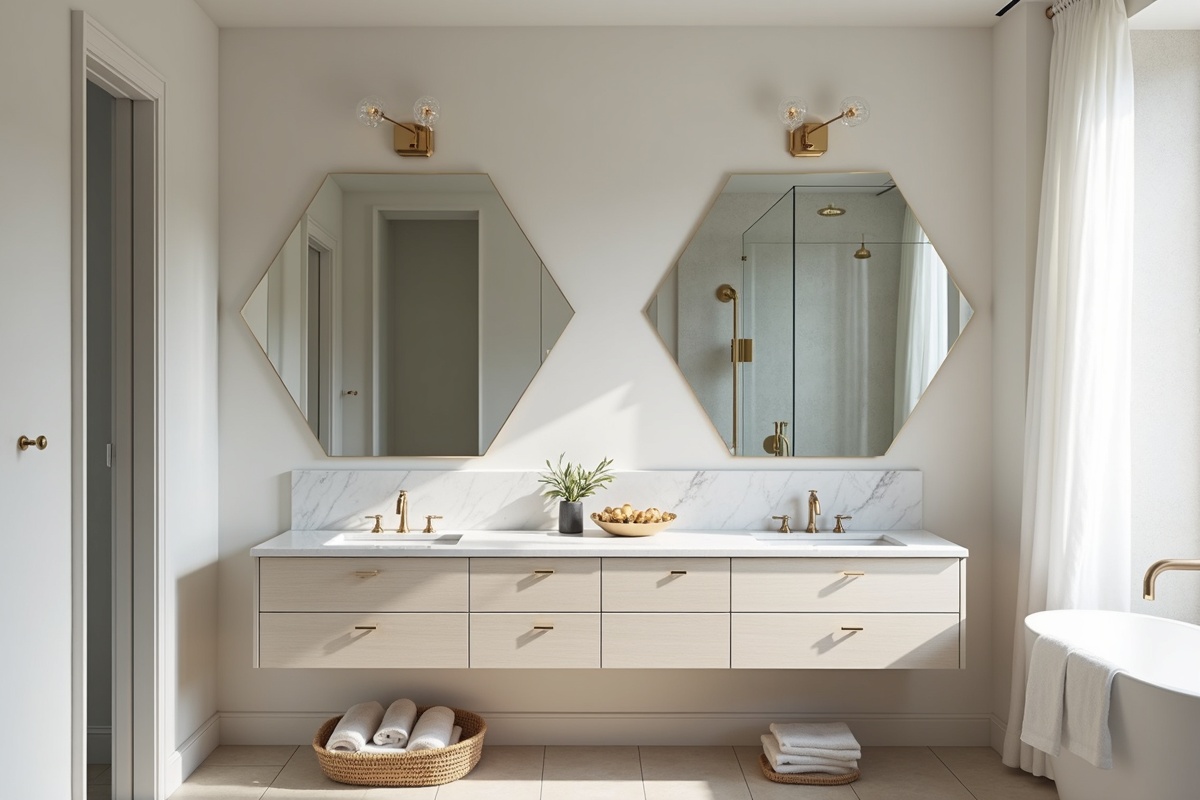
Geometric shapes — hexagons, octagons, diamonds, and other polygons — have become the signature custom shape for modern and minimalist Texas interiors. They work particularly well in powder rooms, as accent pieces, and in clusters of multiple mirrors arranged as a gallery wall.
Common geometric shapes and their typical uses:
- Hexagonal — single statement piece or clustered in honeycomb patterns
- Octagonal — traditional enough to work in transitional interiors, modern enough for contemporary
- Diamond (rotated square) — bold statement piece, often paired with sconces
- Asymmetric pentagons and irregular polygons — signature art-piece mirrors for specific design visions
For clusters, the cleanest installations space mirrors 1-2 inches apart and use identical edge treatments across the group. A mix of three hexagonal mirrors in graduated sizes (18 in., 24 in., 30 in.) is a popular Texas-specific look in powder rooms and small bathrooms.
How Much Does a Custom-Shaped Mirror Cost in Texas?
Custom-shaped mirror cost in Texas generally ranges $150-$800 per piece depending on shape, size, edge treatment, and glass specification (HomeGuide 2025). Complex freeform shapes or specialty glass (antique, tinted, beveled) can push costs higher. Installation is additional and runs $150-$500 depending on size and mounting complexity (Angi 2025).
| 20-30 in. Custom Piece |
| 30-48 in. Custom Piece |
| 48+ in. Oversized |
| Typical Install Labor |
Cost drivers specific to custom shapes:
- Edge finish is usually the biggest single line item — polished edge adds 15-25% over seamed, bevel adds 30-50%, custom ogee adds 50-100%
- Glass thickness — 3/8-inch runs 30-40% more than 1/4-inch
- Specialty glass backing — antique, tinted, or smoked glass adds 40-80% over standard
- Internal cutouts (outlets, plumbing notches) add $40-$100 per cutout
What Edge Finishes Work Best for Specialty-Cut Mirrors?
Edge finish dramatically changes how a custom-shaped mirror looks. For specialty shapes where the edge is a visible design element, the finish is as important as the shape itself.
Polished flat edge — smooth, glossy, minimal visual weight. Works with any custom shape. Most popular for modern interiors.
Beveled edge (1-inch bevel) — adds a chamfered facet around the perimeter that catches light. Best for arch mirrors, ovals, and traditional shapes. Not recommended for complex freeform shapes because the bevel distorts at curves.
Double-beveled edge — beveled both on the front and slightly on the back for extra sparkle. High-end look for formal entries and dining room mirrors.
Ogee (shaped) edge — a decorative S-curve profile. Traditional, ornate look. Best for oval and arch shapes in traditional or Mediterranean Texas homes.
Seamed edge — minimal, slightly rounded edge used when the mirror sits in a frame or J-channel where the edge is hidden. Lowest cost.
Pencil edge — narrow rounded-over edge. Clean, subtle. Works for round and geometric shapes.
Frequently Asked Questions
How precise can custom mirror cuts be for non-standard shapes?
CNC water-jet cutting achieves precision within +/- 1/16 inch on most shapes. Diamond-wheel cuts are typically within +/- 1/8 inch. For most residential installations these tolerances are more than adequate. If the mirror needs to fit into an existing frame or architectural opening within tight specs, we use CNC cutting and verify against the field template before delivery.
What is the minimum and maximum size for a custom-cut mirror?
Minimum practical size is about 6 x 6 inches — below that, glass handling becomes difficult and edge finishing is harder to execute cleanly. Maximum single-piece size is typically 84 x 130 inches using standard mirror stock. Larger installations use multiple seamed pieces, and shape choice at that scale is usually limited to straight-edge geometries (rectangles, trapezoids).
Can any shape be safely wall-mounted?
Most shapes can be safely mounted, but the mounting method changes with geometry. Circles and arches need specific clip or cleat systems that align with the shape. Irregular freeform shapes sometimes need custom mounting brackets fabricated with the mirror. Very narrow shapes (long thin strips) can be prone to flexing and may need thicker glass or laminated backing for safety.
How do you hang a round or arch mirror without damaging it?
Round mirrors use a French cleat (horizontal bar along the center-line), round-mirror clips, or a flush-mount adhesive bracket. Arch mirrors typically use two D-rings spaced equally on the back at the top, or a French cleat along the flat bottom. Heavier pieces above 20 lbs always need stud anchoring — never drywall anchors alone for shaped mirrors.
Are custom-shaped mirrors available in antique or tinted glass?
Yes. Custom shapes can be cut from standard clear mirror, bronze-tinted, gray-tinted, antique mirror (distressed/aged finish), or smoked glass. Specialty glass adds 40-80% to the base mirror cost and sometimes extends lead time by 1-2 weeks because the blank stock has to be ordered in.
Also see our custom mirror any size in Texas guide and our beveled edge mirror custom article for more specialty mirror options.
Need a mirror in a specific shape for your Texas home? Infinity Glass & Glazing fabricates custom mirror shapes — arches, circles, hexagons, and freeform designs — using CNC precision cutting and premium edge finishes, with installation across DFW and greater Texas. Contact us for a free design consultation and quote.
Related reading: