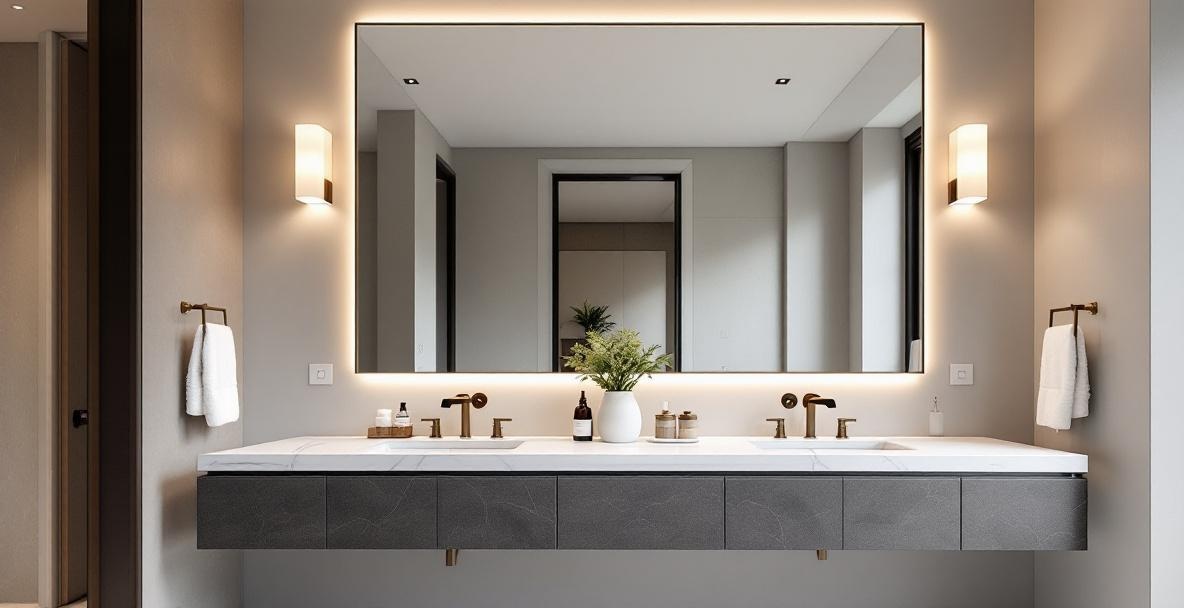

A custom beveled edge mirror has a 45-degree chamfer ground around the perimeter, creating an angled surface that catches and refracts light differently than the main mirror face. Available in bevel widths from 1/4-inch (subtle accent) to 1-3/4 inches (bold decorative statement). The bevel is a fabrication decision — it's ground into the mirror at the shop before installation and cannot be added afterward.
The appeal of a beveled mirror edge is that it does something plain flat-polished glass cannot: it creates a visible, decorative perimeter that catches light from multiple angles throughout the day. As sunlight or artificial lighting changes angle, the bevel catches that light and refracts it in ways that make the mirror edge appear to glow. In a bathroom or bedroom, this creates a subtly dynamic quality that flat glass lacks.
This guide explains bevel geometry, available widths, which bathroom and design styles benefit most, and how to specify the right bevel for your project.
What Is a Beveled Mirror?
A beveled mirror is a mirror whose perimeter has been ground to a 45-degree angled surface — removing the sharp right-angle arris between the mirror face and the cut edge. The angled band reflects light at a different angle than the main mirror surface, which creates the prismatic shimmer beveled mirrors are known for. "Beveled" (sometimes spelled bevelled) refers only to the edge treatment — the mirror glass itself is the same silvered float glass as any flat-polished mirror.
The cut itself is also called a chamfer. What changes between a plain mirror and a beveled one is nothing in the middle of the panel — it is entirely a decision about how the last inch of glass at the perimeter is finished.
How Is a Mirror Bevel Made?
A bevel is ground into the mirror at the fabrication shop in four stages — rough grind, intermediate grind, fine grind, and polish — using diamond abrasive wheels set at 45 degrees. It is done before installation and is part of how the mirror is made, not something applied to a mirror hanging on a wall.
The fabrication process:
Step 1 — Rough bevel grind: A beveling wheel (a diamond abrasive wheel oriented at 45 degrees) grinds the angled surface along the mirror perimeter. This removes glass to the specified bevel width while creating the angled face geometry.
Step 2 — Intermediate grind: Removes scratches from the rough stage. The bevel face begins to clarify.
Step 3 — Fine grind: Further scratch removal. The bevel surface becomes smooth.
Step 4 — Polish: The bevel face is polished to full optical clarity — bright, clear, prismatic. This is the finished bevel visible in the final installation.
The mirror backing (silver layer) on the bevel face is still reflective, but the angled geometry means it reflects light toward different areas of the room. This is what creates the light-catching, dynamic appearance of a beveled edge.
What bevel width means: The bevel width is measured from the outer edge of the mirror to where the bevel meets the main mirror face. A 3/4-inch bevel extends 3/4 inch inward from the edge. The wider the bevel, the more pronounced the light-refraction effect — and the more glass is removed from the outer perimeter (slightly reducing the "effective" flat reflection area of the panel).
Because the bevel consumes perimeter, the width has to be chosen alongside the finished dimensions rather than after them — a wide bevel on an undersized panel leaves very little flat reflection in the middle. Settle the vanity mirror sizing against your fixture and backsplash first, then pick the bevel to suit it.
What Bevel Widths Are Available?
Standard bevel widths range from 1/4-inch to 1-3/4 inches, with 1/4, 1/2, 3/4, 1, and 1-1/4 inch being the most common production widths. Wider bevels make a stronger decorative statement; narrower bevels provide a subtle accent without commanding attention.
| Bevel Width | Visual Effect | Best For | |
| 1/4 inch | Subtle, barely visible at distance | Modern / minimal — just a polished accent | |
| 1/2 inch | Noticeable at medium distance | Contemporary / transitional bathrooms | |
| 3/4 inch | Clearly decorative, strong light catch | Transitional — most popular residential width | |
| 1 inch | Bold framing effect | Traditional / ornate / statement mirrors | |
| 1-1/4 inch | Dominant decorative element | Traditional, formal spaces | |
| 1-3/4 inch | Very pronounced, antique-style | Period-style or very ornate settings |
The most requested bevel width for residential DFW projects is 3/4-inch — wide enough to be clearly visible and create a light effect, but not so wide that it dominates the mirror face at normal viewing distances. For contemporary bathrooms where subtlety is valued, 1/2-inch is the more restrained choice. For traditional or ornate settings, 1-inch and wider create the bold decorative statement that coordinates with other period details.
A wide bevel is one way to reach for a period look; changing the mirror surface itself is the other. The two are often confused at the specification stage but are unrelated decisions — a bevel shapes the edge of an ordinary silver mirror, whereas antique mirror alters the reflective backing across the whole face to produce the clouded, speckled patina. They can be combined, and frequently are on statement pieces.
3/4 in
most popular bevel width for residential bathroom and bedroom mirrors in DFW
Beveled vs Polished Edge Mirror: What's the Difference?
A polished (flat-polish) edge is ground smooth and bright but stays square to the mirror face; a beveled edge is ground at 45 degrees, creating a visible angled band that catches light. Both start as the same bevel edge mirror glass — silvered float glass — and both are safe to touch. The difference is purely visual: flat polish disappears, a bevel announces itself.
| Edge Type | What It Looks Like | When to Choose It | |
| Flat polish (polished edge) | Bright, square, nearly invisible edge | Minimal and modern rooms; mirrors that butt against walls or trim | |
| Beveled edge | Angled 1/4 in. – 1-3/4 in. band that refracts light | Frameless statement mirrors; traditional and transitional baths | |
| Seamed edge | Dull, sanded — a handling edge, not a finish | Edges that will be hidden inside a frame or J-channel |
The choice matters most on frameless mirrors, where the edge is permanently visible. If the mirror will sit inside a frame, pay for neither — a seamed edge is the correct spec because no one will ever see it. If it hangs frameless in a modern room, flat polish keeps the panel quiet. If you want the edge itself to be part of the design, that is what the bevel is for.
Do Beveled Mirrors Work in Modern Interiors?
Yes — beveled mirrors work in modern interiors when specified at narrower bevel widths (1/4-1/2 inch) and paired with contemporary design elements. The common association between beveled edges and traditional or Victorian interiors comes from wide-bevel (1-inch+) mirrors in ornate frames. Narrow bevels on frameless contemporary mirrors are a different aesthetic entirely.
How bevel width affects style association:
Wide bevel (1-inch+), framed: Classic "traditional" beveled mirror look. Associated with Victorian, Edwardian, and traditional American bathroom design. More ornate, more historical.
Medium bevel (3/4-inch), frameless: Transitional. Works in both contemporary and traditional spaces. The most versatile specification for residential projects.
Narrow bevel (1/4-1/2-inch), frameless: Contemporary. The bevel functions as a refined edge detail rather than a decorative statement. Works in minimalist, modern, and Scandinavian-influenced interiors.
The bevel's modern applicability also depends on the frame (or lack of frame). Wide bevel + no frame = contemporary. Narrow bevel + ornate frame = traditional. The combination determines the final aesthetic.
What Is the Cost Difference Between Beveled and Flat Polish Mirrors?
Beveled edge mirror costs more than flat polish due to the additional grinding and polishing stages required — typically adding $1.50-$3.00 per linear foot of beveled perimeter (HomeGuide 2025). For a 36x36-inch mirror (12 feet of perimeter), the bevel adds approximately $18-$36 to the material cost. A 60x48-inch mirror (18 feet of perimeter) adds $27-$54.
Cost calculation for bevel premium:
36x36-inch mirror bevel calculation:
- Perimeter: (36 + 36) × 2 = 144 inches = 12 linear feet
- Bevel cost at $2.00/linear foot: $24 additional
60x48-inch mirror bevel calculation:
- Perimeter: (60 + 48) × 2 = 216 inches = 18 linear feet
- Bevel cost at $2.00/linear foot: $36 additional
For most residential projects, the bevel premium is a modest addition to the total project cost — generally 10-20% more than a flat-polish mirror of the same dimensions (HomeGuide 2025). Many homeowners find the aesthetic enhancement worth the modest additional cost.
Corner bevels (on all four corners) are typically included in the per-linear-foot pricing since the corners are part of the perimeter. Very wide bevels (1-inch+) require more material removal and may be priced at a higher per-linear-foot rate. Bevel charges sit on top of the base install — our mirror installation cost guide for DFW covers what that base actually runs.
Can a Bevel Be Added to an Already-Cut Mirror?
No — beveling must be done before final tempering and cannot be added to an existing cut mirror without removing it and returning it to a fabrication shop. Mirror can be re-ground to add a bevel if the panel is returned to the shop and the bevel grinding is performed on the existing panel. This requires careful handling to avoid breaking the glass during re-grinding.
Practical implications:
Ordering a new mirror: If you want beveled edges, specify this when ordering. The bevel grinding is performed at the shop as part of the original fabrication, before the mirror leaves the facility.
Existing installed mirror: Cannot be beveled in place. If you want to add beveled edges to an existing flat-polished mirror, the mirror must be removed, returned to the shop for bevel grinding, then re-installed. Given the removal and re-installation labor, ordering a new beveled mirror is often more cost-effective than retrofitting an existing one.
Already-tempered glass: Tempered glass cannot be cut or ground at all — any abrasive work after tempering causes shattering (CPSC 16 CFR 1201). Most mirrors are not tempered (standard float glass), so this restriction applies primarily to tempered safety glass applications.
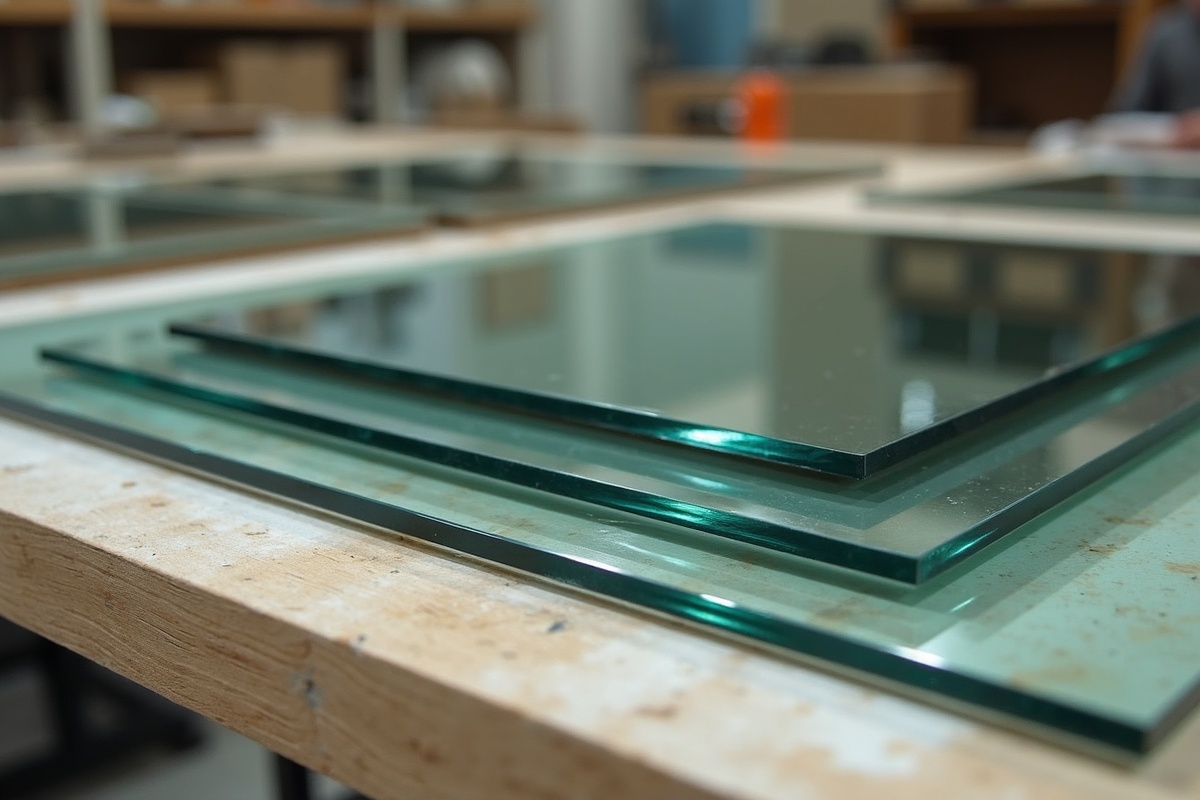
Infinity Glass & Glazing cuts and bevels custom mirrors at our Corinth shop in bevel widths from 1/4-inch to 1-3/4 inches, sized to any dimension — from bathroom vanities to full gym mirror walls. We install throughout Dallas, Fort Worth, Denton, Frisco, McKinney, Lewisville, Flower Mound, Southlake, and Keller. Get a free bevel mirror quote or call (940) 279-1197.
What is the standard bevel width on a mirror?
The most common bevel width for residential bathroom and bedroom mirrors is 3/4-inch. This width is clearly visible and creates a noticeable light-catching effect without dominating the mirror face at normal viewing distances. For more subtle applications, 1/2-inch is popular. For traditional or ornate settings, 1-inch and wider are appropriate.
Are beveled mirrors more expensive than flat-edge mirrors?
Yes, by typically 10-20% for the additional grinding and polishing labor. The cost premium is calculated per linear foot of beveled perimeter — approximately $1.50-$3.00 per linear foot. For a standard 36x36-inch vanity mirror, the bevel adds $18-$36 to the total cost. For most homeowners, this is a modest premium for the aesthetic enhancement.
Do beveled mirrors work in modern interiors or just traditional ones?
Beveled mirrors work in modern interiors when specified at narrower bevel widths (1/4-1/2 inch) on frameless panels. The association with traditional style comes from wide-bevel mirrors in ornate frames. Narrow frameless bevels read as contemporary refinement rather than period decoration. The bevel width and frame (or lack of frame) determine the style association more than the bevel itself.
How do you clean a beveled mirror edge?
Clean beveled edges with a soft damp cloth and glass cleaner — the same approach as the mirror face. The angled surface can collect more dust than a flat edge due to the horizontal component of the chamfer. A soft brush followed by a damp cloth removes debris from the bevel face. Avoid abrasive scrubbers that could scratch the polished bevel surface.
What does a beveled mirror mean compared to a regular mirror?
A beveled mirror is a regular silvered mirror whose perimeter has been ground to a 45-degree angled band, usually 1/4-inch to 1-3/4 inches wide. The glass, the reflection quality, and the thickness are the same as a flat mirror — only the edge finish differs. The angled band catches and refracts light, which is the decorative effect people buy it for.
Is a beveled edge better than a polished edge?
Neither is better — they serve different designs. A flat-polished edge is bright but square and visually quiet, suited to minimal and modern rooms. A beveled edge is a visible design element that reads more decorative and traditional at wider widths. On framed mirrors, choose neither: a seamed edge costs less and is hidden by the frame anyway.
Related reading: custom mirrors in DFW.