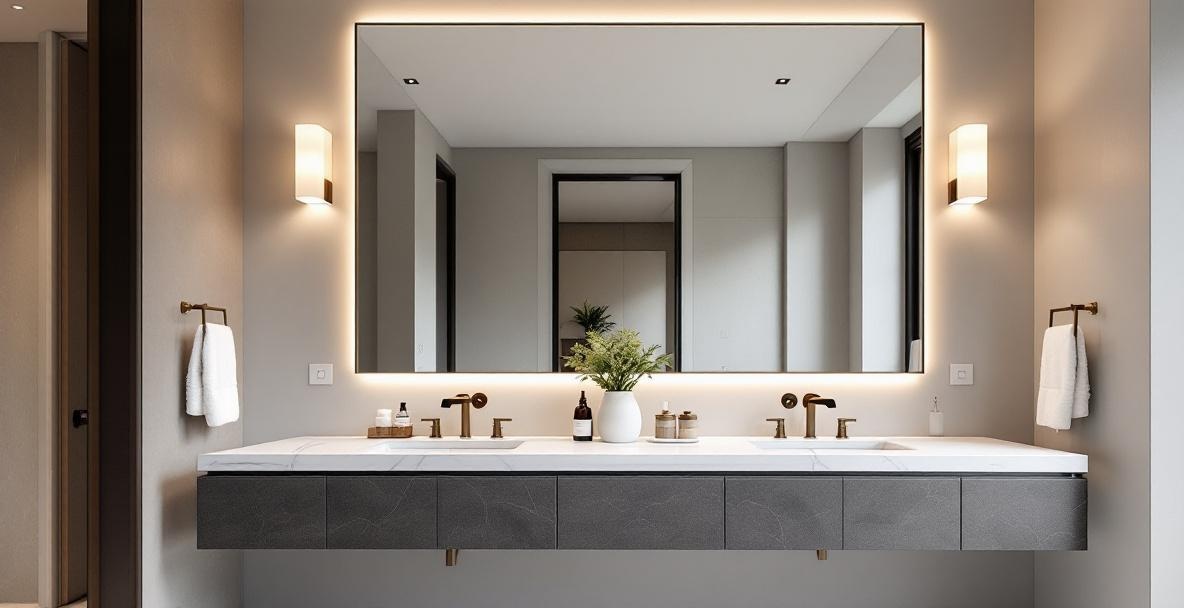
A bathroom vanity mirror should be 2-4 inches narrower than your vanity on each side — this is the standard proportion recommended by VanityArt and most interior designers. For a 60-inch double vanity, that's a 52-56-inch wide mirror. Stock mirrors top out at 48 inches. Custom fabrication gets you the right size for your specific vanity in any width and height.
The most common mistake in bathroom mirror selection: buying a stock mirror without considering the vanity width. A 30x36-inch mirror on a 60-inch double vanity looks like an afterthought. A 54x36-inch custom mirror matched to the vanity width looks designed. The cost difference between the two is often less than $100.
This guide walks you through measuring for a custom vanity mirror, understanding edge options, and getting the right size for your specific bathroom. If you already know you want a bevel, our beveled edge mirror guide covers widths and what each one costs per linear foot.
What Size Should a Bathroom Vanity Mirror Be?
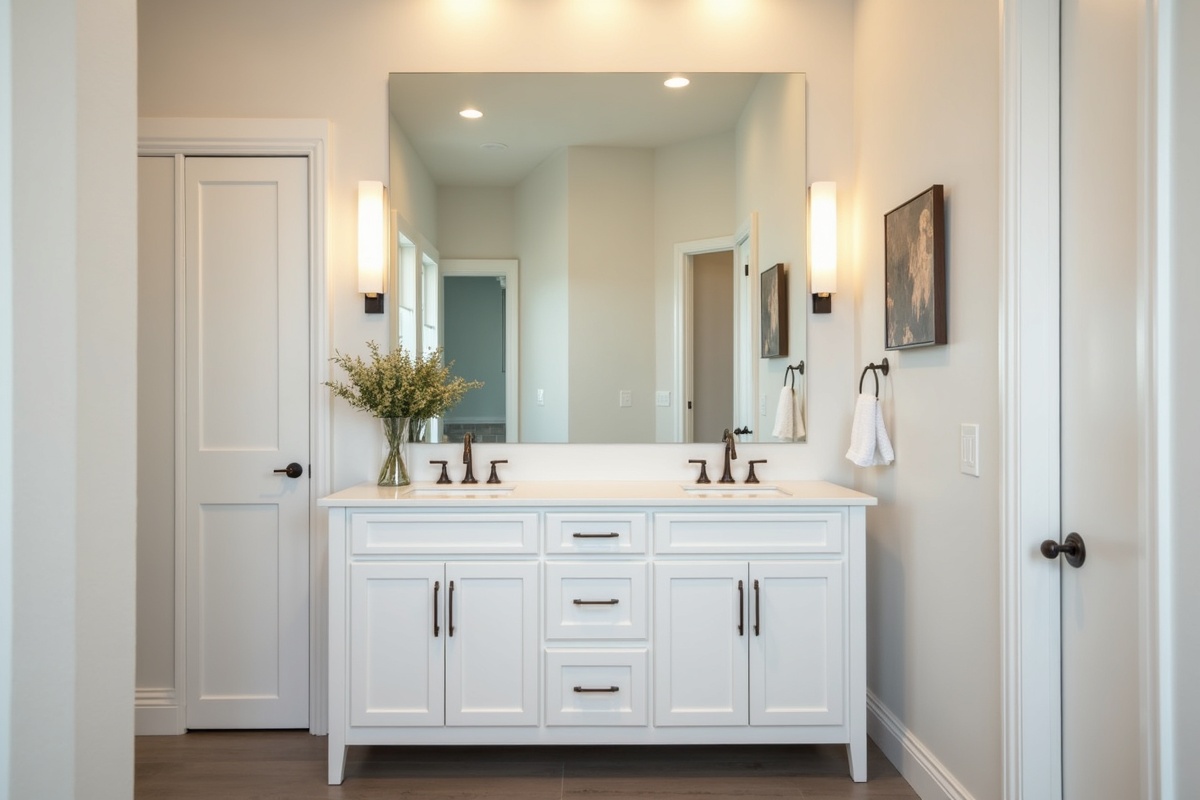
A vanity mirror should span 80-90% of the vanity width (leaving 2-4 inches on each side), and be tall enough to accommodate the full-face view of the users — typically 30-42 inches tall depending on ceiling height and user height. For double vanities, one large mirror or two individual mirrors can both work.
Standard proportion guidelines:
Width: The mirror should be 2-4 inches narrower than the vanity cabinet on each side. For a 48-inch vanity: 40-44-inch mirror. For a 60-inch vanity: 52-56-inch mirror. For a 72-inch double vanity: 64-68-inch mirror.
Height: Depends on the ceiling height, the placement of light fixtures, and the users' heights. A standard height is 28-36 inches. For tall users (6-foot+), 36-42 inches provides full-face visibility. In bathrooms with high ceilings, a taller mirror (up to 48+ inches) uses the vertical space more deliberately.
Placement: The mirror bottom should sit 5-10 inches above the top of the backsplash or countertop. The top of the mirror should be at least 5-6 inches below any overhead light fixture to avoid the mirror reading as "too close" to the ceiling.
Single vs. double vanity mirrors: For double vanities, one wide mirror spanning the full vanity width creates a spa-like appearance. Two individual mirrors (one centered over each sink) are more traditional and often coordinate better with double light fixtures. Both are appropriate design choices.
80-90%
of vanity width is the recommended proportion for a balanced bathroom vanity mirror
How Do You Measure for a Custom Vanity Mirror?
Measure the vanity cabinet width, then subtract 4-8 inches for the mirror width (2-4 inches on each side). For height, measure from 5-8 inches above the countertop to 5-6 inches below the light fixture. If there's no light fixture constraint, choose a height that's visually balanced with the vanity cabinet proportions.
Step-by-step measurement process:
Step 1 — Measure vanity cabinet width: Measure from outer edge to outer edge of the vanity cabinet (not the countertop overhang if it extends). Write down this number.
Step 2 — Determine mirror width: Subtract 4-8 inches from the vanity width to get your mirror width range. For a 48-inch vanity: 40-44-inch mirror. For a 60-inch vanity: 52-56-inch mirror.
Step 3 — Determine mirror bottom height: Mark the position 5-8 inches above the countertop surface (not the backsplash). This is where the bottom of the mirror will sit.
Step 4 — Determine mirror top height: If you have a light fixture above, measure to 5-6 inches below the fixture bottom. This is your maximum height.
Step 5 — Calculate mirror height: Subtract the mirror bottom position (step 3) from the mirror top maximum (step 4). This gives you the available mirror height.
Step 6 — Confirm proportion: A mirror that's wider than it is tall generally looks modern and bathroom-appropriate. A square mirror (equal width and height) is also popular. A taller-than-wide mirror is less common for vanity applications but works in some designs.
What Edge Options Are Available for Custom Vanity Mirrors?
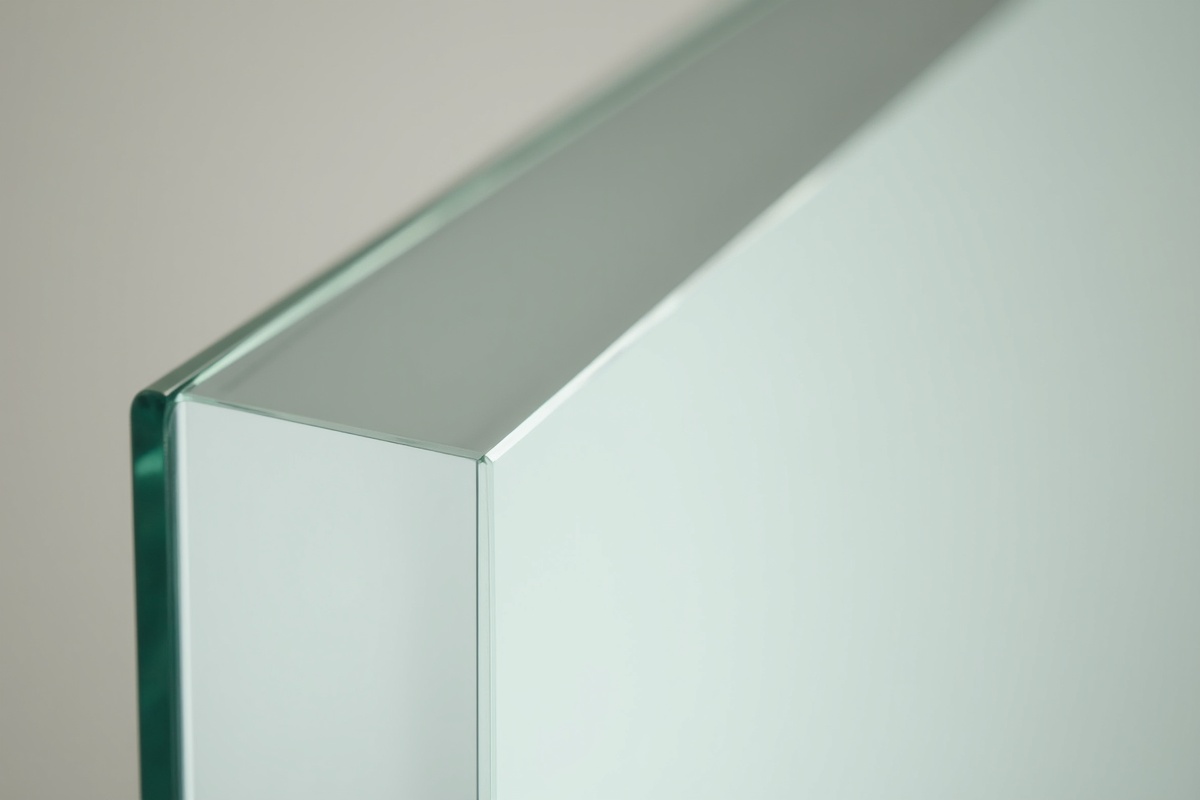
Three edge options are available for custom bathroom vanity mirrors: flat polish (clean, invisible edge), beveled (angled light-catching perimeter), and pencil polish (rounded soft edge). The edge profile is a permanent fabrication decision and should be considered alongside the mounting method.
Flat polish:
- The most common edge for bathroom mirrors
- The cut edge is polished smooth and flat — safe to touch, visually clean
- Best for: frameless mirrors mounted directly to tile or wall; any style
- The edge is subtle — the mirror appears to float on the wall
Beveled edge:
- A 45-degree angled chamfer ground into the perimeter of the mirror
- Available in widths from 1/4-inch (subtle) to 1-1/2-inch (decorative)
- Creates a light-catching, prismatic effect at the mirror perimeter
- Best for: traditional and transitional bathrooms; mirrors mounted at eye level where the bevel is visible
- Adds visual richness without requiring a frame
Pencil polish (rounded edge):
- The edge is ground to a soft, slight radius
- Less common in bathroom applications than flat polish
- Creates a slightly softer visual transition
- Best for: where a flat polished edge feels too "sharp" visually
Which to choose: For most DFW bathroom renovations, flat polish is the practical default. For bathrooms with ornate fixtures, marble countertops, or a traditional/transitional design direction, a beveled edge adds an elegant detail that reads as considered without requiring a frame.
How Is a Custom Vanity Mirror Installed?
Custom vanity mirrors are installed using mirror mastic adhesive — a non-corrosive adhesive that bonds the mirror backing to the wall without damaging the reflective coating. For larger mirrors (over 20 square feet), mechanical standoffs or J-clips supplement the adhesive for additional security.
Installation process:
-
Wall preparation: The wall surface must be clean, dry, and structurally sound. Paint, dust, and oils are wiped off. For tile walls, grout lines are noted — adhesive is applied to the tile surface, not the grout.
-
Mirror positioning: The mirror is test-fit dry to confirm position, then adhesive is applied to the back in a pattern that covers the panel adequately without preventing air circulation in the center (important for thermal movement).
-
Set and secure: The mirror is pressed to the wall and propped in position while the adhesive begins to cure. For heavy panels, temporary supports or J-clips hold the mirror while curing completes.
-
Cure time: Mirror mastic takes 24-48 hours to fully cure. The mirror should not be disturbed during this period.
One important caveat on adhesive selection: Standard construction adhesives are NOT appropriate for mirrors. Many contain solvents that dissolve the mirror backing (the silver coating), causing black edge deterioration — "black edge" or "desilvering" — within a few years (Cardinal Glass Industries). Only mirror-specific, non-corrosive mastic should be used.
What Is the Cost of a Custom Bathroom Vanity Mirror in DFW?
A custom bathroom vanity mirror in DFW typically costs $150-$600 installed depending on size, edge treatment, and mounting complexity (HomeGuide 2025). The average 36x60-inch project runs about $158 in installation cost per Fixr.com (2026), with materials adding $80-$200 depending on dimensions and edge profile.
Cost breakdown by project type:
- Simple vanity mirror (24x30-inch, flat polish, glue up): $80-$150 total
- Standard vanity mirror (36x36-inch, flat polish): $120-$200 total
- Large single-sink mirror (42x36-inch, beveled): $200-$350 total
- Double vanity mirror (60x36-inch, beveled): $300-$500 total
- Oversized double vanity mirror (72x48-inch, flat polish): $400-$650 total
Infinity Glass & Glazing cuts and installs custom bathroom vanity mirrors throughout DFW — from Corinth to Dallas, Fort Worth, Denton, Frisco, McKinney, Lewisville, Flower Mound, Southlake, and Keller. Get a free quote or call (940) 279-1197.
How much smaller should a bathroom mirror be than the vanity?
A bathroom mirror should generally be 4-8 inches narrower than the vanity cabinet (2-4 inches on each side). This leaves a balanced visual margin and ensures the mirror doesn't extend to the wall edges, which can look awkward. For a 60-inch vanity, target a 52-56-inch mirror. For a 48-inch vanity, target a 40-44-inch mirror.
Can you cut a standard mirror to a custom size?
Standard (non-tempered) mirror can be cut by a professional glass shop to any size. Tempered glass mirror cannot be cut after tempering. Most bathroom mirrors are standard mirror (not tempered) and can be custom-cut. For bathroom vanity mirrors, custom fabrication from sheet mirror is the typical approach — the mirror is cut to your specified dimensions from a full sheet.
What is the standard height for a bathroom vanity mirror?
Most bathroom vanity mirrors are 28-36 inches tall. For tall users or bathrooms with high ceilings, mirrors up to 42-48 inches work well. The mirror bottom should sit 5-8 inches above the countertop; the top should be at least 5-6 inches below any overhead light fixture. These constraints typically produce a natural height range of 28-42 inches depending on the specific bathroom.
Should bathroom vanity mirrors be the same width for a double sink?
For a double vanity, you have two options: one large mirror spanning the full vanity width (creates a spa/hotel look), or two individual mirrors centered over each sink (more traditional, often coordinates better with double sconces or pendant lights between the sinks). Both work. A single wide mirror typically requires custom fabrication since stock mirrors top out around 48 inches — narrower than most double vanities.
Related reading: custom mirrors in DFW and our bathroom renovation glass options.