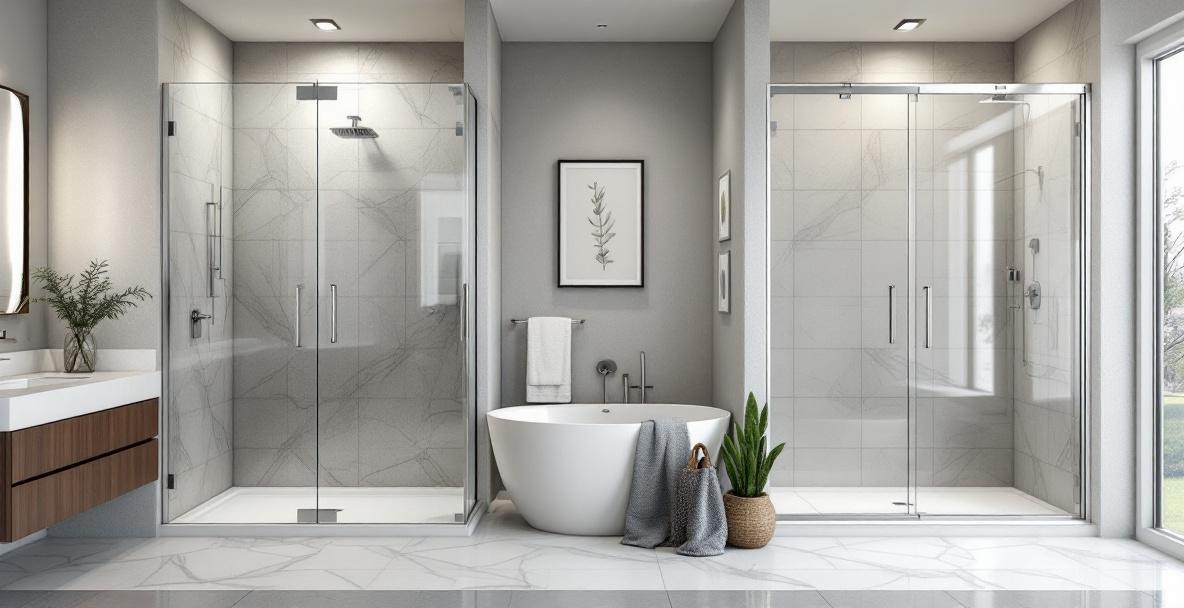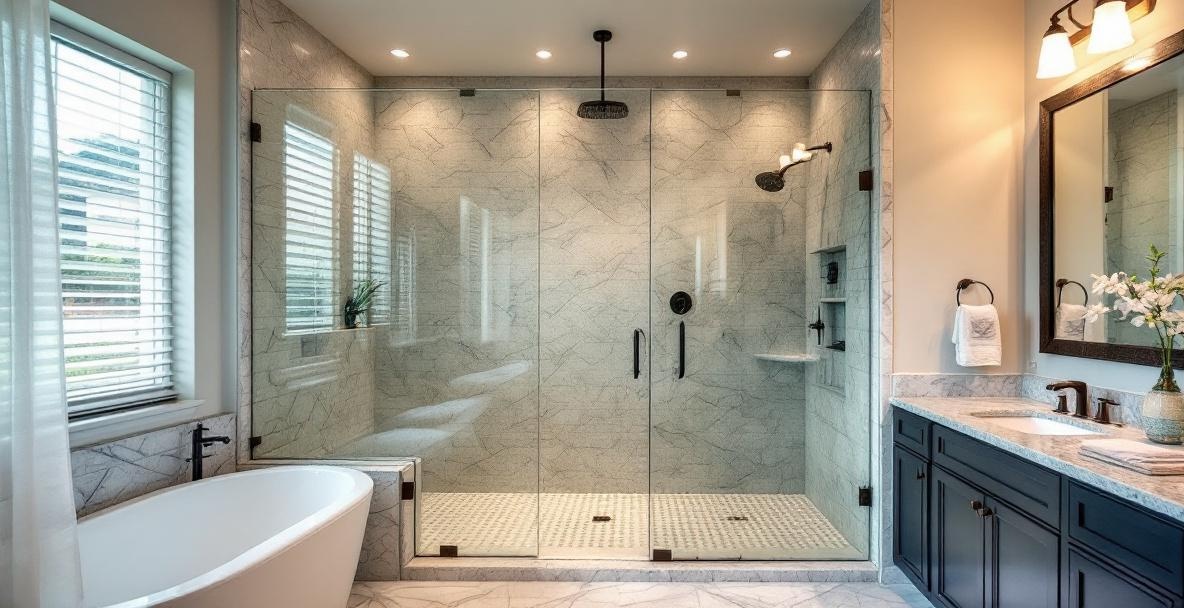
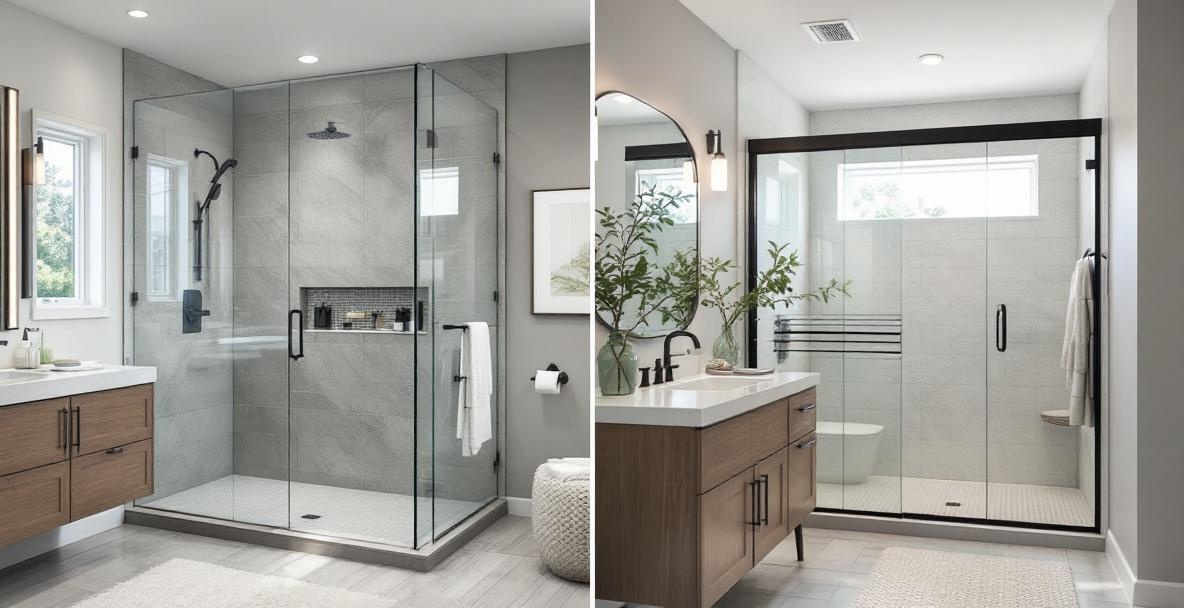
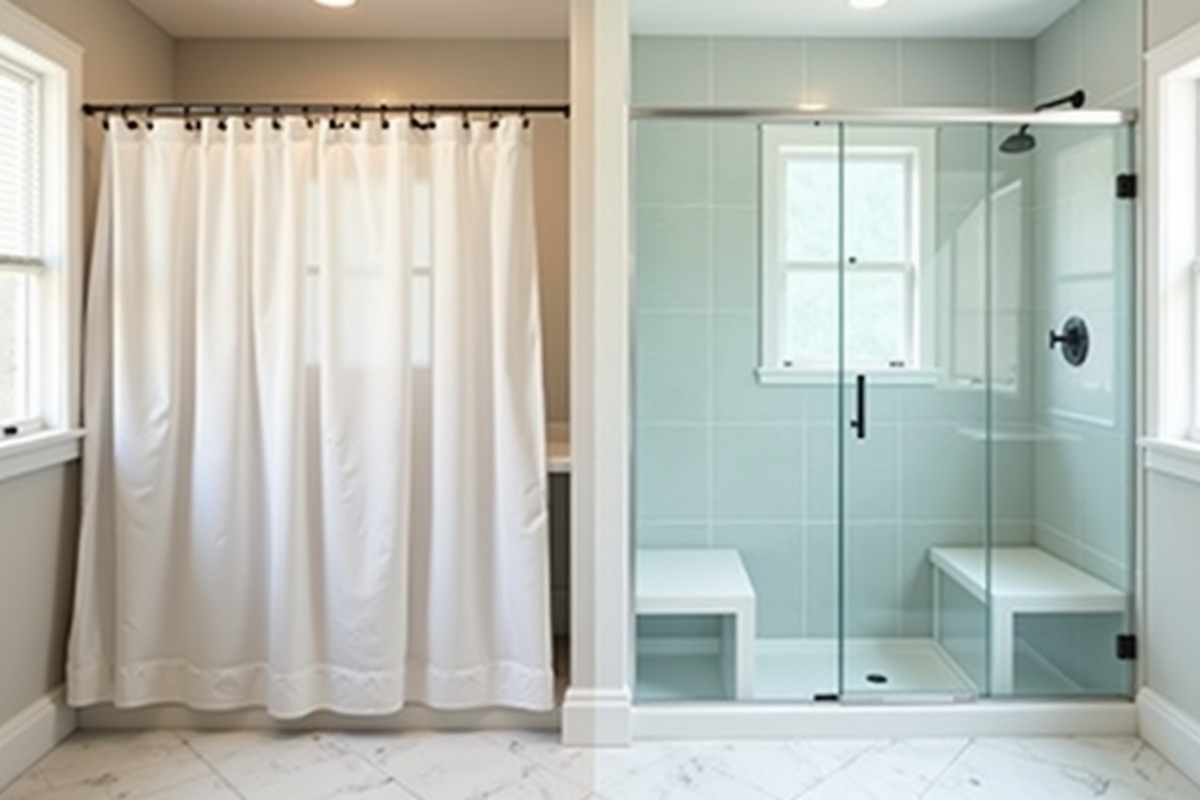
A glass shower door costs $530–$1,390 installed for a standard enclosure versus $20–$100 for a curtain — but the comparison doesn't end there. Glass doors add resale value, resist mold better when properly maintained, and last 20+ years. Curtains need replacement every 6–24 months and contribute to ongoing mold problems in enclosed spaces. For DFW homeowners planning to stay or sell, glass is almost always the better long-term investment.
The shower curtain vs. glass door debate sounds like a budget question, but it's really a question about what you're optimizing for. Curtains win on day-one cost — nothing else. Glass wins on hygiene, maintenance over time, resale value, and bathroom aesthetics. This guide breaks down the honest comparison across every factor that matters, including the scenarios where a curtain actually makes more sense.
Cost Comparison: Upfront vs Long-Term
A shower curtain costs $20–$100 for the curtain itself plus $15–$40 for rings and rod, replaced every 6–24 months. A glass shower door costs $530–$1,390 installed for a standard framed or semi-frameless configuration, or $1,000–$2,500+ for frameless — a one-time cost that lasts 15–30 years. The 10-year cost of curtain replacement often exceeds the cost of a mid-range glass door installation.
Shower curtain 10-year cost:
- Curtain: $20–$100 every 12–18 months on average = $133–$1,000 over 10 years
- Liner (replaced every 6–12 months for hygiene): $10–$30 each = $100–$600 over 10 years
- Hardware (rod, rings): $15–$40, replaced every few years = $45–$120 over 10 years
- 10-year total: $278–$1,720
Glass shower door 10-year cost:
- Standard framed door installed: $530–$1,100 (one-time)
- Semi-frameless installed: $700–$1,550 (one-time)
- Frameless installed: $1,000–$2,500+ (one-time)
- Maintenance (seals, squeegee): $50–$200 over 10 years
- 10-year total: $580–$2,700 (one-time installation, no recurring replacement)
The 10-year math narrows the gap considerably. A $700 framed glass door installation costs roughly the same over a decade as a household that replaces a mid-range curtain every 12–18 months. And the glass door still has 10+ years of useful life remaining while the curtain cycle continues indefinitely.
10%
increase in bathroom resale value from glass shower enclosures — curtains add no measurable resale value ([Investment Properties Info](https://www.investmentpropertiesinfo.com/))
| Upfront cost |
| 10-year total cost |
| Replacement frequency |
| Resale value impact |
| Mold risk |
| Cleaning time |
| Appearance |
| Space perception |
Hygiene and Mold — Which Is Cleaner?
Shower curtains are a persistent mold problem. The fabric or vinyl holds moisture, and the folds and bottom hem create protected zones where mold and mildew establish within weeks of a new curtain. Glass shower doors don't absorb moisture — with a daily squeegee, the glass dries completely and mold has no surface to colonize.
The mold problem with curtains isn't a matter of poor cleaning habits — it's a matter of material. Fabric and vinyl hold moisture after each shower. The bottom hem touches the wet floor and stays damp. The folds trap humidity. Even with regular washing, mold colonies re-establish rapidly because the material remains perpetually damp in an environment with high ambient humidity after each use.
The Centers for Disease Control has documented that mold exposure in indoor environments causes respiratory issues, allergies, and skin irritation. Shower curtains are one of the most common household mold sources because they combine constant moisture, warmth, and an organic surface (fabric) or porous vinyl that mold can attach to.
Glass shower doors eliminate this dynamic entirely. Glass is non-porous — mold cannot colonize a glass surface. Soap scum can accumulate on glass (that's what the squeegee removes), but soap scum is not a mold habitat. The rubber seals and sweeps at the door edges require periodic inspection and replacement, but the glass panels themselves resist mold growth categorically better than any curtain material.
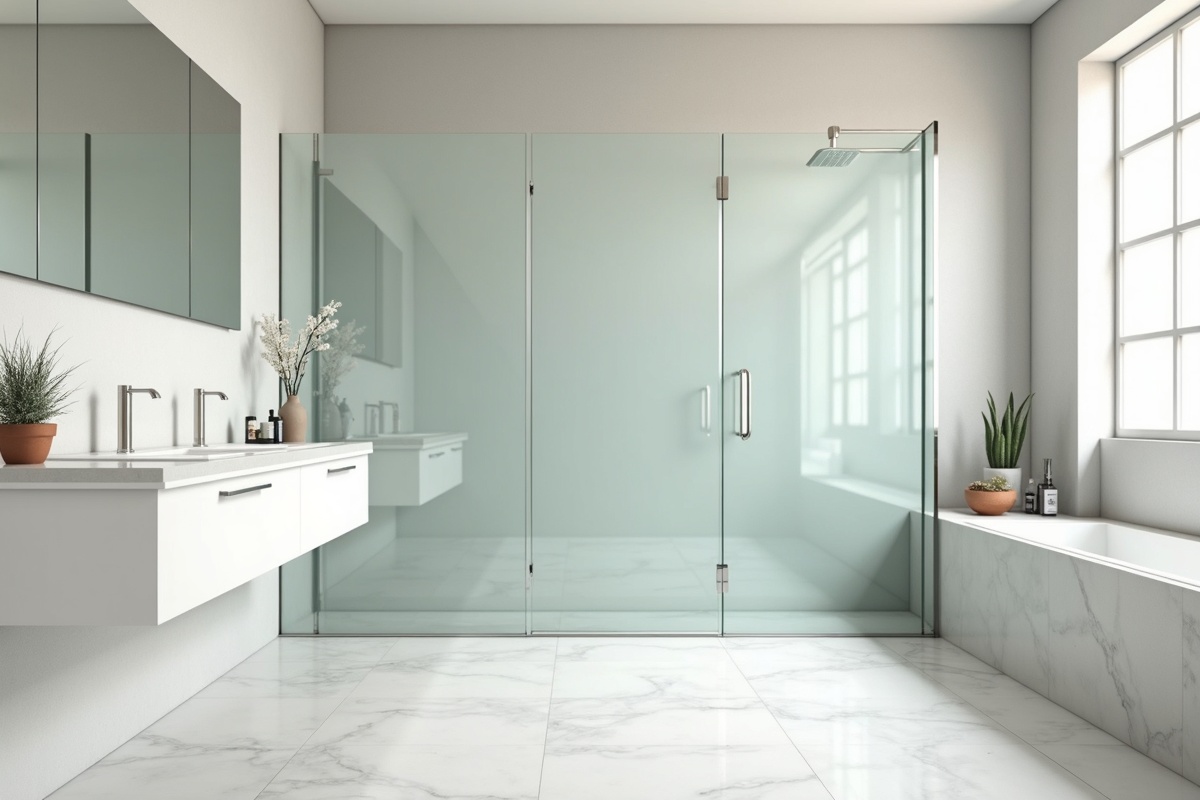
In DFW's climate — hot, humid summers with air conditioning running most of the year — bathroom ventilation matters. Whether you use a curtain or glass door, run the exhaust fan during and for 20 minutes after every shower. With a glass door, this habit keeps the door looking pristine. With a curtain, it slows (but doesn't stop) mold growth.
How Each Affects Resale Value
Glass shower enclosures are among the top features buyers look for in primary bathrooms. Walk-in showers with glass enclosures are cited as the most popular bathroom feature by 45% of real estate experts (West Shore Home). A shower curtain in a master bathroom is perceived as an unfinished renovation item — buyers mentally subtract the upgrade cost from their offer.
In DFW's real estate market, bathroom quality is a major differentiator at every price point above entry-level. The master bathroom is one of the two or three rooms buyers care most about (along with the kitchen and master bedroom). A frameless or semi-frameless glass shower enclosure signals that the homeowner invested in the property; a curtain signals that they didn't.
The 10% bathroom value increase from glass enclosures means that a bathroom valued at $20,000 in the overall home appraisal gains $2,000 in assessed value. On a $400,000 DFW home, that's a measurable return. The cost of a frameless installation ($1,500–$2,500) is frequently recovered in full or in excess at resale.
Curtains don't add value — and in a competitive DFW listing, a master shower with a curtain is a liability, not a neutral feature.
Pros and Cons for Small Bathrooms
In small bathrooms, glass shower doors are the better choice because clear glass creates visual continuity — the eye travels through the glass and perceives more space. A shower curtain divides the room and makes small bathrooms feel cramped. Even a semi-frameless glass panel improves perceived square footage in compact DFW bathrooms.
Curtains in small bathrooms: A curtain drawn closed creates a visual wall across the bathroom. In a 50 sq ft bathroom, that wall cuts the perceived space nearly in half. Even with the curtain open, the fabric bunched at one end adds visual bulk. Curtains can be made to work in small bathrooms, but they're never the space-maximizing choice.
Glass doors in small bathrooms: Clear glass allows the eye to see through to the tile, the back wall, and the full depth of the shower. The bathroom reads as one unified space rather than two divided zones. In Corinth and Lewisville townhomes and condos where bathroom footprints are compact, frameless glass is one of the highest-impact upgrades available for perceived size.
Configuration options for tight spaces:
- Fixed glass panel with an open entry (no door swing required)
- Pivot or hinged door (requires clearance outside the shower)
- Frameless bypass slider (saves swing clearance in very narrow spaces)
Lifespan Comparison
A quality glass shower door lasts 20–30 years; a shower curtain requires replacement every 6–24 months. The lifespan advantage of glass is roughly 15:1 to 30:1 — meaning over a 30-year homeownership period, you'll replace a curtain 15–60 times while a glass door requires no replacement (only periodic seal maintenance).
Shower curtain lifespan:
- Vinyl liner: 6–12 months before mold buildup requires replacement
- Fabric curtain: 12–24 months for most households; longer with diligent washing
- Hardware (rod, rings): 3–5 years before rust and wear
Glass shower door lifespan:
- Tempered glass panels: 20–30+ years under normal conditions; glass doesn't degrade
- Hardware (hinges, handle): 10–20 years; adjustable and replaceable without changing glass
- Seals and sweeps: 3–5 years; inexpensive to replace
- Frame (if framed/semi-frameless): 10–20 years depending on water hardness and maintenance
The practical implication: a glass shower door installed in a DFW bathroom today will still be in service when the home sells. The homeowner who installs it in 2026 is not buying a temporary fix — they're making a permanent improvement to the bathroom.
Which Is Better for Families?
Families with young children often default to curtains on the assumption that glass is more dangerous. The safety assumption is worth examining directly: all shower glass installed by a licensed contractor is tempered safety glass, which is required by code (IRC R308) for shower applications (ICC 2024). Tempered glass breaks into small, blunt-edged pebbles rather than sharp shards if it shatters — the injury profile is dramatically better than regular glass (CPSC 2024).
Curtain rods, by contrast, can pull from the wall if a child grabs them, and a falling rod and hardware creates its own injury risk. Mold exposure from curtains is a health concern for children with respiratory sensitivities.
For active families with young children, the practical considerations are: hinged shower doors require swing clearance (children can be struck by an opening door), handles should be positioned for easy adult control, and slip-resistant shower pans matter more than door type. None of these are reasons to prefer curtains over glass from a safety standpoint.
When to Upgrade From Curtain to Glass
- 1
You're renovating the bathroom
Any bathroom renovation is the right moment to make the glass upgrade. The disruption of tiling, plumbing, or vanity work is already happening — adding a glass enclosure doesn't require a separate mobilization. - 2
You're preparing to sell
If you're listing within 12–24 months, a glass shower enclosure in the master bath is one of the highest-ROI improvements you can make before listing. Budget $1,000–$2,000 for a quality semi-frameless or frameless installation. - 3
Mold is a recurring problem
If you're cleaning or replacing a moldy curtain more than once a year, the glass upgrade pays for itself in time savings and health benefits within 2–3 years. - 4
You're tired of the daily cleaning burden
Curtain + liner + rings + rod requires substantially more maintenance time than a glass door with a daily squeegee. If bathroom maintenance is a friction point, glass dramatically reduces it. - 5
You have a dedicated shower (not a tub combo)
If your shower is a dedicated walk-in (not a bathtub combination), a glass door is the natural design choice — curtains look out of place on a dedicated shower in any bathroom above entry level.
How much does it cost to replace a shower curtain with a glass door?
Replacing a shower curtain with a glass door costs $530–$1,390 for a standard framed or semi-frameless installation and $1,000–$2,500+ for a frameless enclosure in DFW. The existing shower plumbing and tile typically don't need modification — the glass door installs within the existing shower footprint. Measurement, fabrication, and installation are typically completed in one or two visits.
Do glass shower doors prevent mold better than curtains?
Yes, significantly. Glass is non-porous and doesn't absorb moisture, so mold cannot colonize the glass surface. Shower curtains (both fabric and vinyl) retain moisture in their fabric, folds, and bottom hem — creating ideal conditions for mold growth within weeks of installation. With a daily squeegee on glass doors, the surface dries completely and mold has no foothold. The rubber seals at door edges need periodic replacement but the glass itself resists mold categorically better than any curtain material.
Can you install a glass shower door on a bathtub?
Yes — semi-frameless sliding bypass doors are specifically designed for the standard 60-inch bathtub opening. Frameless hinged doors can also be installed on a tub surround in some configurations, though the sliding bypass is more common and practical for tub access. If your bathtub has a standard alcove configuration (two walls plus one open side), a sliding glass door system can be installed without modifying the plumbing or tub surround.
Which is better for rental properties?
For rental properties, framed or semi-frameless glass doors are generally the better choice over curtains — they eliminate the recurring cost and maintenance burden of curtain replacement, resist mold better (reducing deep-clean costs between tenants), and look better in listing photos. Fully frameless glass is appropriate for higher-end rental properties where appearance justifies the investment. In budget rentals, a quality framed glass system is a better long-term choice than curtains even at higher upfront cost.
How often do you need to replace a shower curtain vs glass door?
A shower curtain liner should be replaced every 6–12 months; the curtain itself every 12–24 months depending on material and cleaning habits. A glass shower door requires no replacement under normal conditions — the glass panel is designed to last 20–30 years. Seals and sweeps are replaced every 3–5 years at minimal cost ($50–$150), and hardware can be adjusted or replaced without changing the glass. The replacement frequency difference is roughly 15:1 to 30:1 in favor of glass over a typical homeownership period.
Also see our frameless shower door cost guide and our frameless vs framed shower door comparison.
Infinity Glass & Glazing installs glass shower doors throughout DFW — from entry-level framed systems to custom frameless enclosures — with free in-home estimates and in-house glass fabrication. Contact us for a free estimate on your shower door upgrade.
Related reading: