
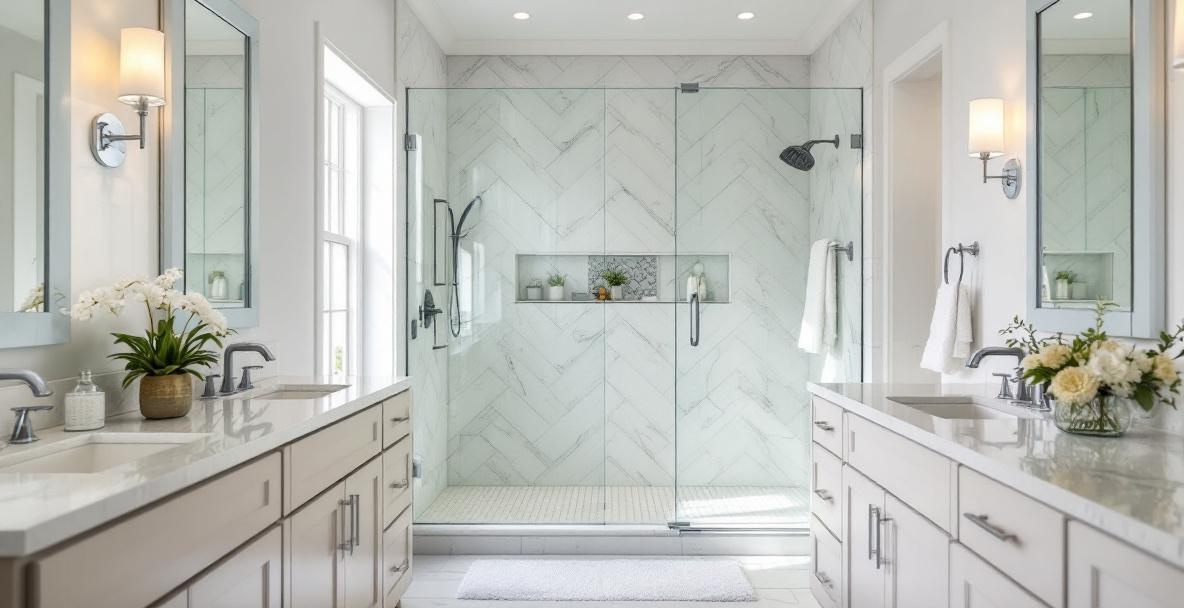
Yes — glass shower doors add measurable home value, with frameless enclosures returning 60–70% of installation cost in resale value added. In the DFW market, where master bathroom quality is a primary buyer evaluation factor above the $350,000 price point, a dated shower curtain or framed enclosure is one of the top buyer objections. Frameless glass is now a buyer expectation in DFW homes above entry-level pricing.
The question "does this upgrade actually pay back?" is the right question before any home improvement project. For glass shower doors — particularly frameless enclosures — the answer is more clearly yes than for many bathroom upgrades. This guide covers the ROI data, why buyers specifically value frameless enclosures, and how the DFW real estate market values bathroom quality.
Do Glass Shower Doors Actually Increase Home Value?
Glass shower doors increase home value by improving buyer perception, reducing buyer objections, and supporting higher offer prices in the DFW resale market. The appraisal impact is secondary to the market impact: frameless shower doors attract more buyers, generate more offers, and reduce the likelihood of a buyer negotiating down because of bathroom condition.
Home value is ultimately determined by what buyers will pay. In the DFW market — where competing homes above the $350,000 price point commonly feature frameless glass — a shower curtain or dated framed enclosure signals an unfinished primary bathroom. Buyers price this in: either demanding a lower purchase price or calculating the replacement cost and discounting accordingly.
The value addition of a glass shower door works through two mechanisms:
Direct value support: An appraiser comparing two otherwise similar homes may assign higher value to the one with a frameless glass enclosure as part of evaluating bathroom finish quality. Appraisers use comparable sales, and comparables with frameless glass command higher prices in the DFW market.
Competitive positioning: In an active DFW listing environment, a master bathroom with a frameless glass shower is a marketing asset — it photographs better, shows better, and gives buyers one fewer reason to favor a competing listing.
60–70%
return on investment for frameless shower door installation in resale value added ([Angi 2026](https://www.angi.com/))
What ROI Can You Expect?
A frameless shower door installation in a DFW master bathroom typically costs $1,500–$5,000 and returns 60–70% of that cost in resale value added — meaning $900–$3,500 in added value per project. This is a mid-range ROI for bathroom upgrades; lower than full bathroom remodels in percentage terms, but higher than many cosmetic-only improvements.
Understanding ROI on a shower door project requires recognizing that the return varies by:
Home price point: In DFW homes above $400,000, frameless shower glass is already the baseline buyer expectation. Installing it doesn't add extraordinary value — it removes a discount. In homes between $250,000 and $400,000, frameless glass moves the bathroom from "acceptable" to "competitive" and can meaningfully affect days-on-market and final offer price.
Existing bathroom condition: A frameless shower door installed in a well-appointed bathroom with quality tile, a current vanity, and good lighting multiplies its ROI by contributing to a bathroom that photographs and shows as a complete package. A frameless door in an otherwise dated bathroom delivers less return.
Timing to sale: ROI is highest when the upgrade happens just before listing — buyers see the new glass and hardware at its best. Glass installed 5–7 years before sale still shows well but has accumulated some hard water deposits and minor wear.
| Frameless shower door |
| Mid-range bath remodel |
| Shower curtain replacement |
| Framed shower door |
| Tile resurfacing |
24%
of Realtors recommend bathroom updates as the single most impactful pre-listing improvement for DFW home sellers ([NAR 2025](https://www.nar.realtor/))
Why Buyers Specifically Prefer Frameless
Buyers prefer frameless shower enclosures because they look cleaner, photograph better, and signal that the bathroom has been maintained and updated — all of which matter in a competitive DFW listing environment. The absence of a metal frame makes the shower look larger, brighter, and more contemporary, which resonates strongly in online listing photography where first impressions determine showing requests.
Buyer psychology around shower enclosures follows a clear pattern in the DFW market:
Shower curtains: Read as temporary. A home with a master shower behind a curtain — especially in a home above $300,000 — registers as a project item in most buyer evaluations. The unspoken buyer thought: "We'll have to do the shower."
Framed shower doors: Read as dated. Metal channel frames accumulate mineral deposits visibly, and the hardware finishes in many framed systems (polished chrome, outdated matte gold) signal the age of the bathroom renovation. Buyers above entry-level pricing factor replacement cost into their offer.
Frameless shower doors: Read as current and complete. Clean glass, architectural hardware in a current finish (matte black, brushed nickel, brushed gold), no channels accumulating scale — this reads as a bathroom that doesn't need immediate work.
The listing photography effect is significant: frameless enclosures appear more open in photos because there is no metal obstructing the view of the tile work. A well-tiled shower behind frameless glass is one of the strongest selling photos in a DFW master bathroom listing.
How Glass Compares to Other Bathroom Upgrade Investments
A frameless shower door delivers a higher per-dollar ROI than most standalone bathroom upgrades because it transforms the appearance of the shower — the single most-evaluated element in a buyer's bathroom assessment — without requiring the disruption and cost of a full bathroom remodel.
The bathroom is consistently rated by Realtors and buyers as the most important room after the kitchen for resale impact. Within the bathroom, the shower is the single focal point that buyers evaluate first. A glass enclosure upgrade captures bathroom perception improvement at lower cost than any other approach.
Comparison to other per-dollar investments:
Vanity replacement: $500–$2,500. Improves one visual element but doesn't transform buyer perception of the overall bathroom. Lower ROI than shower upgrade because buyers evaluate vanity condition second, after the shower.
Tile resurfacing: $500–$1,500. Can update dated tile cost-effectively. Good ROI for bathrooms with sound but aesthetically dated tile. Works well in combination with shower glass upgrade.
Full bathroom remodel: $15,000–$35,000+. Highest total ROI in dollar terms, lowest per-dollar (50–74% per NAR/JLC 2025). The right choice when multiple elements are dated; overkill when primarily the shower needs updating.
Frameless shower door: $1,500–$5,000. High per-dollar ROI because it directly upgrades the element buyers evaluate most. Best standalone investment when the shower is the primary bathroom liability.
50–74%
cost recovery on a mid-range bathroom remodel — frameless shower door upgrades achieve similar per-dollar ROI at a fraction of the total project cost ([NAR/JLC 2025](https://www.nar.realtor/))
Which Shower Door Types Add the Most Value?
Frameless enclosures add more value than framed or semi-frameless systems — buyers recognize and prefer the frameless look. Within frameless, larger enclosures (walk-in configurations, neo-angle), premium hardware finishes (matte black, brushed gold), and low-iron clear glass add progressively more value in the DFW premium market.
By enclosure type — value addition ranking for DFW resale:
-
Frameless walk-in or wet room: Maximum visual impact. A frameless walk-in shower with no door — just open glass panels — is the most photogenic and buyer-attractive configuration. Best for master baths above $500,000 where buyer expectations are highest.
-
Frameless swing door with fixed panel: The standard master bath configuration. Single hinged door with one or more fixed panels. Strong resale position across the $300,000–$600,000 DFW market segment.
-
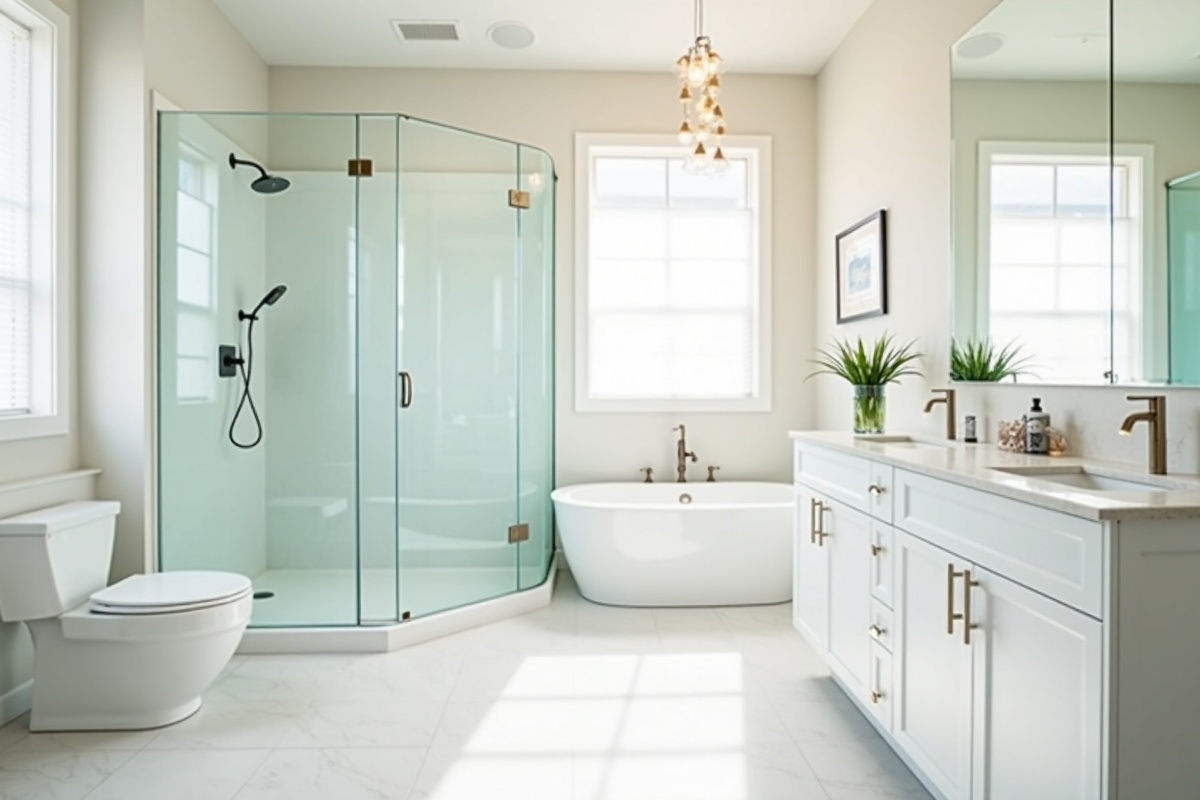
Frameless neo-angle: Five-panel configuration for corner showers. Higher fabrication complexity and cost, but strong visual impact. Common in DFW homes with corner shower layouts.
-
Semi-frameless: Top frame, no side frames. Some buyer credit for the cleaner look vs. full frame. Less impact than full frameless — buyers in the premium market notice the frame.
-
Framed: Minimal value over shower curtain in the eyes of most DFW buyers above entry-level pricing. The ROI is primarily in removing buyer objection to a curtain, not in adding value.
Glass type matters for value perception too. Low-iron (ultra-clear) glass — which eliminates the slight green tint of standard float glass — shows tile work more accurately and reads as more premium. The low-iron upgrade costs 10–20% more and is worth specifying in high-end master bath renovations where tile quality is a feature.
How DFW Real Estate Values Bathroom Upgrades
In the DFW market specifically, bathroom condition is among the most scrutinized elements in the $350,000–$700,000 home segment — where buyers have enough options to be selective and where the price point creates an expectation of move-in-ready master bathrooms. Frameless shower glass at this price point is a baseline expectation, not a luxury feature.
DFW market context for bathroom upgrade ROI:
Price point $250,000–$350,000: Buyers at this price point have lower finish expectations. A quality framed enclosure or even a well-maintained curtain rod may not be a significant buyer objection. Frameless glass adds value but is not universally expected.
Price point $350,000–$500,000: Frameless shower glass is the standard in competing listings. A seller without frameless glass in the master bath faces an objective competitive disadvantage. ROI at this price point is highest because the investment closes a competitive gap.
Price point $500,000+: Frameless glass is baseline. Value-adding upgrades at this price point move to glass type (low-iron, textured, tinted), hardware quality (solid brass PVD, architectural specifications), and configuration (walk-in, steam-ready, wet room). Standard frameless is expected, not differentiating.
DFW communities with highest bathroom upgrade ROI: Southlake, Frisco, McKinney, Westlake, Highland Village, and Flower Mound — communities with buyers actively comparing high-finish resale homes — show the clearest correlation between bathroom glass quality and buyer offer behavior.
What to Invest in Before Selling Your Home
If you're selling a DFW home and the master bathroom has a shower curtain or dated framed enclosure, a frameless glass upgrade is the highest-ROI standalone investment available. For $1,500–$3,500 installed, you eliminate the primary buyer objection about the master bathroom and improve listing photography — two outcomes that directly affect days-on-market and offer price.
Pre-listing bathroom upgrade priority order for DFW homes:
- Replace shower curtain with frameless glass — highest impact per dollar if no glass is currently present
- Replace dated framed enclosure with frameless — strong ROI if the framed hardware shows corrosion or significant scale
- Update hardware finish on existing frameless enclosure — moderate ROI if the glass is in good condition but hardware is dated or corroded
- Deep clean and seal existing glass — if frameless glass is present and in good condition, professional cleaning and glass coating delivers good ROI at low cost
If you're staging a DFW home with an existing framed or dated shower enclosure and can't budget for full replacement before listing, professional glass cleaning and polishing — combined with new towels and accessories — creates a better first impression at minimal cost. But if the enclosure has visible corrosion, mold in the channels, or hardware failures, replacement is a better investment than trying to clean what can't be cleaned back to presentable.
Also see our full shower enclosure ROI breakdown and our guide to whether a frameless shower door is worth it.
Infinity Glass & Glazing installs custom frameless shower enclosures across Corinth, Dallas, Fort Worth, Frisco, McKinney, Southlake, and all DFW communities. Precise in-home measurement and glass ordered to those exact dimensions deliver a custom fit without the rework that stretches lead times. Contact us for a free estimate or call (940) 279-1197.
How much value does a frameless shower door add?
A frameless shower door returns 60–70% of its installation cost in resale value added, according to Angi's 2026 data. On a $2,000 installation, that's approximately $1,200–$1,400 in added home value. Beyond the direct appraisal effect, frameless glass improves buyer perception of the master bathroom, reduces the likelihood of a buyer negotiating down for bathroom condition, and improves listing photography — all of which contribute to a faster sale at a higher price in the DFW market.
Does a glass shower door increase your appraisal value?
Frameless glass shower enclosures can contribute to a higher appraisal when they represent a material upgrade over comparable homes in the area. Appraisers compare subject properties to recent comparable sales — if comps feature frameless glass, the subject property with a shower curtain or framed enclosure may appraise at the lower end of the range. A frameless enclosure brings the property in line with comparable finish quality, supporting a higher appraisal conclusion. The exact contribution depends on the local comparable pool and how the appraiser weighs bathroom finish quality.
Is frameless or framed better for resale value?
Frameless is significantly better for resale value in the DFW market above entry-level pricing. Buyers at the $350,000+ price point have established an expectation for frameless glass in master bathrooms — framed systems read as dated, and buyers calculate replacement cost as a discount from offer price. Below $300,000, the difference is less pronounced, and a quality framed system may not significantly disadvantage a seller. For any home above $350,000 with plans to sell within 5–10 years, frameless glass is the superior investment.
Do real estate agents recommend glass upgrades before listing?
Yes — 24% of Realtors identify bathroom updates as the most impactful pre-listing improvement (NAR 2025). Among bathroom updates, shower enclosure upgrades are among the most commonly recommended because the shower is the primary buyer focus in bathroom evaluation. DFW Realtors working in the $350,000–$600,000 market segment regularly advise sellers to replace framed enclosures or shower curtains with frameless glass before listing — the cost is modest relative to the listing price, and the buyer perception impact is disproportionately positive.
What is the cost vs value added for shower door upgrades?
A frameless shower door installation in DFW costs $1,500–$5,000 depending on configuration, glass type, and hardware selection. At a 60–70% ROI, a $2,500 installation adds approximately $1,500–$1,750 in resale value. The remaining $750–$1,000 is the "enjoyment cost" — the value you receive from using the improved shower during your remaining ownership. For sellers planning to list within 12–18 months, a frameless glass upgrade is one of the few pre-sale improvements where the combination of resale value and reduced days-on-market justifies the investment clearly.