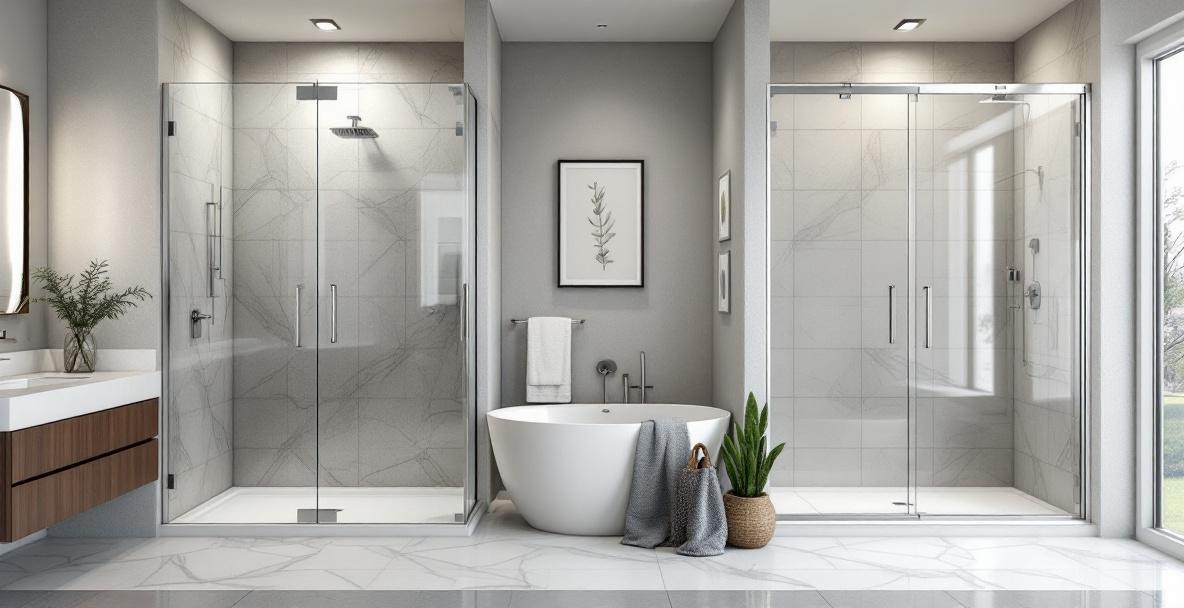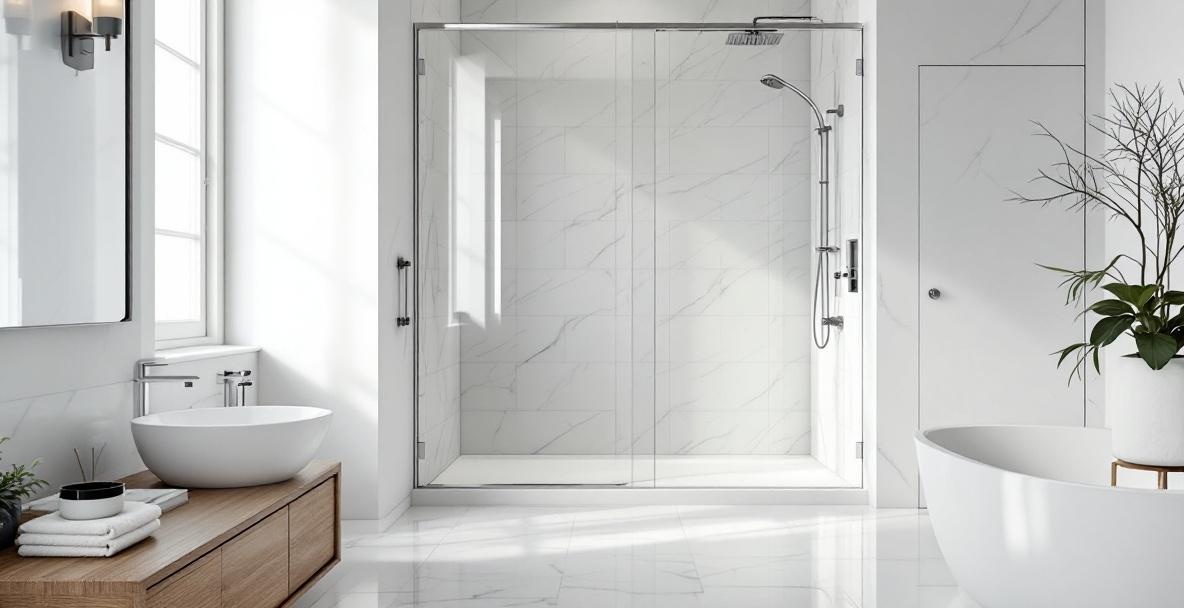
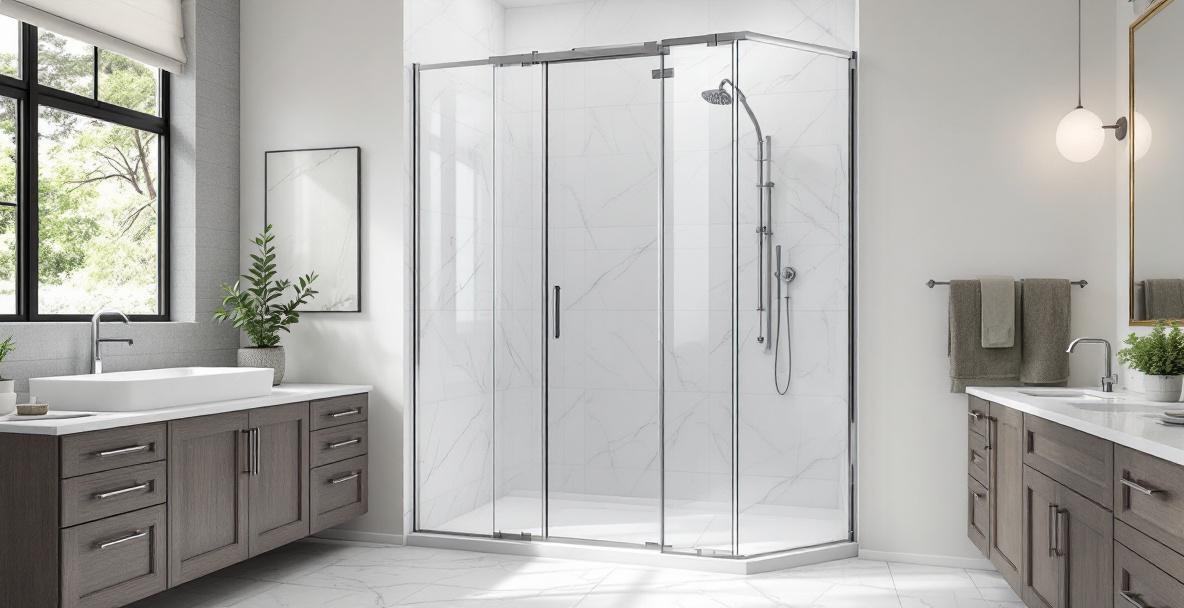
Neo-angle shower enclosures cost $1,200 to $2,000+ installed, according to Horow's 2025 pricing data, making them a mid-range option that maximizes corner space. These three-panel enclosures fit into 90-degree corners and create a diamond-shaped shower that opens into the room at an angle -- a smart solution for bathrooms where space is tight.
Not every bathroom has room for a full rectangular enclosure. If you're working with a corner layout -- especially in a guest bath, secondary bathroom, or older DFW home with compact floor plans -- a neo-angle enclosure turns dead corner space into a functional shower.
This guide covers everything from space requirements and costs to the step-by-step installation process, plus why details like mitered corners and the choice between framed and frameless make a real difference in the final result.
[INTERNAL-LINK: frameless shower doors guide -> /blog/frameless-shower-doors-dallas-tx]
What Is a Neo-Angle Shower Enclosure?
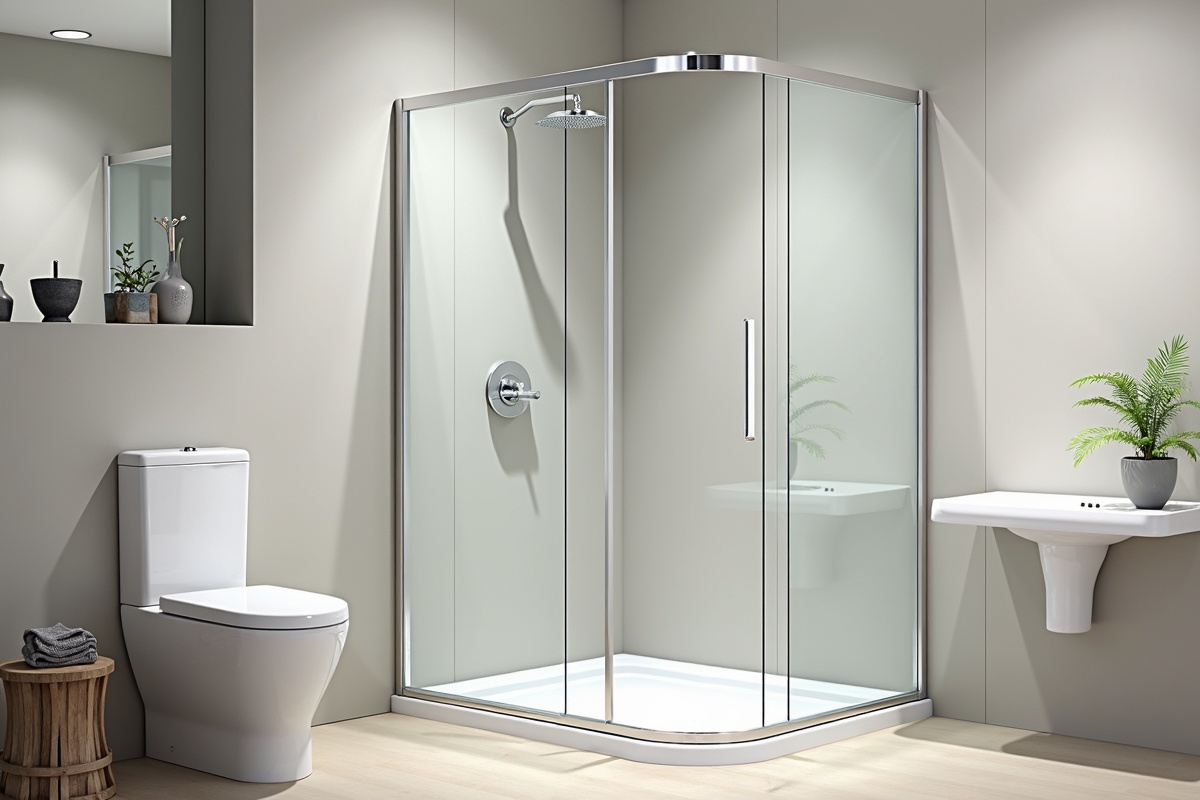
A neo-angle shower enclosure uses three glass panels set at angles across a corner, creating a pentagonal (five-sided) shower space. Two walls of the bathroom form the back, and the three glass panels form the front -- typically with a door in the center panel and fixed panels on each side.
Think of it as cutting the corner off a square. Instead of a curved quadrant or a flat door across the corner, a neo-angle creates angled flat surfaces that open the shower toward the center of the room. The door sits on the front-facing panel, so you step in at an angle rather than straight ahead.
This geometry does two things well. First, it uses corner space that would otherwise be wasted -- the shower footprint stays tight against two walls. Second, the angled entry directs you into the room rather than into a wall, which makes the shower feel more accessible even in small bathrooms.
Neo-angle enclosures have been a staple in bathroom design for decades, but they've seen renewed interest as frameless glass options have become more available. The combination of angled geometry and minimal hardware creates a striking look that works in both traditional and modern bathrooms.
$1,200-$2,000+
installed cost for neo-angle shower enclosures (Horow, 2025)
How Much Does Installation Cost?
Neo-angle shower enclosures cost $1,200 to $2,000+ installed for framed versions and $1,800 to $3,000+ for frameless, according to Horow (2025). The higher cost compared to standard sliding doors reflects the more complex geometry -- three angled panels require more precise measurement and fabrication than a single door.
What drives the price up or down:
- Framed vs. frameless -- Frameless costs 40-60% more because the glass must be thicker (3/8-inch to 1/2-inch) and the angled joints require precision hardware
- Glass thickness -- 1/2-inch glass adds 20-30% over 3/8-inch but provides better rigidity at the angled joints
- Hardware finish -- Chrome is standard. Matte black, brushed nickel, and brushed gold cost $100-$300 more
- Custom vs. standard sizes -- Stock neo-angle kits cost less but only fit specific base dimensions. Custom fabrication fits any corner.
- Corner finishing -- Mitered corners add precision to the angled joints and are worth the investment
Labor for neo-angle installation runs higher than standard doors because aligning three angled panels is more time-intensive. Expect $400-$800 for professional installation in the DFW area.
What Are the Space Requirements?
The minimum base size for a neo-angle shower is 36 by 36 inches, though 38 by 38 inches or larger is more comfortable. The International Residential Code (IRC) requires a minimum finished interior dimension of 30 by 30 inches and a door opening of at least 22 inches for shower enclosures.
Here's what you need to plan for:
Base dimensions:
- 36 by 36 inches -- minimum functional size, feels tight but meets code
- 38 by 38 inches -- the most common size, comfortable for average adults
- 42 by 42 inches -- spacious, allows built-in bench or corner shelf
- 48 by 48 inches -- premium size, feels like a luxury enclosure
Ceiling height: Standard 8-foot ceilings work fine. The enclosure typically stops 6-8 inches below the ceiling to allow steam to escape and simplify installation.
Door clearance: The angled door swings outward into the room. Make sure there's at least 24 inches of clear space in front of the door -- check for toilet clearance, vanity edges, and towel bar placement.
Drain placement: Neo-angle bases typically have a center drain. If you're retrofitting into an existing corner, verify that the drain location works with your plumbing. Moving a shower drain costs $200-$500 and requires access beneath the floor.
How Are They Installed Step by Step?
Neo-angle installation takes 3 to 5 hours on-site for most enclosures, but the full process from first measurement to finished shower spans 3 to 4 weeks due to the custom fabrication required for angled glass panels.
- 1
Template and Measure
A technician visits your home and creates precise measurements of the corner space. Neo-angle enclosures are especially sensitive to out-of-square corners -- the two walls rarely meet at exactly 90 degrees, so every angle is measured independently. Some installers create a cardboard or foam template of the base footprint. - 2
Select Configuration
You choose between framed and frameless, pick glass type and thickness, select hardware finish, and confirm door swing direction. The installer calculates panel sizes based on the base dimensions and the desired entry angle (most neo-angles use equal 135-degree angles on the side panels). - 3
Custom Fabrication
Each of the three panels is cut to exact dimensions, edges are polished or mitered, holes are drilled for hinges and hardware, and the glass is tempered. Because all three panels must fit together at precise angles, fabrication tolerances are tighter than a standard door. This step takes 2 to 3 weeks. - 4
Install the Shower Base
If a new base is needed, it's set and leveled first. Neo-angle bases are either acrylic (pre-formed) or tile-ready (custom-built with a mortar bed and waterproof membrane). The base must be perfectly level for the glass to sit correctly. - 5
Mount Hardware and Set Glass
Wall channels or clamps are secured to studs in both walls. The two fixed side panels are set first, then the door panel is mounted with hinges. Each panel is checked for plumb and alignment. All joints are sealed with silicone, and door operation is tested. - 6
Final Inspection and Cure
The installer checks door swing, water drainage, seal integrity, and overall alignment. Silicone needs 24 hours to fully cure before the shower can be used.
Why Are Mitered Corners Essential for Neo-Angle?
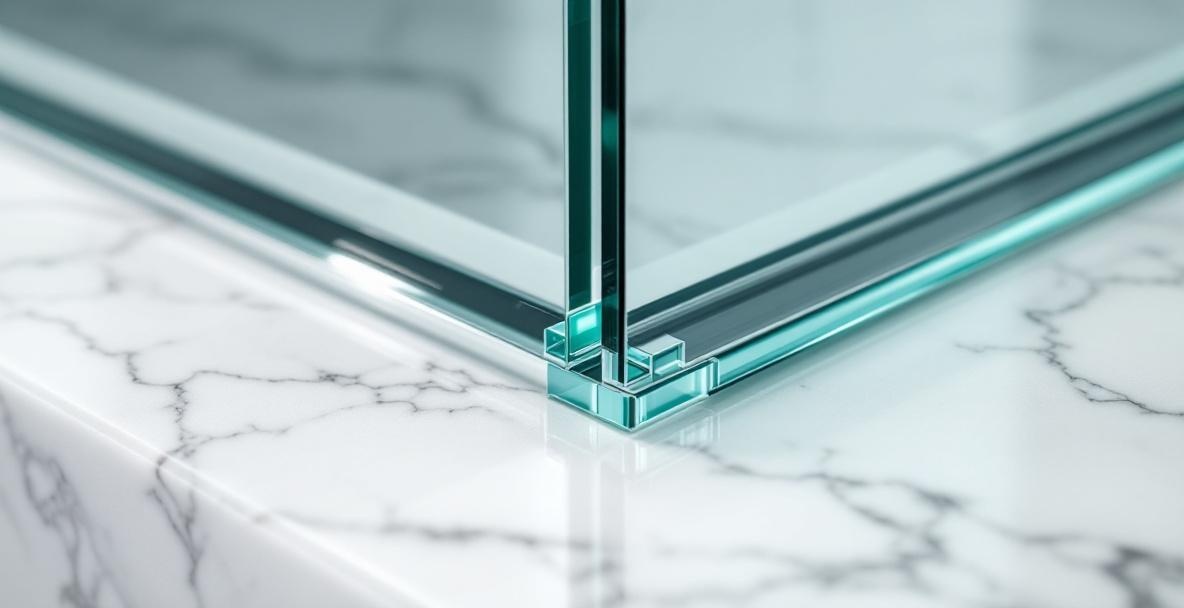
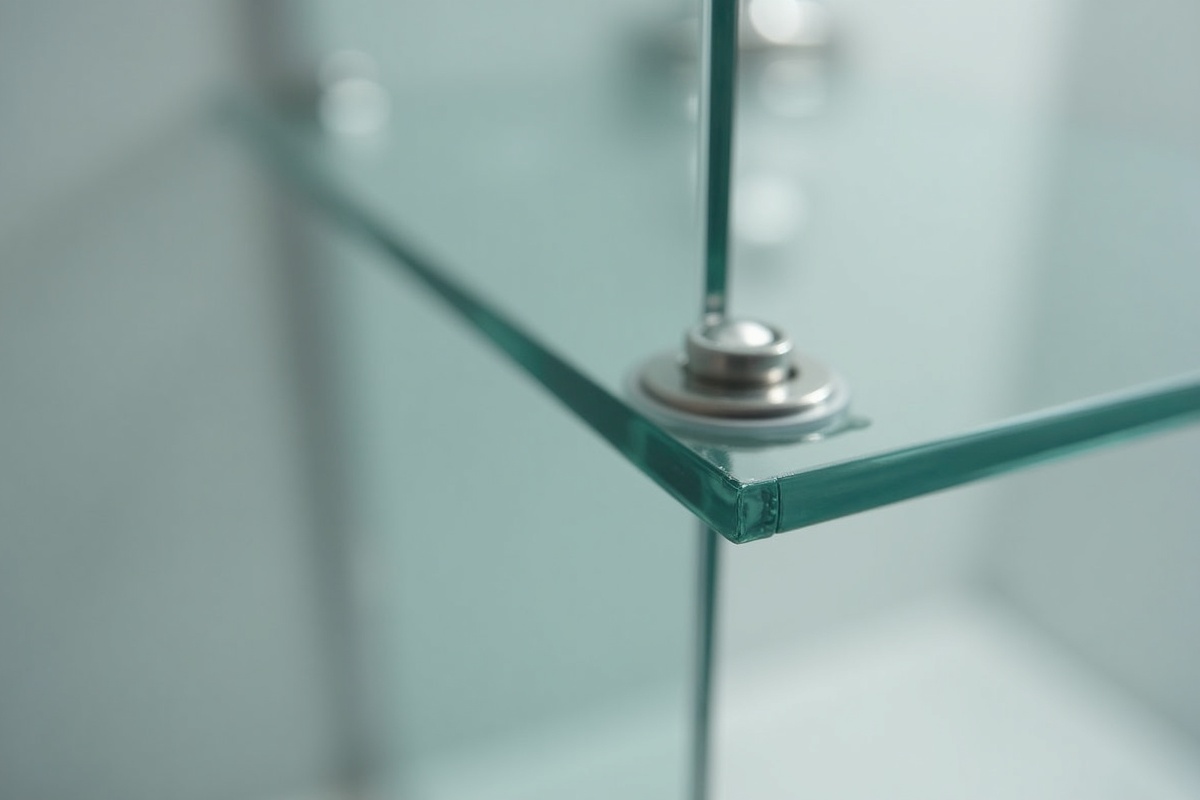
Mitered corners are more important on neo-angle enclosures than any other shower type because the angled joints are fully visible from multiple angles. A butt joint with silicone filling the gap between panels looks acceptable on a straight 90-degree corner -- on an angled neo-angle joint, it looks unfinished.
Neo-angle enclosures have two critical joints where the fixed side panels meet the center door panel. These joints sit at 135-degree angles (or similar), and because the enclosure projects into the room, both joints are visible from the bathroom's main sightlines.
With mitered edges, each panel's edge is cut at a precise angle so they mate flush. The result is a clean line of glass meeting glass -- no gap, minimal silicone, and a far more refined appearance. The structural benefit matters here too: mitered surfaces create a larger contact area at the joint, adding rigidity to the three-panel assembly.
Most glass shops don't miter neo-angle corners because the angles aren't a simple 45-degree cut. They're calculated based on the specific enclosure geometry, which means the CNC edging equipment must be set to a custom angle for each job. It takes experience and precision equipment.
At Infinity Glass & Glazing, we fabricate mitered corners in-house for every neo-angle enclosure. It's one of the details that makes our work distinct. See examples of our enclosures.
Frameless vs. Framed Neo-Angle: Which Is Better?
Frameless neo-angle enclosures look dramatically better because the angled geometry is meant to be showcased, not hidden behind aluminum framing. However, framed versions cost 30-40% less and may be the practical choice for budget-focused projects. According to Accio (2025), 78% of homeowners now prefer frameless over framed in all shower configurations.
Here's how they compare:
| Installed Cost |
| Glass Thickness |
| Appearance |
| Maintenance |
| Lifespan |
| Mitered Corners |
Choose frameless when:
- The neo-angle is in a primary bathroom where appearance matters most
- You want to see the tile work through the glass without visual interruption
- Long-term durability is a priority
- You're already investing in a quality bathroom remodel
Choose framed when:
- Budget is the main driver
- The shower is in a secondary or guest bathroom
- You prefer a more traditional look
- The enclosure is a temporary solution before a future remodel
One important note: framed neo-angle enclosures use aluminum tracks that follow the angled geometry. Over time, water sits in these tracks and causes corrosion -- a problem that's more pronounced on angled surfaces because water doesn't drain out of the track as easily as it does on horizontal tracks.
[INTERNAL-LINK: shower door costs -> /blog/shower-door-cost-dallas-tx]
Considering a neo-angle enclosure for your bathroom? Infinity Glass & Glazing serves Corinth, Fort Worth, Dallas, Denton, Lewisville, Flower Mound, Keller, Southlake, and the entire DFW metroplex. Request a free in-home estimate or call (940) 279-1197.
What size bathroom do you need for a neo-angle shower?
A neo-angle enclosure fits in bathrooms with a corner space as small as 36 by 36 inches. The total bathroom can be quite compact since the shower tucks into the corner. You need at least 24 inches of clear space in front of the door for safe entry and exit, per the IRC minimum clearance requirements.
Can a neo-angle shower enclosure be frameless?
Yes. Frameless neo-angle enclosures use 3/8-inch or 1/2-inch tempered glass that supports itself without a metal frame. They cost more than framed versions ($1,800-$3,000+ vs. $1,200-$2,000) but look significantly better and last longer. The angled geometry of a neo-angle is particularly well-suited to frameless because it showcases the glass.
How long does neo-angle shower installation take?
On-site installation takes 3 to 5 hours. The full process from measurement through custom fabrication to installation spans 3 to 4 weeks. Neo-angle enclosures take longer to fabricate than standard doors because three angled panels must be cut to precise specifications.
Are neo-angle showers more expensive than standard enclosures?
Yes, typically 20-40% more than a comparable standard shower door. A framed neo-angle runs $1,200 to $2,000+ installed, while a standard framed sliding door costs $500 to $1,200. The premium reflects the more complex geometry, additional glass panels, and tighter fabrication tolerances.
Related reading: