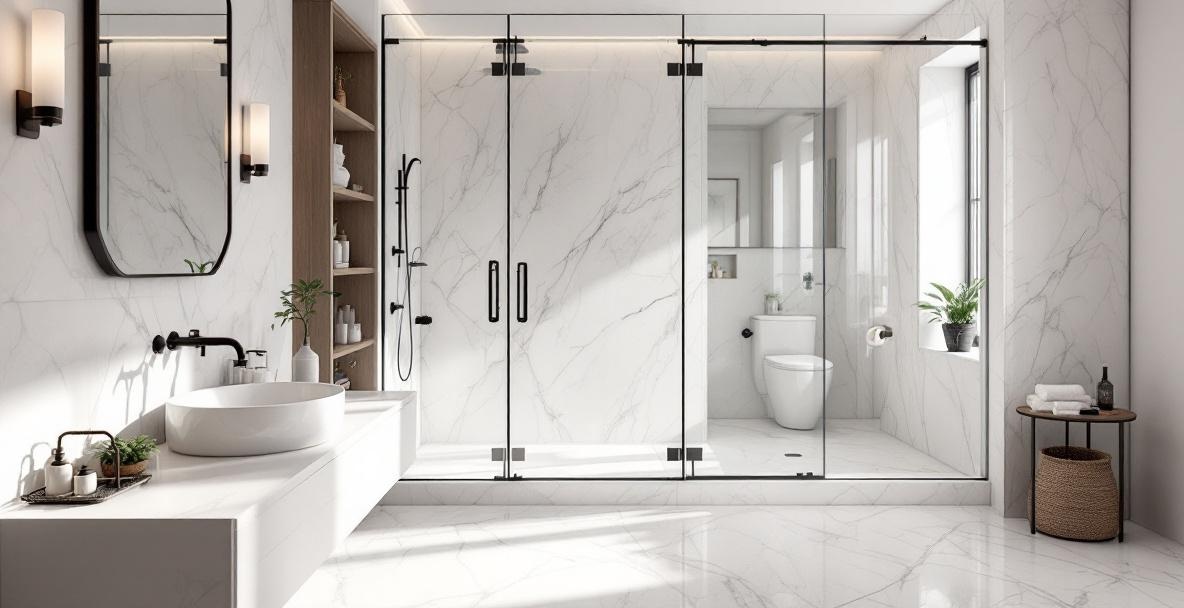
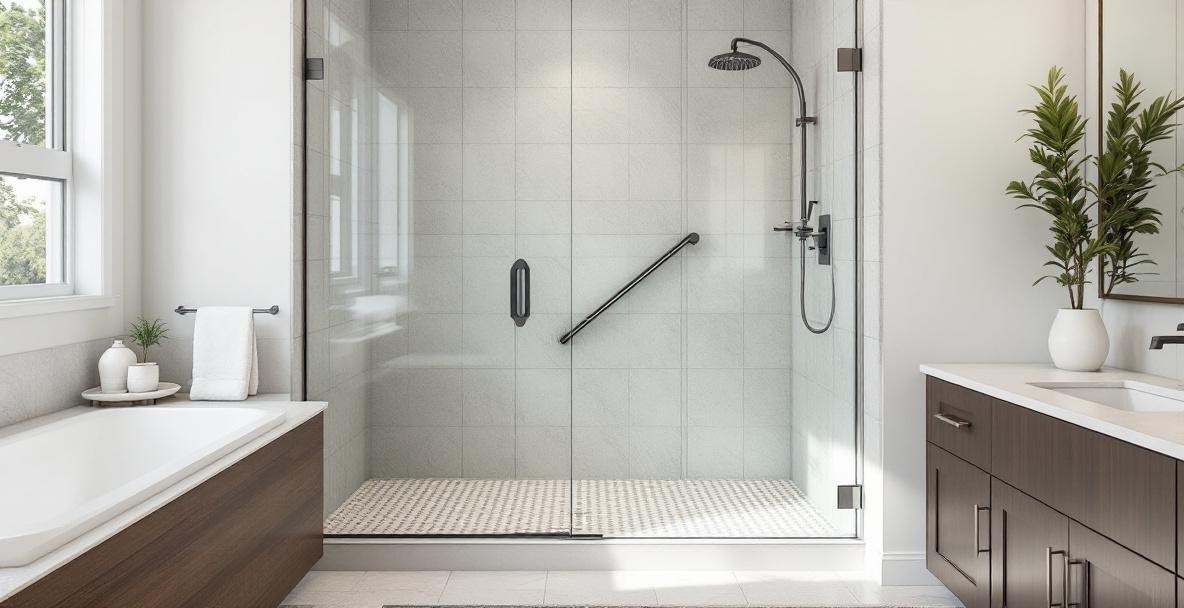
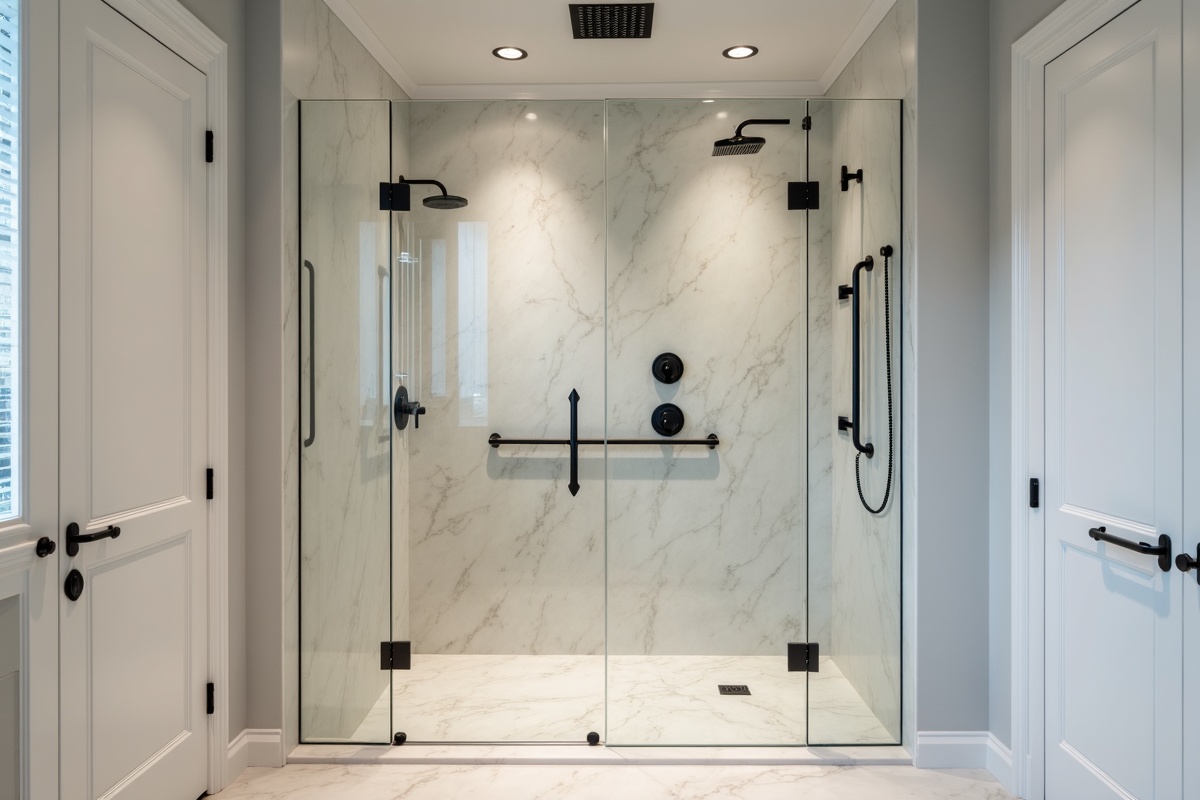
Universal design shower enclosures are built to serve every user — at any age, ability level, or stage of life — without requiring modification or special accommodation. The design criteria are specific: a zero-threshold curbless entry, a shower interior sized for wheelchair access or caregiver assistance, outward-opening or walk-in glass configurations, and structural integration of safety features that do not look institutional. Done correctly, a universal design enclosure looks identical to a luxury frameless shower.
Universal design is not about designing for disability — it is about designing for human reality. People experience temporary injuries. They recover from surgeries. They age. They live with family members across a wide range of mobility levels. According to the NKBA 2026 Design Trends Report, 72% of design professionals report that homeowners are expanding primary bathrooms specifically for wellness and universal design purposes (NKBA 2026). In DFW, where new-construction homes in McKinney, Prosper, and Frisco are being built for long-term ownership, universal design shower enclosures are increasingly specified from the beginning — not retrofitted later.
What Is Universal Design?
Universal design is a design philosophy, not a regulatory standard. It means creating spaces, products, and environments that are usable by all people to the greatest extent possible, without the need for adaptation or specialized design. The concept was formalized by architect Ronald Mace at NC State University and is governed by seven principles: equitable use, flexibility in use, simple and intuitive use, perceptible information, tolerance for error, low physical effort, and size and space for approach and use.
In the shower context, universal design means: no threshold to step over, enough interior space to turn a mobility aid, a door configuration that does not require precise timing or strength to operate, grab support available where needed, and visual clarity for the occupant — all delivered in materials and finishes that are indistinguishable from standard luxury bathroom design.
Universal design differs from ADA compliance in one critical way: ADA compliance is a legal standard for public buildings and commercial spaces. Universal design is a voluntary design goal for residential spaces. A universally designed home bathroom may meet or exceed ADA standards, but it is designed around livability rather than legal minimum thresholds.
72%
of design professionals report homeowners are expanding bathrooms specifically for wellness and universal design (NKBA 2026)
What Do ADA Standards Require for Showers?
While residential bathrooms are not legally required to meet ADA standards, the ADA specifications provide the best-available evidence-based measurements for accessible shower design. Designers and contractors commonly use them as a starting point for universal design work.
The US Access Board specifies two primary shower configurations under ADA guidelines (US Access Board):
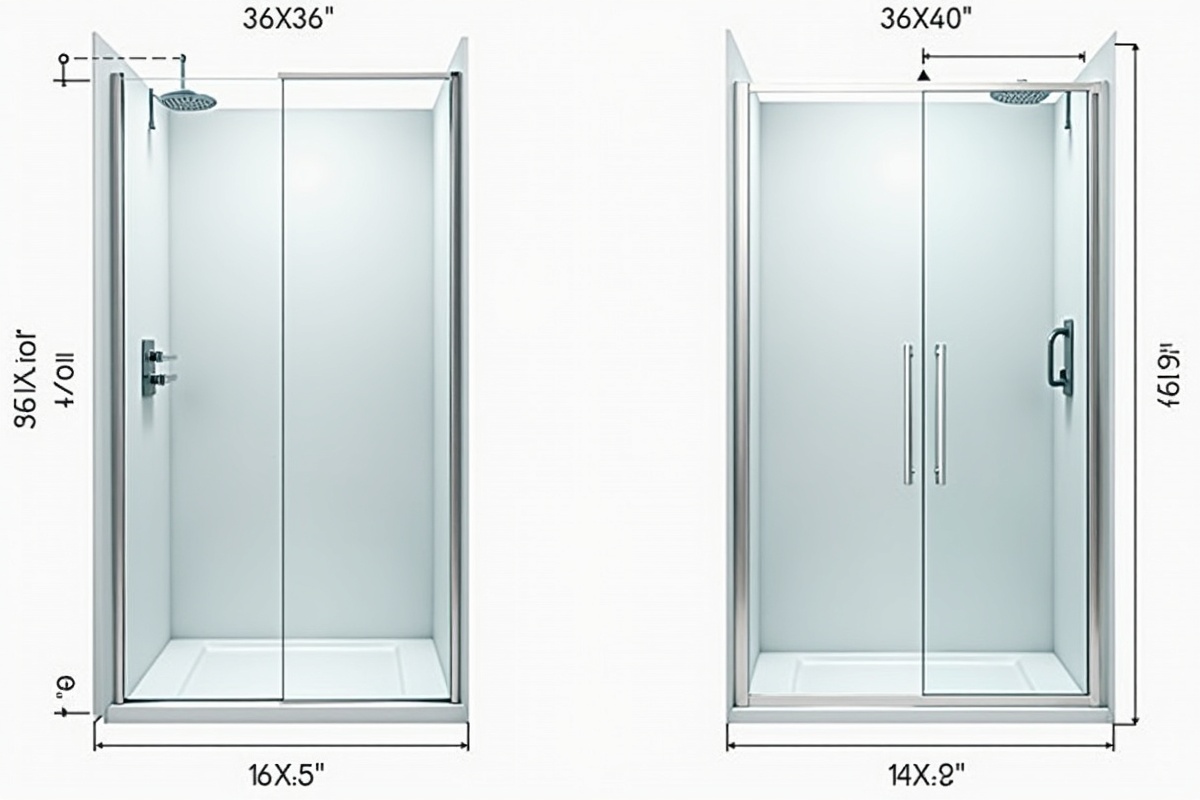
Transfer shower: 36 in. x 36 in. minimum interior dimensions. Designed for users who transfer from a wheelchair to a fixed shower seat. Requires a 36 in. wide entry, a seat on the side wall, and grab bars on three walls.
Roll-in shower: 30 in. x 60 in. minimum interior dimensions (standard) or 36 in. x 36 in. with an adjacent 36 in. turning space (alternate). Designed for wheelchair users who remain in their chair or use a shower wheelchair. Requires a continuous threshold-free entry, no obstructions in the 36 in. entry path, and grab bars on three walls.
For residential universal design, most designers target dimensions at or above these minimums — often a 36 in. x 48 in. or 36 in. x 60 in. interior for flexibility, or a 60 in. x 36 in. walk-in configuration that accommodates both assisted and independent use.
What Are Zero-Threshold Glass Enclosures?
Zero-threshold glass enclosures — also called curbless or barrier-free enclosures — are the defining characteristic of a universally designed shower. The floor surface is continuous from the bathroom into the shower, with no raised curb, lip, or step to navigate.
From a glass design standpoint, zero-threshold enclosures work with frameless glass in several configurations:
Walk-in with fixed panels (no door): The most accessible and most visually clean option. One or two fixed glass panels create a partial enclosure with a walk-in entry gap at least 36 in. wide. No door mechanism, no threshold, no obstacle. The shower floor drains toward a linear drain positioned at the entry wall or rear wall, keeping water contained without a curb.
Pivot door, outward-opening: A full-enclosure option with a pivot door that swings outward (away from the shower interior). No threshold at the door base — a specialized sweep seal contains water at floor level. The door opens to a full 90 or 180 degrees (with swing-clear hinges), providing adequate clear width for mobility aid use.
Bypass sliding door (frameless): A sliding door bypasses the need for swing clearance, which is useful in bathrooms where outward door swing is obstructed by a toilet or vanity. Top-hung frameless sliders eliminate the bottom track, reducing the threshold to a minimal guide strip rather than a full curb.
What Glass Door Types Work Best for Universal Design?
| Walk-in (no door) |
| Outward-swing pivot |
| Swing-clear pivot (180 deg) |
| Top-hung bypass slider |
| Bi-fold (space saver) |
| Inward-swing pivot |
The inward-opening pivot door is the one universal design exclusion: if a user falls inside the shower and lands against the door, an inward-opening door becomes impossible to open from outside. This is a critical safety failure for an otherwise-accessible enclosure. Always specify outward-opening or sliding configurations for universal design applications.
How Do You Make Universal Design Look High-End?
The most common design objection to universal design bathrooms is the assumption that accessibility features compromise aesthetics. This was historically true — institutional grab bars in chrome, pre-formed acrylic surrounds, and utilitarian shower chairs were the standard vocabulary. None of that applies to glass-based universal design.
Elements that maintain luxury aesthetics:
Frameless glass panels in floor-to-ceiling format: Extending the glass panels from floor to ceiling eliminates the visual gap between the top of the panel and the ceiling — the most common detail that makes a shower feel like a boxed-in enclosure rather than an architectural statement. Floor-to-ceiling frameless glass reads as spa-quality regardless of accessibility configuration.
Grab bars in designer finishes: Matte black, brushed brass, and brushed nickel grab bars are available in the same finishing specifications as shower door hardware. A matte black grab bar integrated into a matte black frameless enclosure is visually intentional rather than retrofitted.
Integrated tile bench: A shower bench built from the same tile as the shower walls and floor reads as an architectural feature rather than a medical device. Sized at 17–19 in. height (ADA transfer height standard) and extending the full width of one shower wall, it functions as a seating option, a shaving bench, and an accessibility feature simultaneously.
Linear drain with matching tile insert: A linear drain inset with the same tile as the shower floor is nearly invisible. It enables the curbless floor slope without the visual break of a visible drain grate.
What Does a Universal Design Enclosure Cost in DFW?
Universal design glass enclosures cost more than standard frameless installations due to larger panel dimensions, thicker glass specifications for grab bar integration, and the additional engineering involved in curbless floor systems. However, they compare favorably to retrofitting a standard bathroom later — particularly given the cost of through-glass grab bar prep, which requires pre-tempering drilling that cannot be done after installation.
- 1
Plan Before You Build
Universal design features cost significantly less when planned into an original renovation than when retrofitted. Through-glass grab bar holes must be drilled before tempering. Curbless floor systems require waterproofing planned from the substrate up. Build it right the first time. - 2
Size Up the Shower Footprint
Target a minimum of 36 in. x 48 in. interior (preferably 36 in. x 60 in. or larger) to meet ADA-influenced universal design standards. If the current shower footprint is smaller, this may require borrowing space from an adjacent closet or reconfiguring the bathroom layout. - 3
Specify the Right Glass Thickness
Use 1/2 in. tempered glass for any panel that will anchor grab bars. Use 3/8 in. for panels without structural attachment points. Work with your glass installer to map the grab bar locations before the glass is tempered. - 4
Choose an Outward-Opening or Walk-In Configuration
Confirm the door configuration before finalizing the layout. Outward-opening pivot doors require clear floor space outside the enclosure equal to the door's swing arc. Walk-in configurations require adequate floor slope to contain water without a door. - 5
Integrate Safety Features at Rough-In
Install blocking for future grab bars in shower walls at the rough framing stage, even if you are not installing grab bars today. This allows surface-mounted wall grab bars to be added at any time without opening the wall. - 6
Select a Matching Hardware Finish
Choose shower enclosure hardware in the same finish as your planned grab bars. Order both from the same supplier if possible to ensure finish consistency. Matte black and brushed nickel are the most widely available in both categories.
Typical DFW cost ranges for universal design glass enclosures:
A standard frameless enclosure (no universal design features) runs $1,100–$2,500 installed in DFW. A full universal design glass enclosure — curbless entry, walk-in or outward-swing pivot, 1/2 in. glass with through-grab-bar prep, 36 in. x 48 in. or larger — runs $2,500–$6,000 for the glass and installation. The curbless floor conversion (tile, waterproofing, linear drain) is a separate scope typically adding $2,000–$4,500 depending on shower size.
The investment compounds positively: assisted living costs exceeding $54,000 per year make even a $10,000 bathroom renovation a rapid payback when it extends independent living by several years (ConsumerAffairs 2025).
Why Are DFW Homeowners Choosing Universal Design Now?
The DFW Metroplex has one of the fastest-growing populations of homeowners in the 50–70 age range in the country, driven by sustained in-migration from higher-cost metros. Many of these homeowners are purchasing in communities like Frisco, Prosper, Celina, and McKinney with the explicit intention of long-term ownership — and they are designing homes accordingly.
Universal design shower enclosures are also gaining traction among DFW homeowners who are not yet thinking about their own aging but are planning homes that accommodate aging parents, visiting family members with mobility limitations, or their own recovery from surgery or injury. The flexibility of universal design — it works for everyone, not just those with permanent limitations — makes it a genuine quality-of-life improvement rather than a contingency plan.
What is the difference between universal design and ADA compliance?
ADA compliance is a federal legal standard that applies to commercial buildings and public accommodations. It sets specific minimum dimensions, clearances, and hardware specifications for accessible facilities. Universal design is a voluntary design philosophy for residential spaces that uses those same principles as a guide — but focuses on livability and flexibility for all users rather than legal minimum thresholds. A universally designed home bathroom often meets or exceeds ADA standards, but its goal is comfort and adaptability, not code compliance.
What size shower is needed for wheelchair access?
The US Access Board specifies 36 in. x 36 in. minimum for a transfer shower (wheelchair user transfers to a fixed bench) and 30 in. x 60 in. minimum for a roll-in shower (user remains in a shower wheelchair). For residential universal design, most designers target 36 in. x 48 in. minimum, with 36 in. x 60 in. preferred for comfortable wheelchair turning and caregiver assistance room.
Can a universal design shower still look luxurious?
Absolutely. The design vocabulary of universal design — curbless entry, frameless glass, integrated bench, linear drain — overlaps almost entirely with the vocabulary of high-end luxury shower design. A universally designed shower built with floor-to-ceiling frameless glass, matte black hardware, and a linear drain insert is indistinguishable from a luxury-only shower to most observers. The accessibility features are structural, not visual.
Does universal design reduce resale value?
No — and in many DFW markets it improves marketability. Universal design features appeal to a broad buyer pool: families with young children (curbless is safer for toddlers too), buyers with temporary injuries, buyers anticipating aging parents moving in, and buyers planning for their own long-term use. Zillow research consistently shows that accessible bathroom features correlate with faster sale times and broader offer pools, particularly in markets with significant 55+ buyer activity.
What is the best door style for a universal design shower?
A walk-in configuration with no door is the highest-accessibility option — there is nothing to open, no threshold to clear, and no door that can block access if a fall occurs. For homeowners who want a full enclosure, an outward-swinging pivot door with swing-clear hinges (180-degree opening) is the best choice: it opens completely out of the entry path and does not obstruct rescue access if the occupant falls against it. Inward-opening doors are incompatible with universal design.
Also see our full guide to aging-in-place bathroom glass solutions and our overview of custom shower enclosures in DFW.
Infinity Glass & Glazing designs and installs universal design shower enclosures across the DFW Metroplex — from Corinth and Lewisville to Frisco, McKinney, and Southlake. Custom frameless glass, curbless entry systems, through-glass grab bar prep, and accessible door configurations, all built to look as good as they function. Contact us for a free estimate.
Related reading: