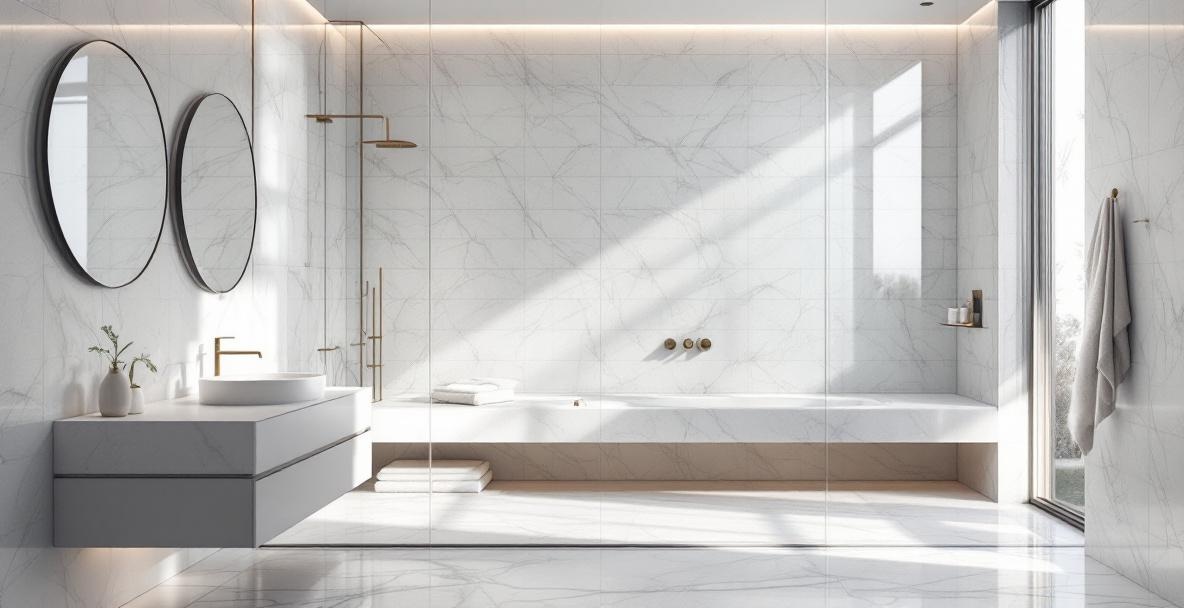
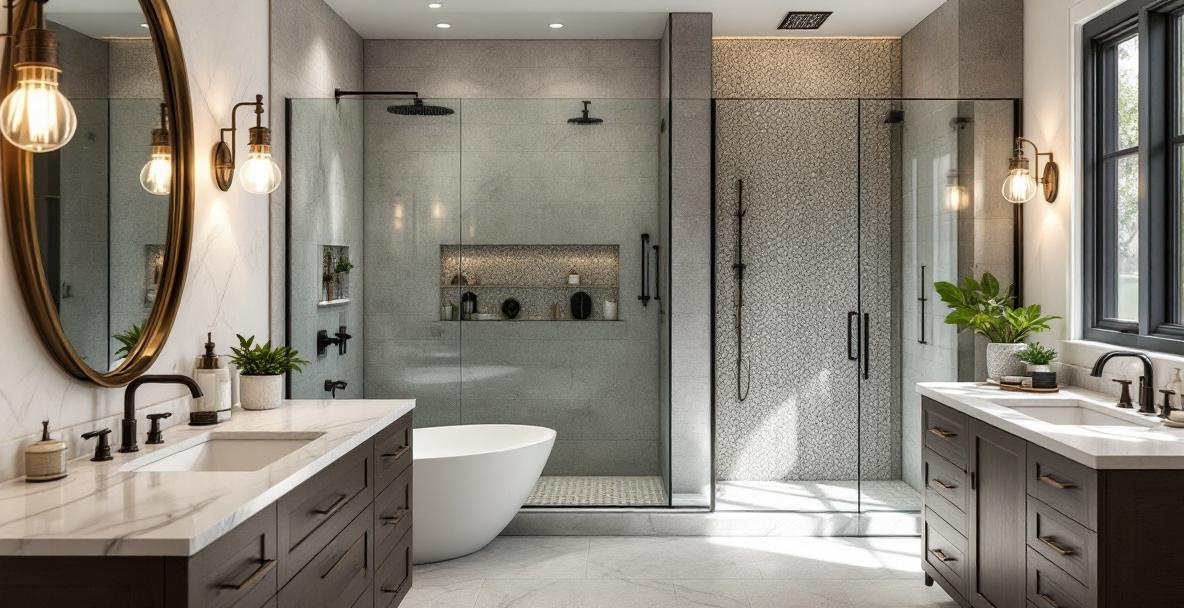
The biggest bathroom design trends for 2026 are: spa-inspired walk-in showers replacing bathtubs as the primary focal point, warm metal finishes (brushed brass, unlacquered bronze) overtaking cool chrome across the DFW market, larger bathroom footprints driven by primary suite expansion, nature-forward color palettes replacing the all-white bathroom, and smart glass beginning to appear in luxury DFW new construction. DFW is ranked the #1 real estate market to watch in 2026, making these trends especially relevant to North Texas homeowners.
Bathroom design in DFW has shifted decisively. The all-white, chrome-and-subway-tile bathroom that defined the 2015–2020 new construction era is giving way to something warmer, more personal, and considerably more spa-like. What's driving the change: DFW buyers in the $500K–$1.2M range — the market's dominant segment — expect a primary bathroom that functions and photographs like a resort.
This guide covers every major 2026 bathroom design trend relevant to North Texas homeowners, with specific guidance on glass, hardware, and materials from the team at Infinity Glass & Glazing in Corinth.
The Biggest Bathroom Design Trends for 2026
Six trends define the 2026 DFW bathroom: primary bathroom expansion (more square footage allocated to bath than ever before), spa-shower dominance (bathtub removed or relegated to a secondary role), warm color palettes replacing cool neutrals, textured surfaces across tile and glass, warm metal hardware specification, and smart technology beginning to integrate into glass and fixtures. These trends reinforce each other — they're not isolated; they form a coherent design direction.
89%
of design professionals say primary bathroom space allocation is the top priority in new residential projects — more square footage going to the bath than any previous cycle (NKBA, 2026)
1. Primary bathroom expansion: The single biggest structural shift in 2026 bathroom design is square footage. Design professionals report that clients are requesting more space for the primary bathroom than in any previous building cycle. In Frisco, McKinney, and Southlake new construction, primary suites now routinely allocate 150–250 sq ft to the bathroom alone. The driver: a pandemic-era shift in how homeowners relate to the bathroom — less utility room, more daily retreat.
2. Shower replaces bathtub as the centerpiece: The freestanding soaking tub, the aspirational symbol of master bath luxury through the 2010s, is losing ground to a much larger, more elaborate walk-in shower. In DFW, the National Kitchen and Bath Association's 2026 survey found 55% of homeowners now prioritize shower size over keeping a bathtub (NKBA 2026). What homeowners want instead: a walk-in shower large enough to feel like a private room, with rainfall ceiling head, multiple body sprays, steam option, and a full glass enclosure.
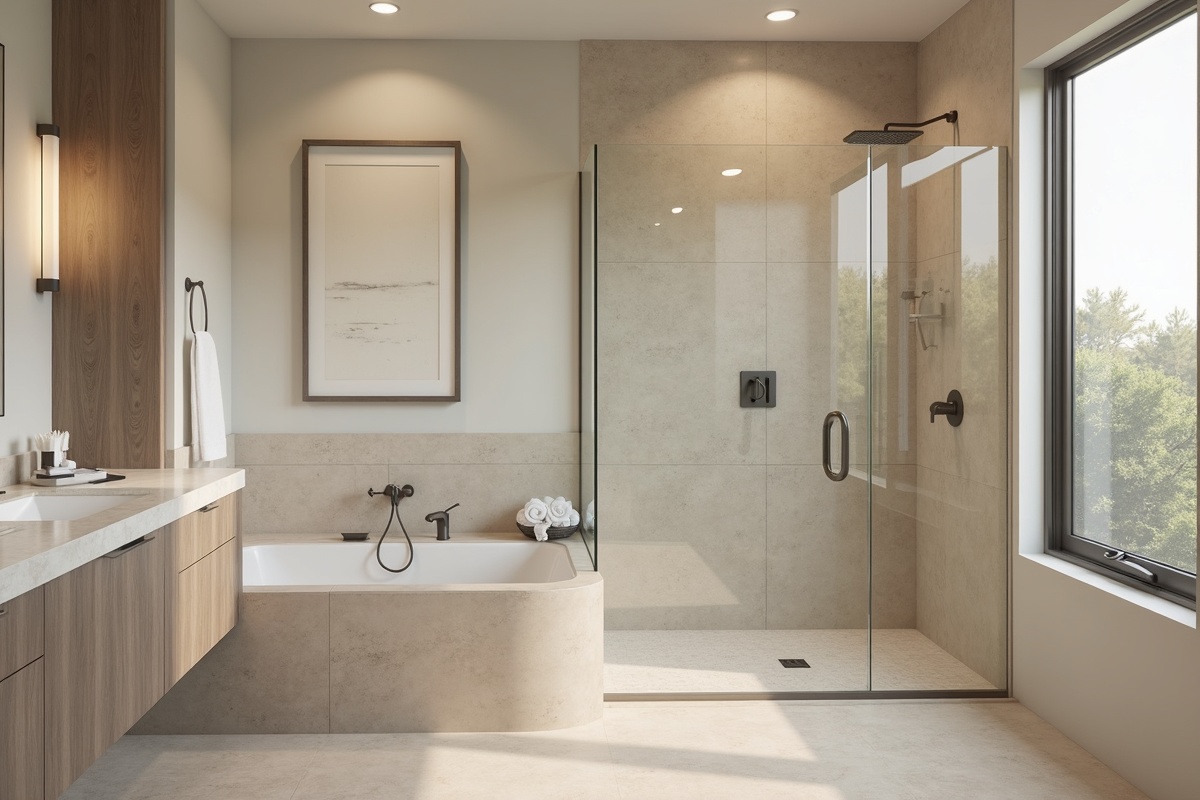
3. Warm color palettes replacing cool neutrals: The all-white bathroom is not disappearing — it's warming up. Creamy ivories, warm greiges, sandy taupes, and earthy terracottas are replacing cool grays and bright whites. In DFW, the specific palette shift is from cool gray + white marble (2018–2022) to warm beige + travertine-look tile (2024–2026). Hardware follows suit: warm brass and bronze over cool chrome and satin nickel.
4. Textured surfaces everywhere: Flat, smooth surfaces are giving way to texture across both tile and glass. Fluted limestone, ribbed porcelain, rough plaster walls, microcement floors, reeded glass shower panels — tactile materials that the smooth-is-best aesthetic of the previous decade had eliminated. In glass, this means fluted and reeded panels appearing in shower enclosures, cabinet inserts, and mirror surrounds.
5. Warm metal hardware across every fixture: Brushed brass, satin brass, unlacquered bronze, and warm gold are replacing the chrome-and-satin-nickel pairing that defined transitional DFW bathrooms for a decade. The shift is not just in shower door hardware — it extends to every visible metal surface: faucets, towel bars, lighting trim, mirror frames, cabinet pulls.
6. Smart technology integration beginning: Smart glass (switchable PDLC technology) and smart shower systems with app and voice control are appearing in luxury DFW new construction. Adoption is early-stage but accelerating — NKBA 2026 data shows 51% of bathroom designers expect significant smart technology integration growth in the next three years (NKBA 2026).
Why DFW Homeowners Are Choosing Larger Walk-In Showers
The walk-in shower has replaced the bathtub as the signature element in DFW primary bathrooms because of three converging factors: the pandemic-era shift toward home-as-retreat, DFW's large primary suite footprints (which make ambitious shower designs possible), and real estate data showing that oversized showers generate stronger buyer response than freestanding tubs in the $600K–$1.2M DFW market.
The math on bathtub use tells the story plainly: surveys consistently find that most bathtubs in primary bathrooms are used fewer than once per week, while the shower is used daily. In the calculus of 150 square feet of primary bath space, allocating 50 sq ft to an underused bathtub vs. 50 sq ft of additional walk-in shower makes clear ROI sense.
What DFW homeowners are building instead of the freestanding tub:
Oversized walk-in showers (60" x 60" or larger): The baseline "large" shower is now 60x60 inches — once considered luxurious, now the starting point for primary bathroom specifications in DFW new builds above $600K. Premium specifications run 72x72 or 84x84 with bench seating, recessed niches, and multiple shower heads.
Wet room designs: A dedicated wet room — the entire shower zone contained behind floor-to-ceiling glass, no curb, with both a rainfall shower head and a freestanding soaking tub inside the glass enclosure — is the premium DFW bathroom statement for 2026. The wet room preserves the bathtub option for those who want it while creating a dramatically more impressive glass enclosure. For the simpler open-entry version of this idea, walk-in shower glass panels deliver the doorless layout at a fraction of the wet-room cost.
Steam shower rooms: Steam generators are appearing in more DFW primary bathroom specs. A steam-capable frameless shower requires sealed glass from floor to ceiling (no open tops) and specific hardware tolerances. Infinity Glass specifies and installs steam-rated frameless glass enclosures across DFW — our steam shower enclosures page covers the transom, the sealing detail, and where the glass scope stops and the generator trade begins.
Glass and Hardware Finishes That Are Trending Right Now
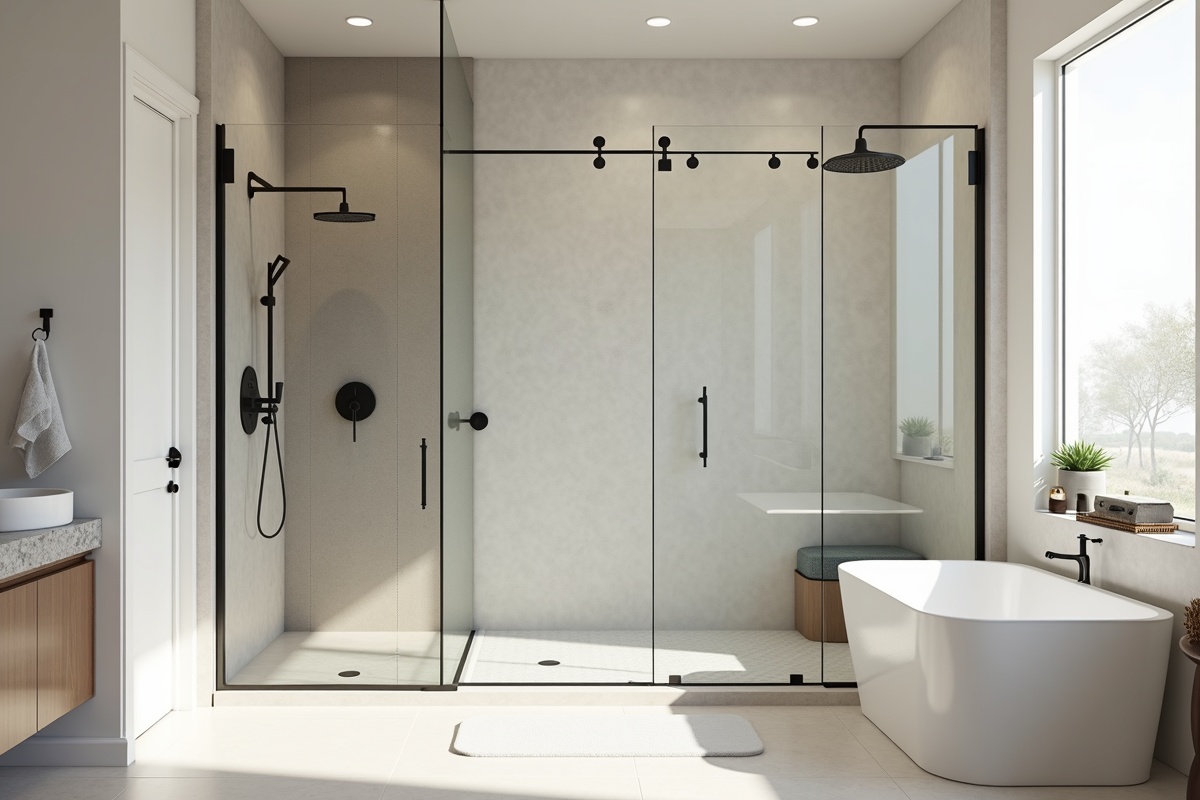
Glass and hardware specifications in 2026 DFW bathrooms are moving decisively toward warm metals and textured glass — brushed brass, unlacquered bronze, and warm gold replacing chrome; fluted and reeded glass panels appearing alongside clear frameless glass in the same enclosure systems.
What's trending in shower glass:
Clear frameless (still dominant): Clear 3/8" or 1/2" tempered glass in a fully frameless configuration remains the top shower enclosure specification in DFW. It hasn't changed — the dominance has only grown as it moves from a luxury upgrade to the baseline expectation at any price above entry-level.
Textured glass panels (growing fastest): Fluted and reeded glass is the fastest-growing glass specification in DFW residential bathrooms. Typically used as a single panel within a primarily clear frameless system — the shower wall facing the toilet or bedroom area uses fluted glass for privacy, while the remaining panels stay clear. The result is a frameless enclosure with a dramatic visual accent.
Low-iron (Starphire/Ultra-Clear) glass: Standard clear glass has a slight green tint, visible at the edges and in thick glass. Low-iron glass is optically colorless — edges appear silver-white rather than green. For shower enclosures with 1/2" glass, low-iron is a meaningful visual upgrade. Growing in DFW as buyers become educated on the option.
Hardware finishes trending in DFW for 2026:
- Brushed brass / satin brass: The warm-toned alternative to matte black. Pairs with Calacatta, cream, and warm beige tile palettes. The fastest-growing finish in DFW master bath specifications.
- Matte black (still strong): Remains the top single finish choice, with strong visual impact against light tile. Showing early signs of saturation at the highest design-forward DFW zip codes.
- Unlacquered brass / warm gold: The most artisanal choice — ages and develops patina over time. Specific to luxury new construction and high-end renovation. Growing but not yet mainstream.
- Brushed nickel (steady): The enduring transitional neutral. Still widely specified, but no longer the prestige choice in primary bath new construction.
75%
of design professionals confirm warm tones are replacing cool neutrals as the dominant bathroom palette in 2026 (Fixr, 2026)
Smart Technology Entering the Bathroom
Smart bathroom technology in 2026 falls into two categories: established smart fixtures (digital shower systems with app and voice control, smart mirrors with integrated lighting and display) and emerging glass technology (switchable PDLC glass for privacy on demand). DFW luxury new construction is leading adoption, with wider market penetration expected by 2027–2028.
Smart shower systems: Digital shower controllers from Kohler, Moen, and Delta allow precise temperature and flow control via touchscreen, app, or voice command (Alexa/Google). In DFW luxury new construction, smart shower controls are appearing as standard specifications in the $900K+ primary bath segment.
Smart mirrors: LED-integrated mirrors with built-in defoggers, adjustable color temperature (for makeup vs. ambient lighting), and optional display overlays (weather, time, calendar) are appearing in DFW bathrooms as an accessible smart upgrade. Unlike smart glass, smart mirrors have a clear installation path — they replace a standard mirror without glass fabrication work.
Smart glass (PDLC switchable): PDLC glass transitions from frosted to clear on electrical demand — a switch, app, or voice command. In bathroom applications, it replaces fixed frosted glass in shower panels facing bedrooms or in bathroom windows facing neighboring properties. Cost: $150–$300/sq ft. Still a luxury specification in DFW, but NKBA data shows 28% of design professionals expect smart glass installations to increase significantly (NKBA 2026).
For a deep dive on smart glass technology, costs, and whether it makes sense for your DFW bathroom, see our smart glass shower doors guide.
Color Palettes Replacing the All-White Bathroom
Warm, earthy color palettes are the defining shift in 2026 DFW bathroom design: creamy ivory and soft beige replacing bright white, warm taupe and greige replacing cool gray, and terracotta/clay accents appearing as architectural colors rather than just decorative accessories. The all-white bathroom is not gone — it's warming up.
The palette progression visible in DFW bathrooms:
2016–2020: Cool gray + bright white + Carrara marble look. Grout in silver-gray or bright white. Hardware in chrome or satin nickel.
2020–2023: Transitional warm gray + off-white + Calacatta marble look. Grout in warm gray. Hardware shifting toward brushed nickel, matte black emerging.
2023–2026: Warm beige + creamy ivory + travertine look or Arabescato marble look. Grout in warm cream or greige. Hardware in brushed brass, satin brass, or matte black. Deep charcoal or slate as a bold alternative palette.
Specific color directions DFW homeowners are choosing in 2026:
- Warm cream/ivory tile with brushed brass hardware — the dominant warm palette in Southlake, Frisco, and McKinney
- Greige large-format porcelain with matte black hardware — contemporary-transitional choice in Uptown Dallas and Park Cities renovation
- Warm gray/taupe with brushed nickel — the safe transitional choice that won't polarize buyers
- Deep charcoal/slate with chrome or matte black — the dramatic alternative, primarily in urban and contemporary applications
Color is also arriving through the glass itself: back-painted glass panels put a solid, saturated color on vanity backsplashes and accent walls with no grout lines to maintain — a natural fit for the warm terracotta and deep slate directions above.
Which Trends Deliver the Best ROI in North Texas
Three 2026 bathroom trends deliver measurable ROI in the North Texas market: frameless glass shower enclosure upgrades (accelerate sales and support pricing in the $500K–$1.2M segment), hardware finish modernization from chrome/satin nickel to warm metals (low-cost, high-visibility improvement), and bathroom expansion where room is available (the single highest-ROI bathroom improvement per square foot added). Smart glass and elaborate technology remain ROI-neutral at best.
#1
real estate market to watch in 2026 — DFW's strong market makes bathroom ROI calculations more favorable than most US metros (CNBC/PwC, November 2025)
Frameless glass enclosure (highest glass-specific ROI): A frameless glass shower enclosure installation — the glass and hardware portion only — runs $1,800–$5,500 in DFW depending on configuration. This single upgrade consistently generates buyer response that translates to faster sales in the $500K–$1.2M segment. Real estate agents in Frisco, Southlake, and McKinney rank frameless glass among the most frequently cited features in buyer feedback.
Hardware finish modernization: Replacing chrome or polished brass hardware with brushed brass or matte black is a low-cost, high-visibility improvement. Cost: $400–$1,200 for shower hardware in a typical enclosure. Impact: immediate modernization of a dated bathroom without tile or fixture changes.
What doesn't pencil for ROI: Smart glass ($150–$300/sq ft) and elaborate smart shower systems add cost that rarely converts to equivalent resale value in the DFW market. They're meaningful for owners who will use the features daily — but as a resale investment, they're harder to quantify than a frameless glass upgrade or hardware modernization.
How to Apply 2026 Trends to Your DFW Home
The practical approach for DFW homeowners is to layer 2026 trends by budget and timeline: start with hardware modernization (lowest cost, immediate visual impact), add frameless glass if an enclosure replacement is needed, consider tile and palette changes during a full remodel, and evaluate smart technology only for primary user value rather than resale ROI.
- 1
Assess Your Current Hardware First
Walk through your bathroom and note every visible metal: shower door hinges and handle, shower head and faucet, towel bars, cabinet pulls, mirror frame. If the majority is chrome or polished brass from 2010 or earlier, hardware modernization is the single highest-impact low-cost change available. Brushed brass, matte black, or brushed nickel replacements run $400–$1,200 for shower hardware. Our chrome vs. brushed nickel breakdown is the place to start if you're weighing those two.
- 2
Evaluate Your Shower Enclosure
If your shower enclosure is framed or semi-frameless, or if the existing frameless enclosure has dated hardware or yellowed seals, a replacement enclosure is likely your best investment. Infinity Glass provides in-home measurements and quotes across DFW — existing tile typically stays, only the glass and hardware changes.
- 3
Consider Glass Type Upgrades
If you're already planning an enclosure replacement, consider upgrading from standard clear glass to low-iron (optically colorless) glass, or adding a fluted glass panel to one portion of the enclosure for a 2026-current textured effect. These upgrades add $200–$600 to a typical enclosure project.
- 4
Plan Any Tile or Palette Changes Last
Tile and paint palette changes require the most disruptive work — tile demolition, backerboard repair, retiling. If budget allows, a full bathroom remodel that addresses tile, hardware, and enclosure simultaneously will achieve the most cohesive 2026 result. Plan glass and hardware specifications to coordinate with your tile palette before ordering.
Infinity Glass & Glazing designs and installs custom frameless shower enclosures, fluted glass panels, low-iron glass upgrades, and specialty bathroom glass across DFW. Serving Corinth, Dallas, Fort Worth, Frisco, McKinney, Southlake, Lewisville, Denton, and surrounding areas. Get a free estimate or call (940) 279-1197.
How much does a DFW bathroom remodel cost in 2026?
A frameless glass shower enclosure replacement (the glass and hardware only) runs $1,800–$5,500 installed in DFW depending on size and configuration. A full bathroom remodel including tile, plumbing fixtures, glass enclosure, vanity, and lighting typically runs $12,000–$40,000+ in North Texas (HomeGuide 2025). Hardware modernization alone — replacing shower hardware in an existing enclosure — can be accomplished for $400–$1,200. Get a custom estimate from Infinity Glass at (940) 279-1197.
Which bathroom features add the most resale value?
In DFW's $500K–$1.2M market, frameless glass shower enclosures generate the strongest buyer response among glass and hardware improvements. Real estate agents in Frisco, McKinney, and Southlake consistently cite frameless glass as a feature that accelerates sales and supports pricing against competing inventory. Full primary bathroom expansions deliver the highest total ROI but require the largest initial investment. Hardware modernization from chrome to warm metals or matte black delivers strong visual impact at a relatively low cost.
Are frameless shower doors still popular in 2026?
Frameless shower doors are more popular in 2026 than ever — they've shifted from a luxury upgrade to the expected baseline in DFW primary bathrooms above entry-level pricing. Buyers in the $500K+ market view semi-frameless or framed enclosures as renovation items. The specific trend within frameless is toward larger enclosures, fluted glass accents, and warm-toned hardware (brushed brass, satin brass) rather than the matte black that dominated 2022–2024.
What colors are trending in bathrooms this year?
Warm, earthy palettes are replacing cool neutrals in 2026 DFW bathrooms: creamy ivory and soft beige replacing bright white, warm travertine and greige tile replacing cool gray and Carrara marble look. Hardware follows the same warm shift: brushed brass and satin brass are growing fastest; chrome is declining in master bath specs. The all-white bathroom hasn't disappeared — it's warming up significantly, with cream and ivory replacing stark white in the dominant palette.
How long does a full bathroom renovation take in DFW?
A full primary bathroom renovation in DFW — demolition through finished installation — typically takes 4–8 weeks for the tile and plumbing work, plus 1–2 weeks for glass fabrication and installation once the tile is set. Total timeline: 5–10 weeks from start to finished glass installation. Infinity Glass typically delivers and installs frameless shower enclosures 2–4 weeks after final measurements. Glass installation itself takes 2–4 hours on-site.
Also see our bathroom remodel shower ideas for 2026 and our guide to modern bathroom glass trends.
Related reading:
- minimalist bathroom glass design