Custom Mirror Fabrication and Installation
Custom Mirrors — Any Size, Any Shape, Fabricated In-House for DFW
We cut mirrors to your exact dimensions in our Corinth shop and install them across the DFW metroplex. No standard sizes, no big-box quality — just glass made to measure.
Standard-sized mirrors from hardware stores are designed for mass production, not for your bathroom. They come in a handful of fixed dimensions, usually with basic factory edges, and often require trim pieces or awkward mounting solutions to cover the gaps between the mirror and your tile.
Custom mirrors solve that problem entirely. We cut to your exact measurements — width, height, and shape — and finish the edges to whatever profile you specify. A custom mirror fits your vanity, fills your wall, and looks like it was designed for the space. Because it was.
From single vanity mirrors in Frisco bathrooms to full gym mirror installations in McKinney, we fabricate and install mirrors for DFW homeowners and businesses every week. It's one of the most impactful, cost-effective upgrades you can make to a bathroom, a bedroom, or any room where light and depth matter.
Why Choose Us
What Sets Our Custom Mirror Installation Apart
Cut to Any Dimension
Width, height, and shape to your exact specs. Single vanity mirrors, double-vanity spans, full-wall installations — no size too small or too large.
Multiple Edge Finishes
Flat polished, beveled, pencil-polished, seamed, and chipped edge options. We'll help you pick what works for your design.
Moisture-Resistant Backing
Available for bathroom and high-humidity applications. Dramatically reduces edge blackening over time.
In-House Mirror Fabrication
Mirrors cut, polished, and finished in our Corinth, TX shop. Every edge is finished by hand — not a machine production line.
Professional Installation
Proper anchoring for any wall type. We handle studs, drywall anchors, and adhesive — everything the job requires.
Residential & Commercial
Bathroom mirrors, gym wall mirrors, restaurant accent mirrors, retail fitting rooms. We serve both homeowners and businesses.
Types of Custom Mirrors We Build
Vanity and bathroom mirrors are our most common request. A custom mirror can span the full width of a double vanity without seams, cover an odd-shaped wall above a vessel sink, or run floor-to-ceiling in a master bath for a dramatic effect.
Wall mirrors for living rooms, dining areas, and entryways are another popular application. A large custom mirror can double the perceived size of a room and dramatically improve its natural light — particularly in homes with limited windows.
Gym and studio mirrors are a specialty. We install floor-to-ceiling mirror walls in home gyms, yoga studios, and fitness facilities across DFW. Proper mirror installation in a gym requires careful anchoring to handle the span and weight, plus edge finishing that won't create safety hazards — things a standard mirror install doesn't address.
Restaurant and retail mirrors for hospitality and commercial clients complete our range. Bar back mirrors, decorative accent mirrors, and fitting room mirrors in retail environments all require the combination of custom sizing and professional installation that we provide.
Edge Profiles: Polished, Beveled, and More
The edge of a mirror is a design decision. For most bathroom installations, a flat polished edge — where the raw glass edge is ground smooth and buffed to a clean shine — is the standard. It's clean, frameless, and looks intentional.
Beveled edges add a 1" angled grind around the perimeter that catches light and gives the mirror a more formal, traditional look. This works particularly well in powder rooms, dining rooms, and spaces with classic or transitional design styles.
We also produce mirrors with pencil-polished edges (a narrower bevel), chipped edges (a rough, intentional chip along the perimeter for a more rustic aesthetic), and seamed edges (a light grind that removes the sharp factory edge without polishing). We'll show you samples and help you pick what works for your space.
Mirror Backing Options and Anti-Moisture Protection
Standard mirrors use a silver nitrate backing layer sealed with a copper layer and then a protective paint. In high-humidity environments like bathrooms, this backing can develop black edge spots over time if moisture gets under the seal.
For bathroom installations — particularly frameless mirrors mounted flush to a tile wall — we recommend mirrors with moisture-resistant backing. These use a specially formulated coating that resists edge corrosion for significantly longer, particularly in showers or around soaking tubs where steam is a constant.
We'll make a specific recommendation based on where your mirror is going. For a living room feature wall, standard backing is fine. For a bathroom with a steam shower nearby, moisture-resistant is worth the modest upcharge.
Installation: How We Mount Custom Mirrors
Mirror weight and span determine the mounting method. Smaller mirrors (under 20 square feet) typically mount with J-bars and clips — a secure, industry-standard approach that allows the mirror to be removed if needed.
Larger wall installations and gym mirrors use a combination of adhesive and mechanical fasteners to distribute the load properly across the wall structure. We locate studs, use the right anchors for the wall type, and ensure the mirror is plumb and level before the adhesive sets.
We handle all wall prep, install all hardware, and clean the mirror surface before we leave. We don't leave you with a pile of packaging and instructions — we finish the job.
Our Process
From First Call to Finished Install
Measure Your Space
Provide your dimensions or we'll come measure. For large installations, an in-person measurement ensures we account for outlets, switches, and wall obstructions.
Select Your Edge Profile
Flat polished, beveled, or other finish options. We'll show you samples and make a recommendation based on your style and application.
In-House Mirror Fabrication
Mirror cut and edge-finished in our shop. Typical lead time is 5–7 business days for standard sizes.
Installation
Our crew anchors and installs your mirror — clips, J-bars, adhesive, or a combination depending on size and wall type.
From the Shop
A Recent Custom Mirror Installation Project
“Donavon Wheeler runs the custom mirror operation himself — vanity mirrors, gym walls, statement pieces, commercial bar-back work, all coordinated through the Corinth shop.”
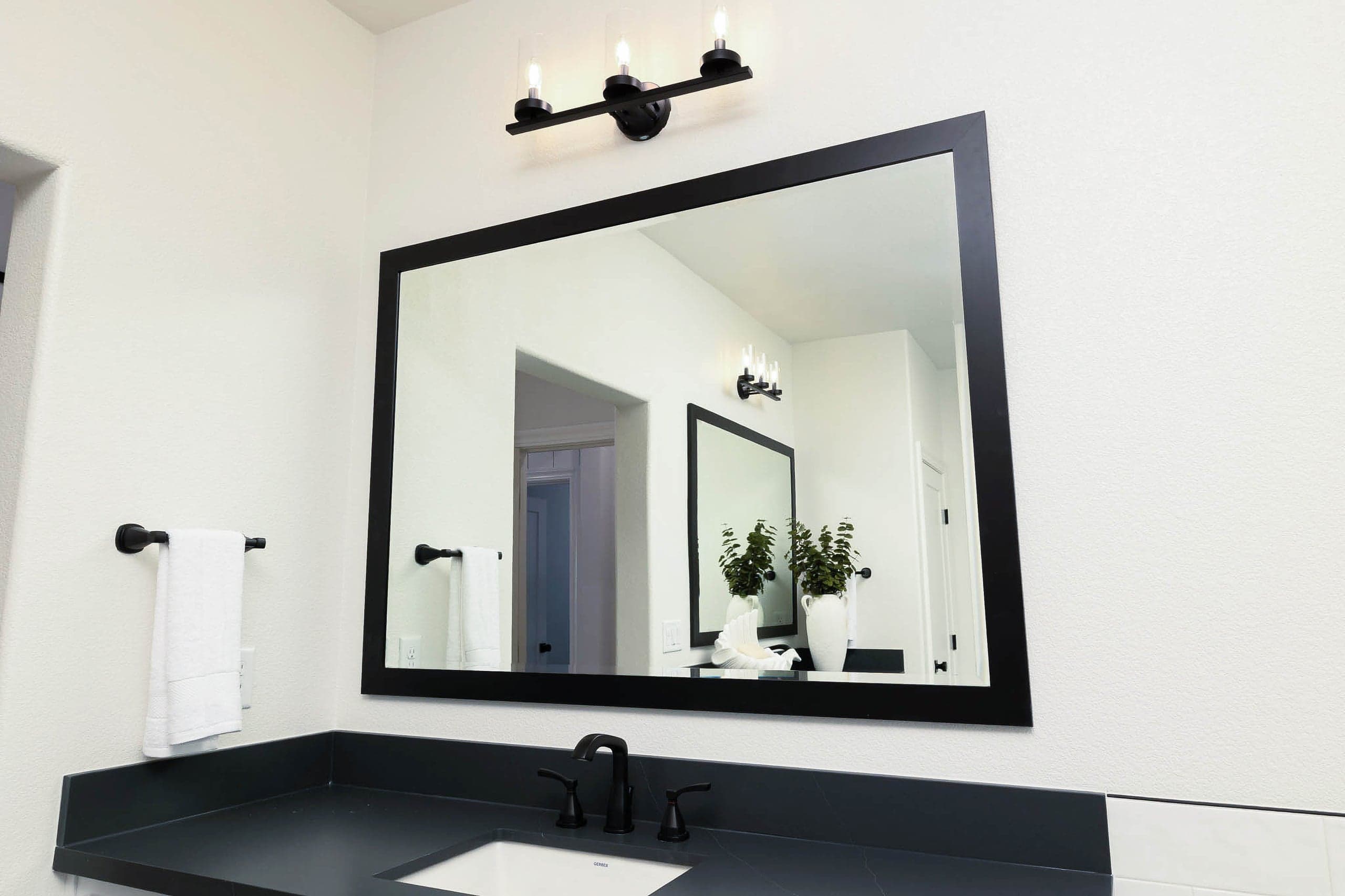
In March 2026 we fabricated and installed a 96-inch full-width over-vanity mirror in a Kings Gate primary bathroom in Plano — 1/4-inch glass, flat polished edges, moisture-resistant backing given the steam exposure 4 feet from the mirror. Cut from a single sheet, edge-finished in our shop, installed in 90 minutes with J-bar and mirror-clip combination. Total: $480 installed.
Moisture-resistant CopperFree mirror backing for steam-exposed primary baths is sourced through the Guardian Glass Carrollton facility — roughly doubles the in-service lifespan per the manufacturer spec.
FAQ
Common Questions
How much does a custom mirror cost in DFW?
Custom mirrors typically range from $8 to $25 per square foot depending on thickness, edge finish, and backing type. A 48"×36" vanity mirror with a flat polished edge runs approximately $150–$300. A large gym mirror wall for a 12'×8' space might run $1,500–$3,000 including installation. We provide exact quotes after measurement.
How long does a custom mirror take?
Most custom mirrors are ready for installation within 5–7 business days of order confirmation. Large installations or specialty edge profiles may take up to 10 business days. Installation itself is typically 1–3 hours depending on size.
Can you cut mirrors to non-rectangular shapes?
Yes, we can cut mirrors to custom shapes including arched tops, angled cuts, and other non-standard profiles. More complex shapes take slightly longer to fabricate and are priced accordingly. Contact us with your specific requirements.
Do custom mirrors need special cleaning?
Clean with a lint-free microfiber cloth and a good glass cleaner — we recommend avoiding ammonia-based cleaners on mirrors as they can damage the backing over time. Windex has an ammonia-free version. Spray the cloth, not the mirror directly, to prevent liquid from running behind the glass and contacting the backing.
In Your City
Custom Mirror Installation in Specific DFW Cities
See city-specific details — pricing, neighborhoods, and project examples — for custom mirror installation in the cities below.
Learn More
Related Guides from Our Blog
Ready for a Free Estimate in DFW?
Call us directly or request a quote online. Same-day estimates available for DFW and surrounding areas.