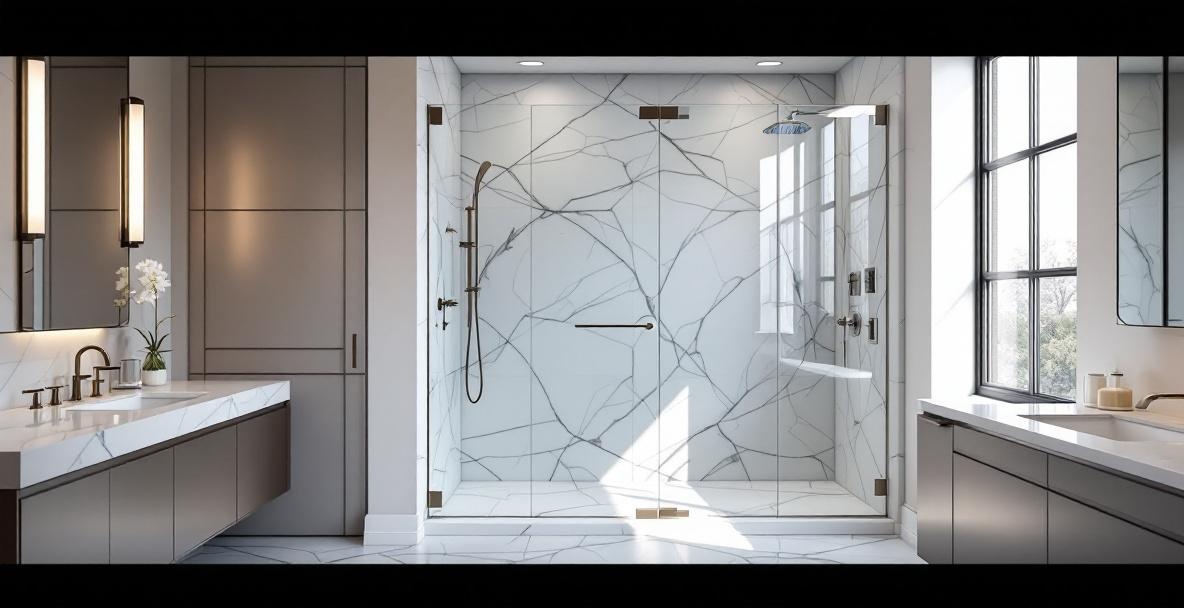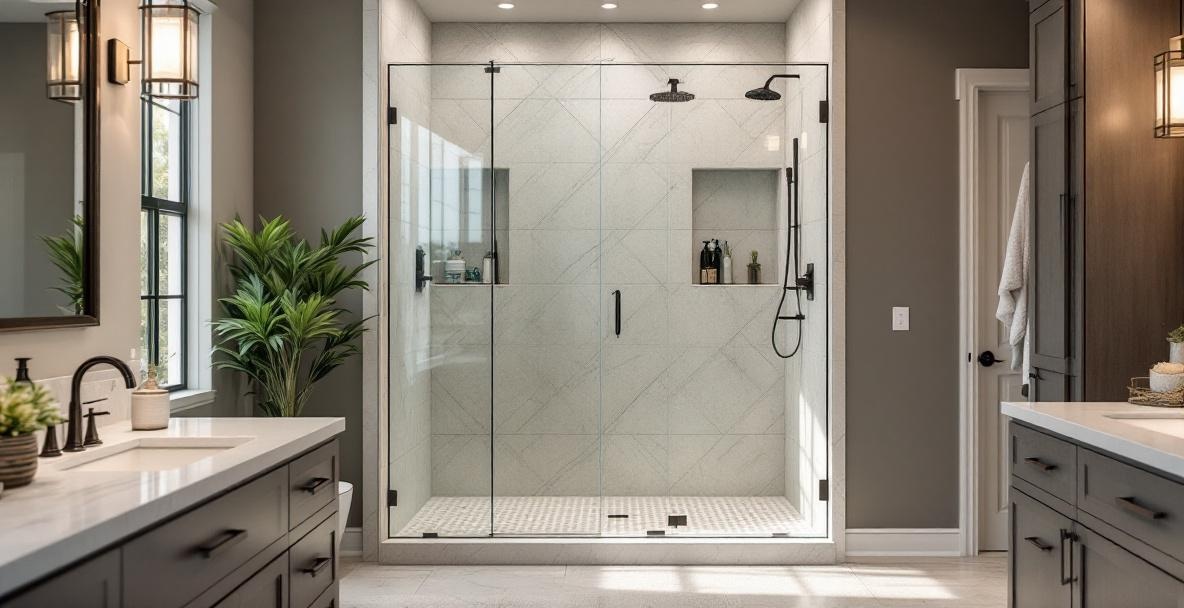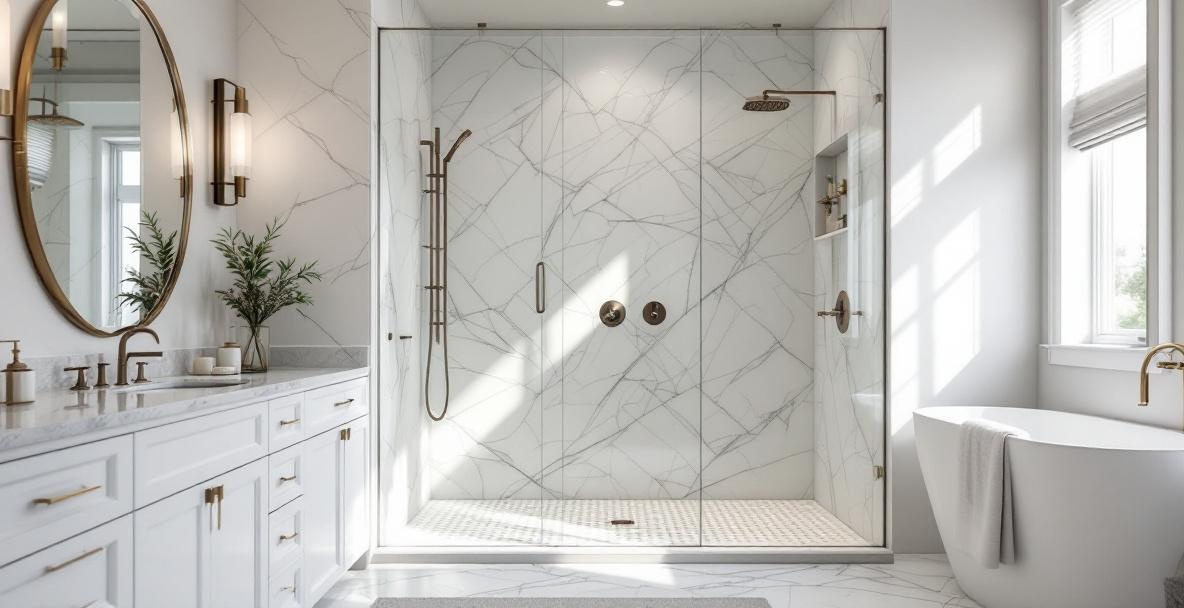
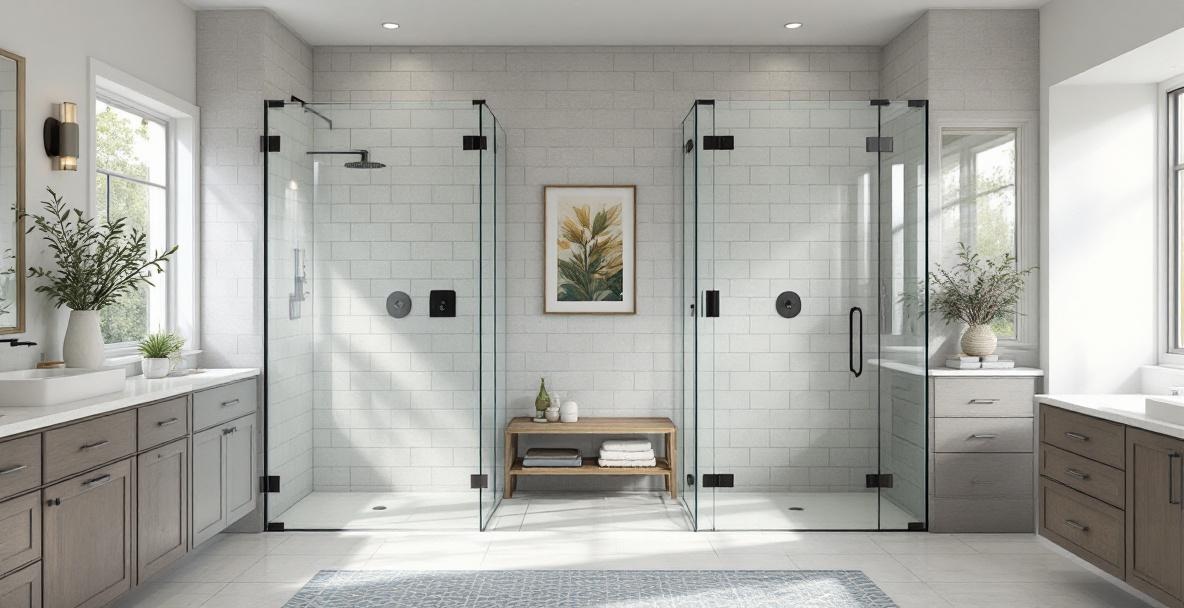
Double door shower configurations cost 30–50% more than equivalent single door setups (ACE Decor Bath) and work best when the opening is 50 inches or wider (KJ Bath). Single doors suit most standard openings under 48 inches. National average shower door installation costs run $530–$1,390 (Angi 2026), with double door configurations landing toward the high end and above it.
The question of single vs. double shower doors is partly practical (does your opening require it?) and partly aesthetic (what do you want the shower to look like and how do you want to enter it?). This guide covers the functional and cost differences between the two configurations so you can make the right call for your DFW bathroom.
What Is the Difference?
A single door shower enclosure uses one hinged door panel — typically 22"–30" wide — alongside one or more fixed glass panels to close the shower opening. A double door configuration uses two hinged panels (sometimes called French doors) that meet in the center of the opening, each swinging outward (or inward, or bi-directionally). The entry width, hardware complexity, and visual presence are all meaningfully different between the two.
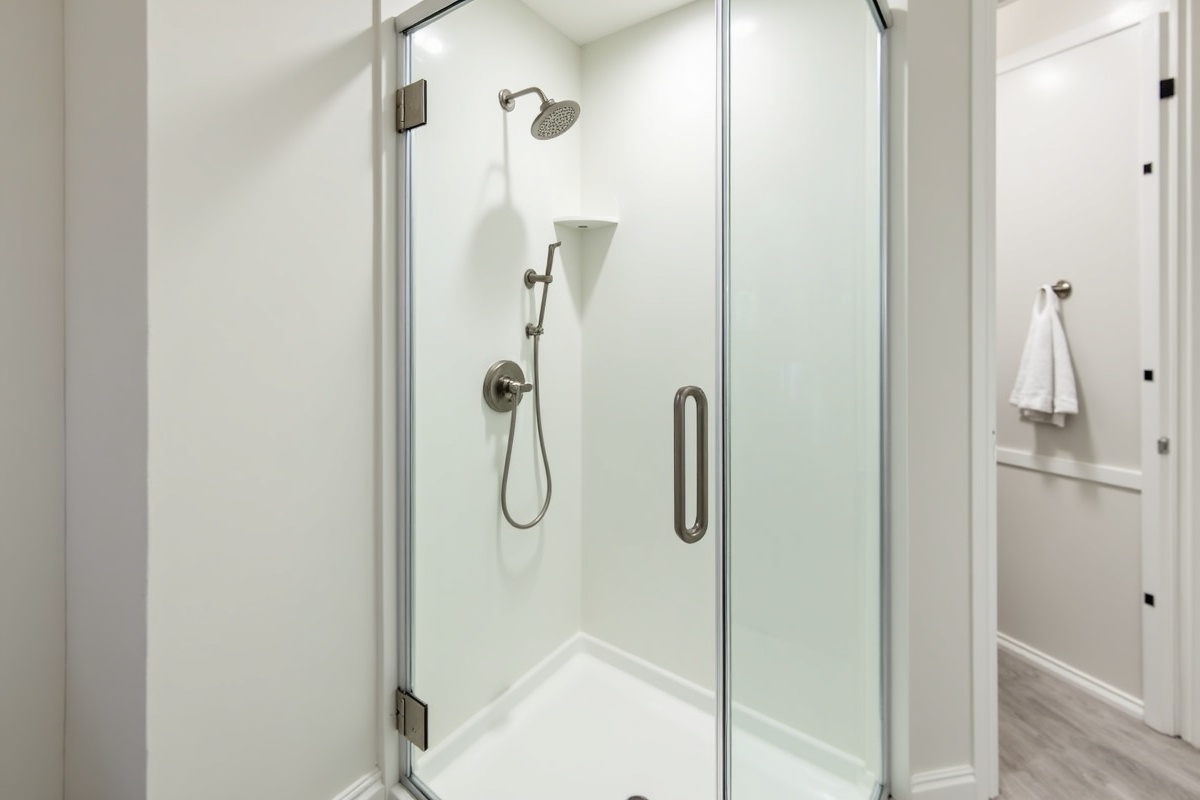
Single door enclosures: The standard frameless configuration for most DFW primary bathrooms. A door panel on one side of the opening swings on hinges, with a fixed panel (or wall) on the other side. Entry width equals the door panel width — typically 22"–30". The door carries the full weight of the panel on 2–3 hinges.
Common single door configurations:
- Door + fixed panel: Door swings from hinges attached to a fixed panel. The fixed panel is attached to the wall with hardware or a U-channel.
- Door + return: Door swings from wall-mount hinges; an adjacent fixed panel creates the enclosure on the perpendicular side. Common for corner showers.
- Door + two fixed panels: Wide opening with a door on one side, two fixed panels on the other — gives a wider entry than a single fixed panel while keeping one door.
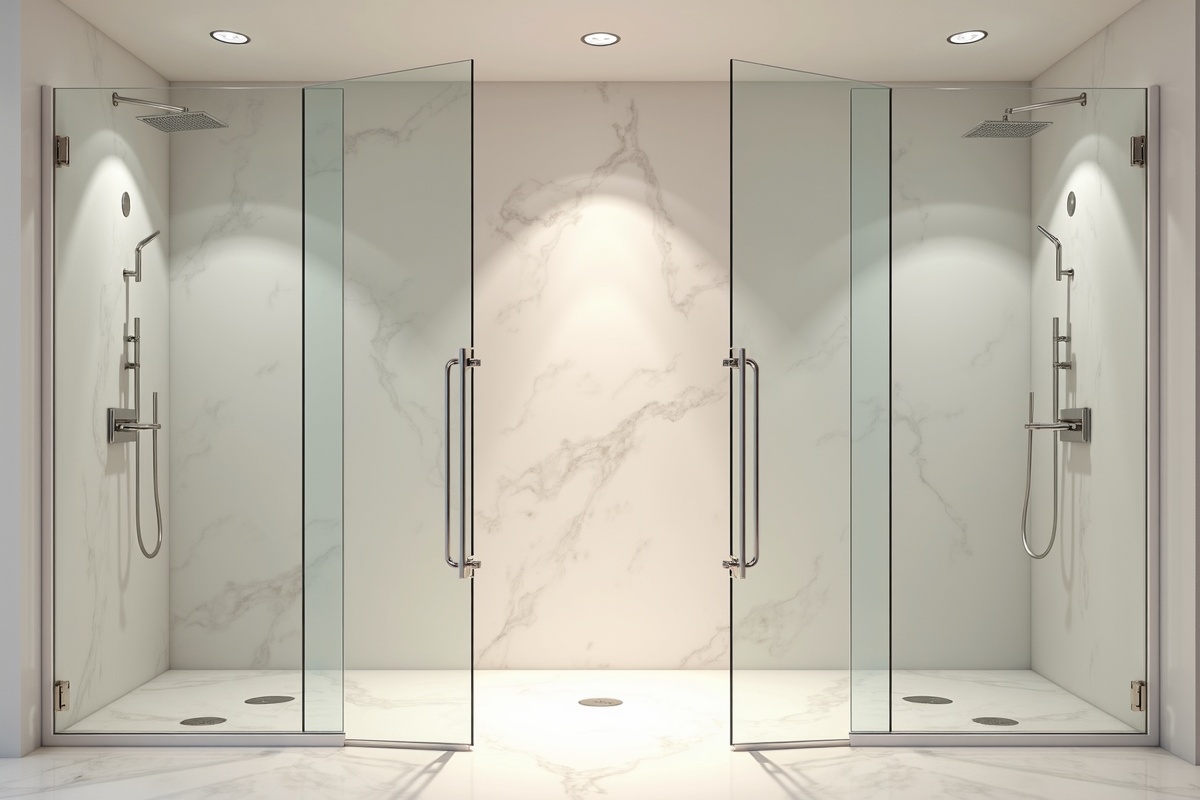
Double door (French door) enclosures: Two door panels, typically equal in width, each hinged at opposite sides of the opening and meeting at the center with a magnetic catch or center pull hardware. Each panel swings independently. Combined entry width when both doors are open is the full opening minus the frame elements — typically 48"–72"+ depending on the opening size.
| Best opening width |
| Entry width when open |
| Cost vs. equivalent single |
| Hardware complexity |
| Water seal points |
| Visual impact |
| Swing clearance needed |
30–50%
additional cost for double door shower configuration vs. equivalent single door setup (ACE Decor Bath)
How Your Shower Opening Size Determines the Right Choice
Single doors suit openings under 48 inches because the door panel width (typically 22"–30") provides a practical entry for the space. Double doors make functional sense at 50 inches and wider, where a single 24"–30" door in a wide opening means entering through a narrow opening in a large shower — which feels awkward and looks unbalanced.
The visual balance problem with wrong-size doors: Imagine a 60"-wide shower opening with a single 24" door and a 36" fixed panel. You enter through 24" — less than half the opening width — into a spacious shower. Aesthetically, the door looks small relative to the opening. The fixed panel dominates. The shower reads as under-specified.
Now imagine the same 60" opening with double 30" doors. Both doors open simultaneously to reveal the full shower. The entry feels proportional to the space. The paired hardware creates symmetry that the single-door configuration lacks.
The opposite problem with too-small openings: Double doors on a 40"–45" opening mean each door panel is only 20"–22" wide — the hardware and seals take up more of the opening proportionally, and the entry doesn't feel significantly wider than a single door would provide. The additional hardware cost and seal complexity doesn't buy a meaningful functional improvement. Below 48", single door is almost always the better specification.
The practical minimum for double doors: Most glass professionals recommend a minimum opening of 50" for a double door to function well and look proportional. This gives each panel approximately 25" of width — enough for comfortable operation and a balanced appearance. Below that, single door is the right call.
Cost Comparison
National average shower door installation runs $530–$1,390 (Angi 2026). In DFW, frameless single door configurations with a fixed panel typically run $1,000–$2,200. Double door frameless configurations on wide openings run $1,800–$3,500+ — the premium reflects additional glass, additional hinge sets, center hardware, and the more complex installation involved.
What drives the single door cost:
- One door panel (3/8" or 1/2" tempered glass, custom cut)
- 2–3 hinges in specified finish
- One handle
- One or two fixed panels depending on enclosure configuration
- Sweeps and seals
What drives the double door premium:
- Two door panels (each custom cut and tempered)
- 4–6 hinges in specified finish (two per door, minimum)
- Two handles
- Center hardware — magnetic catches or a center pull that both panels latch to
- A center seam between the two panels that must seal properly (additional seal complexity)
- More complex measurement and installation — the two panels must be perfectly aligned to meet cleanly at center
DFW price ranges for common configurations:
- Single frameless door + fixed panel (standard opening): $1,000–$2,200
- Double frameless door (50"–60" opening): $2,000–$3,000
- Double frameless door (60"–72" opening): $2,500–$3,500+
- Double frameless door with fixed panels (large enclosures): $3,000–$5,000+
For showers wider than 60", double doors become increasingly common as a design specification in DFW's higher-end primary bathroom market (Southlake, Frisco, Keller, McKinney). The wider the shower, the more a single door feels under-specified and the more a double door enhances the spatial drama.
When Double Doors Make Sense for Large Walk-Ins
Double doors aren't just about entry width — they're a design statement for large shower spaces:
Spa-style master baths: In DFW master bathrooms with 60"–72"+ shower footprints, double doors create the kind of grand entry that reads as intentional and high-end in listing photography. The paired hardware, the simultaneous open, the symmetrical glass panels — it's a specification that signals quality.
Side-by-side shower use: For couples who shower simultaneously in a large enclosure, double doors mean both can enter and exit without one person waiting for the other to clear the opening. Practical for the use case, not just aesthetic.
Steam showers: Sealed steam shower enclosures with a door on each end — one entry door, one door that connects to an adjacent seating area or cold room — use the double door approach on a single opening for a different reason: controlling steam. This is a specialized application that your fabricator can specify.
Statement bathrooms approaching renovation: If the primary bathroom is getting a full renovation (new tile, new fixtures, new vanity), a double door shower is the kind of upgrade that elevates the room from "renovated" to "designed." The additional cost at renovation time is smaller relative to the total project than it would be as a standalone upgrade.
Accessibility Impact of Each Configuration
Outswing single doors provide good accessibility for most users — ADA-compliant when the door swings outward and the clear floor space requirements are met. Double doors on wide openings can actually exceed single-door accessibility in practice: with both doors open, the full shower width is accessible, which accommodates shower chairs and walkers better than a single 24"–30" entry.
Single door accessibility: Standard single-door installations for accessibility:
- Outswing configuration (door opens outward) allows caregiver access if occupant falls
- 32"–36" door width specified for wheelchair transfer (rather than standard 22"–28")
- Zero-threshold floor at the entry (no curb)
- Hardware operable with one hand, no grasping or pinching required
Double door accessibility: For aging-in-place designs and wheelchair users, a double door on a wide shower has a specific advantage: both doors can be opened to expose the full shower width, eliminating the entry bottleneck of a single panel. This is particularly relevant for roll-in shower designs where the full floor width needs to be accessible for wheelchair positioning.
The tradeoff: double doors require operating two panels rather than one. For users with limited arm strength, single-door with a wider panel may be easier to operate than double doors.
Hardware Differences Between the Two
The hardware on a double door configuration is genuinely more complex:
Hinge count:
- Single door: 2–3 hinges (2 for lighter doors, 3 for 1/2" glass or taller panels)
- Double door: 4–6 hinges (2–3 per door)
More hinges mean more alignment complexity at installation and more hardware to inspect and maintain over time.
Center catch hardware: Double doors meet at the center and need a mechanism to hold them closed and sealed. Options:
- Magnetic catch: A magnet embedded in one panel's edge attracts a metal strike on the other. Simple, quiet, easy to operate.
- Center pull: A handle mounted at the center point of the opening serves as both a pull and a latch. Requires a handle compatible with the two-panel configuration.
- Top-and-bottom catches: Some installations use catches at the top and bottom of the center seam rather than (or in addition to) a center-mounted element.
The center seam is also a seal point — the gap between the two doors must be sealed with a magnetic or compression gasket that prevents water from exiting at the center. This is additional hardware that single doors don't require and that must be maintained alongside the other seals.
Which Works Best With Frameless?
Both configurations work fully frameless. The question is which is more commonly specified:
Single frameless door: The dominant configuration in DFW primary bathrooms. Frameless single-door + fixed panel is the standard for shower openings from 36"–54". It's clean, architectural, minimal in hardware, and easy to maintain.
Double frameless door: Less common but growing in DFW's luxury bathroom market. The visual impact is significant on wide openings, and the frameless execution — no metal surrounding the glass — makes the double door appear as two floating glass panels meeting at the center. For the right opening size and design intent, it's a genuinely distinctive specification.
The installation precision requirement: Double frameless doors demand extremely precise fabrication and installation. Both panels must be cut to exactly match the opening halves. The hinges must be aligned so both doors hang plumb, level, and at the same height. The center edges must be cut and polished to close tolerances so they meet cleanly. Any misalignment shows as a visible gap or asymmetry at the center seam.
This precision requirement is why double doors should only be specified with a fabricator who has experience installing them — and why in-house fabrication (where the installer and fabricator communicate directly) is particularly valuable for this configuration.
When should you choose double doors over single?
Choose double doors when the shower opening is 50 inches or wider and you want a proportional entry that matches the scale of the space. Double doors also make sense for luxury primary bathrooms where the installation is meant to be a design statement, for showers used by two people simultaneously, and for large accessibility-focused designs where the full opening width needs to be accessible. Below 50 inches, single door is almost always the better functional and aesthetic choice.
Are double shower doors significantly more expensive?
Yes — double door configurations cost 30–50% more than equivalent single door setups (ACE Decor Bath). In DFW's frameless glass market, expect to pay $2,000–$3,500+ for a quality double frameless door on a 50"–72" opening vs. $1,000–$2,200 for a comparable single door + fixed panel. The premium reflects two door panels, double the hinge hardware, center catch hardware, and the more complex installation alignment required.
Can you have double doors on a 5-foot shower?
Yes — a 60" (5-foot) opening is the minimum practical width for double doors and works well at that dimension. Each panel would be approximately 28"–30" wide (accounting for center hardware and seals), which provides enough opening width for each door to look proportional and for the entry to be meaningfully wider than a single 24"–28" door panel. Below 50" total opening, double doors are generally not recommended — the entry advantage over single door is minimal and the cost premium doesn't deliver a proportional benefit.
Are double doors harder to keep watertight?
Double doors have more seal points than single doors — the center seam between the two panels is an additional water control point that single doors don't have. The magnetic center gasket or compression seal at the center must be maintained alongside the standard sweeps and edge seals. In practice, a professionally installed double door with quality center sealing hardware is fully watertight. The maintenance requirement is slightly higher — an additional seal to inspect and eventually replace — but not dramatically so.
What is the minimum width for double shower doors?
Most glass professionals recommend a minimum opening of 50 inches for double doors to function well and look proportional. This gives each panel approximately 24"–25" of width — enough for comfortable operation and a balanced appearance. At 48" and below, a single door with a fixed panel is almost always the better specification: the entry is comparable in practical width, and the simpler configuration costs less and is easier to maintain.
Also see our custom frameless shower design guide and our frameless shower doors in Dallas-Fort Worth.
Infinity Glass & Glazing fabricates both single and double door frameless shower enclosures in-house at our Corinth facility. We measure, fabricate, and install throughout DFW — Lewisville, Flower Mound, Denton, Frisco, Southlake, McKinney, Keller, and surrounding communities. Contact us for a free estimate and we'll help you specify the right configuration for your shower.
Related reading: