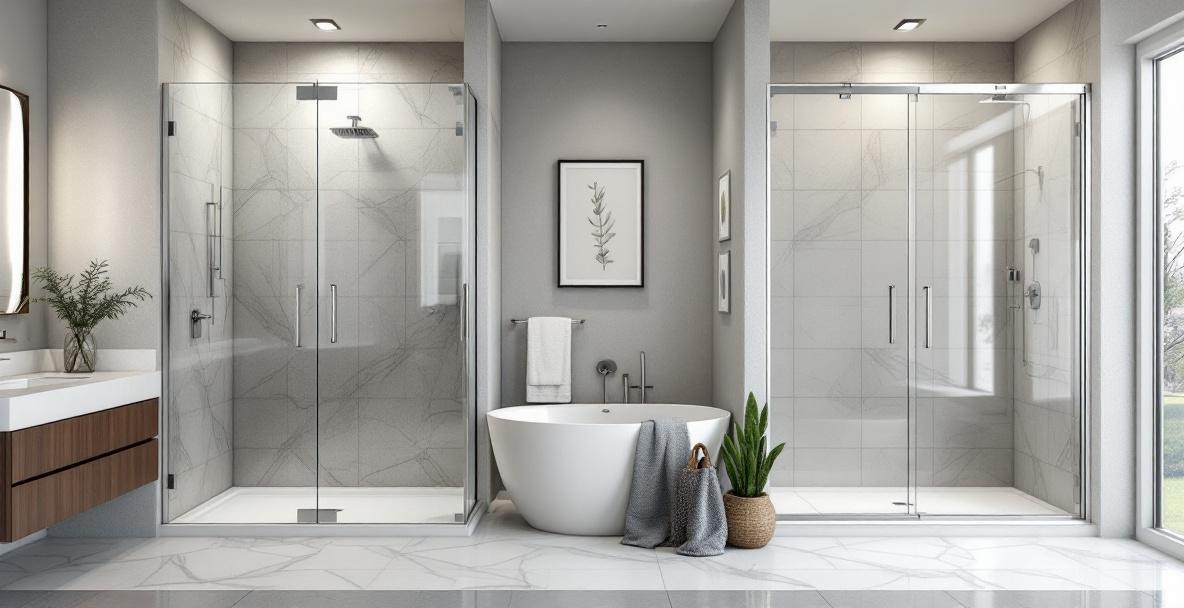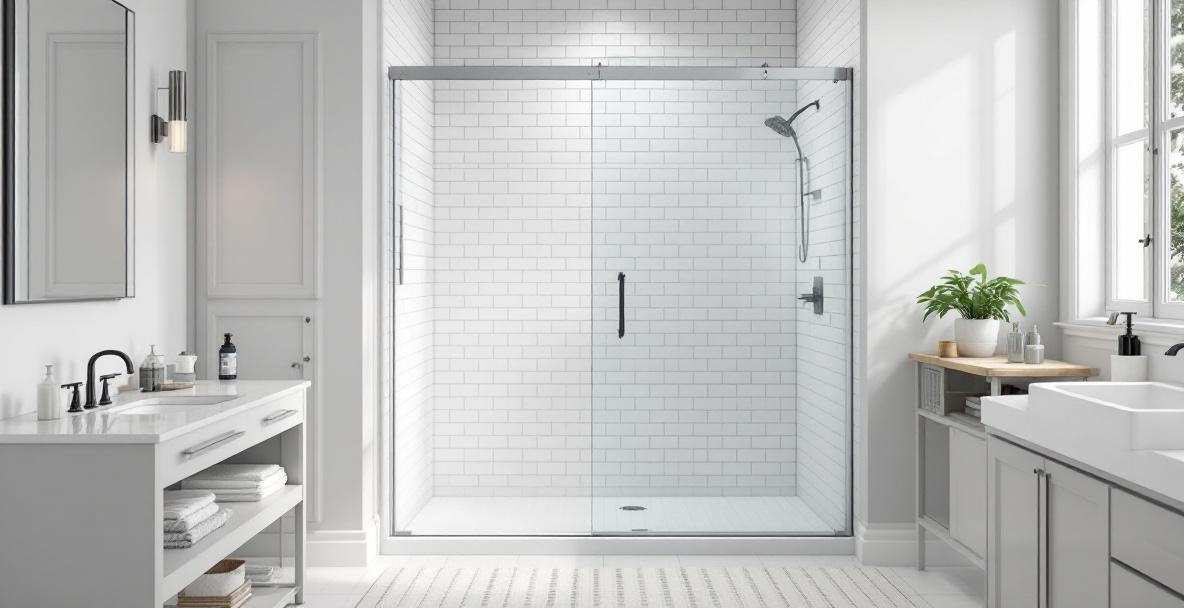
Hinged shower doors require 24–36 inches of swing clearance outside the shower and cost $1,000–$2,500+ installed for frameless. Sliding shower doors eliminate swing clearance requirements and save 6–9 square feet of usable floor space, with installed cost starting around $400–$1,500 (Angi 2026). In DFW master bathrooms with adequate clearance, hinged frameless is the premium standard. In compact bathrooms or tub combinations, sliding is the practical solution.
The sliding vs. hinged decision shapes your shower — not just aesthetically, but functionally. The door you choose affects how you enter and exit the shower every day, how much floor space the bathroom feels like it has, how you clean the door hardware, and what your bathroom will look like to buyers when you sell. This guide covers every factor, with clear guidance on which choice works best for each bathroom type.
Design and Mechanical Differences
A hinged shower door swings on one or two hinges attached to the wall or an adjacent glass panel, opening inward, outward, or both. A sliding shower door rides on a top track (frameless bypass) or top-and-bottom tracks (framed slider) and moves laterally along the shower opening without requiring clearance outside the shower. The mechanical difference determines everything from installation complexity to cleaning requirements.
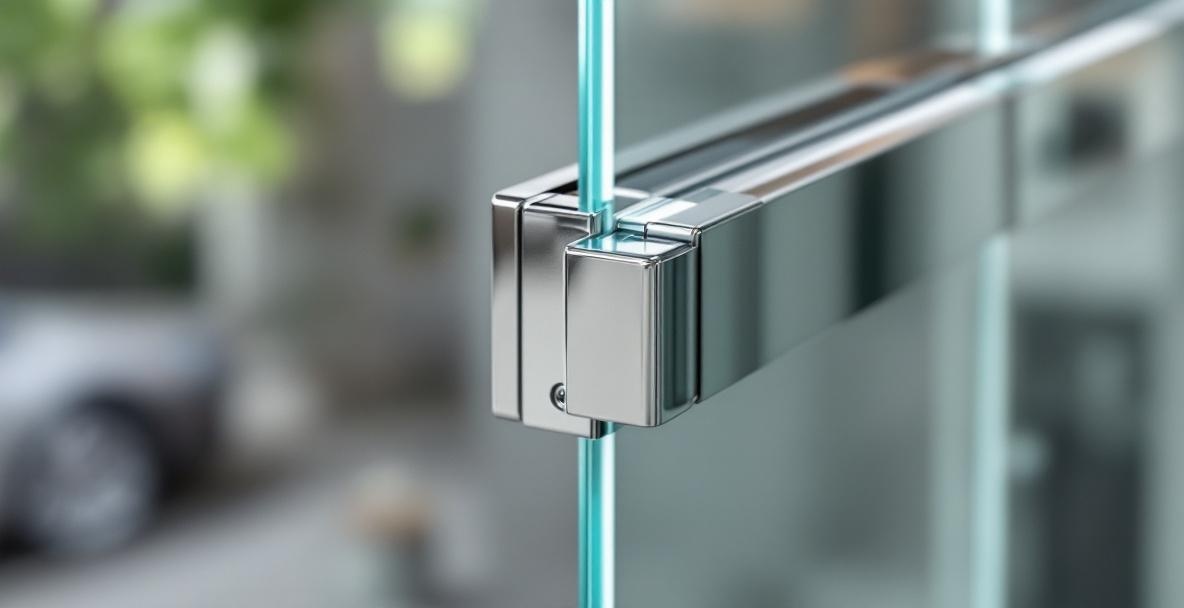
Hinged shower doors: Hinges are the structural element — they carry the full weight of the door panel and determine how the door opens. Standard hinge configurations:
- Wall-mount hinges: Door attaches directly to the tile wall via glass-clamping hinges; no adjacent glass panel required
- Glass-to-glass hinges: Door attaches to an adjacent fixed glass panel; the panel provides structural support
- Pivot hinges: Door pivots on a single point at the top and bottom rather than using traditional hinges; allows inward and outward swing
The door panel itself is the moving element. In a frameless hinged configuration, the door is 3/8"–1/2" tempered glass with no frame — purely the glass and the hardware.
Sliding shower doors: Sliding systems use a track at the top (and sometimes bottom) to guide the door panel laterally. In frameless bypass systems, a minimal header bar at the top supports the rollers; the door hangs from the rollers and slides freely. In semi-frameless systems, a full top track and usually a bottom threshold guide the door.
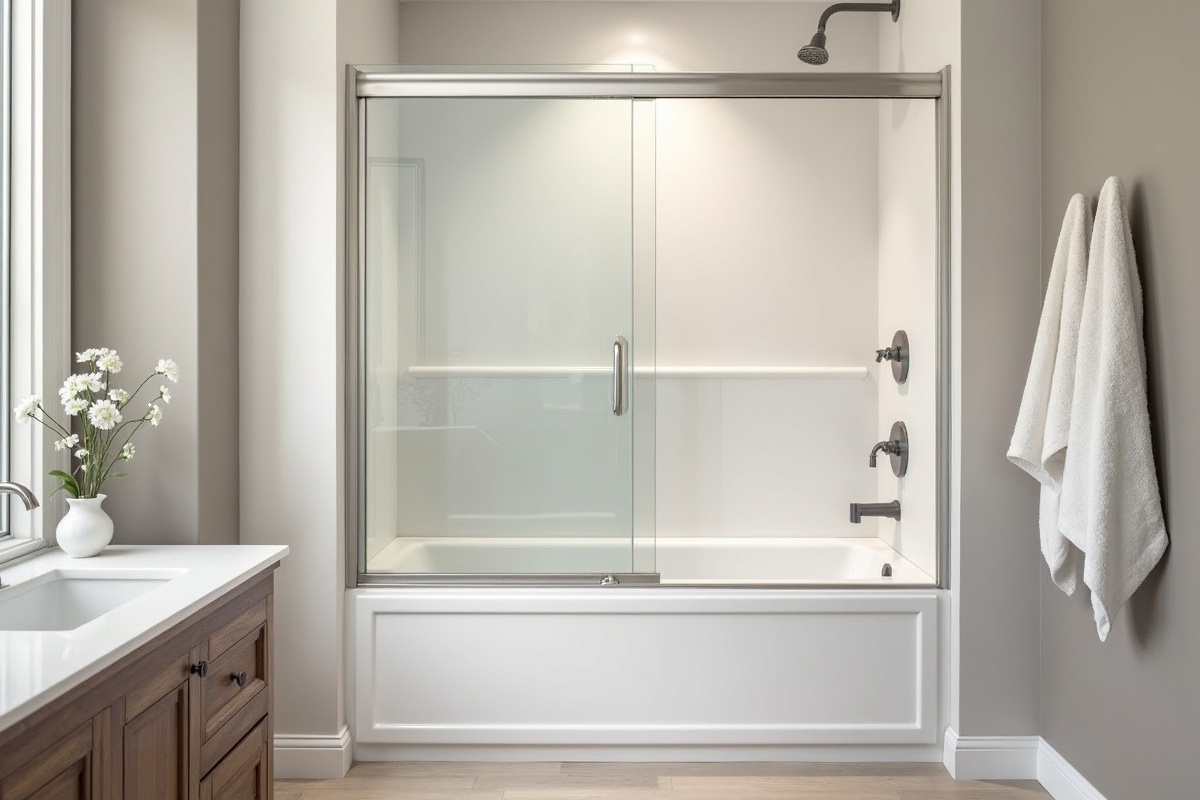
Most sliding shower systems for bathtubs use two panels that bypass each other (bypass doors) — both panels are the same width, and they overlap in the center when closed. Walk-in shower sliding systems may use a single sliding panel that parks against a fixed panel.
| Swing clearance needed |
| Space saved vs hinged |
| Installed cost DFW |
| Frameless options |
| Cleaning burden |
| ADA accessibility |
| Best application |
Which Is Better for a Small Bathroom?
In a small bathroom, a sliding door eliminates the swing clearance requirement that makes hinged doors impractical in tight spaces. A hinged door that opens outward needs 24–36 inches of clear floor space in front of the shower — in a 40–55 square foot bathroom, that clearance may conflict with the vanity, toilet, or door.
The clearance problem with hinged doors in small bathrooms: A standard 24"–30" wide hinged shower door panel needs the same amount of clear floor space in its swing arc. If the shower is positioned across from a toilet (common in compact DFW guest baths and primary baths in older homes), a hinged door that opens toward the toilet creates a conflict. An inward-swinging door resolves this — but if the shower itself is compact, stepping back to clear the door swing becomes awkward.
How sliding doors solve the problem: A sliding door requires no clearance outside the shower. The door panel moves parallel to the shower opening — it doesn't project into the bathroom at all during operation. In a bathroom where space is genuinely constrained, this is a functional advantage that outweighs aesthetic considerations.
The visual trade-off: A sliding door that bypasses (two panels, each half the opening width) means you're always entering through half the opening. A 60" wide tub combination with bypass doors gives you a 30" entry — tight but standard. A hinged frameless door on the same opening would give you the full 60" entry (if frameless) or close to it, which is more comfortable and looks better photographically.
Cost Comparison in DFW
Hinged frameless shower doors cost $1,000–$2,500 installed for a standard DFW configuration; sliding systems range from $400–$1,500 depending on framing level (Angi 2026). The cost difference reflects hardware complexity, glass thickness, and whether custom fabrication is required.
Sliding shower door cost in DFW:
- Basic semi-frameless bypass (60" tub opening): $400–$700
- Quality semi-frameless bypass with hardware upgrade: $700–$1,100
- Frameless bypass or single slider (walk-in shower): $1,000–$1,800
- Frameless single slider with fixed panel (large walk-in): $1,500–$2,500+
Hinged shower door cost in DFW:
- Basic framed hinged door: $400–$700
- Semi-frameless hinged with partial frame: $600–$1,200
- Frameless hinged (single door + fixed panel): $1,000–$2,000
- Frameless hinged (multi-panel enclosure): $1,800–$3,500+
The overlap in the middle ranges is important: a quality semi-frameless slider and a quality semi-frameless hinged door at the same shower opening cost roughly the same. The significant cost difference is between entry-level sliding systems and premium frameless hinged enclosures — these are different products for different applications, not direct comparisons.
What drives the cost of each:
- Sliding systems: track hardware, roller quality, panel count, and whether a bottom threshold is included
- Hinged systems: hinge quality and count, glass thickness (3/8" vs 1/2"), fixed panel inclusion, and custom fabrication precision
A walk-in shower remodel with a frameless hinged enclosure delivers approximately 70% ROI on a $5,000–$11,000 investment (Fixr 2025). If you're renovating the master bathroom before a sale, the hinged frameless upgrade in a shower with adequate clearance typically delivers better return than a sliding system.
Cleaning and Maintenance Differences
Hinged shower doors are easier to maintain than sliding doors. A hinged frameless door has only hinge hardware and a handle — no tracks, no rollers, no bottom threshold. A sliding door has a top track (and often a bottom track or threshold) that collects water, soap residue, and hair. In DFW's hard water environment, sliding tracks require dedicated cleaning that hinged systems don't.
Hinged door maintenance:
- Glass: squeegee after each use (20 seconds) prevents mineral buildup
- Hinges: wipe with a microfiber cloth; periodic inspection for alignment
- Handle: wipe clean; no moving parts other than any latch mechanism
- Sweeps and seals: inspect annually; replace every 3–5 years
- Total maintenance burden: minimal
Sliding door maintenance:
- Glass: same squeegee routine as hinged
- Top track: water and soap enter the track and leave deposits; periodic cleaning with a soft brush
- Rollers: clean roller wheels; lubricate annually with silicone-based lubricant to prevent squeaking and sticking
- Bottom threshold (if present): the highest-maintenance element — water, soap, and debris accumulate in the channel; requires scrubbing with a small brush
- Total maintenance burden: moderate to significant
The bottom track of a sliding shower door is one of the most difficult cleaning tasks in any bathroom. In DFW's hard water environment, mineral deposits build up in the track channel and are difficult to remove without acid-based cleaners or patient scrubbing. This is a real daily-life consideration for homeowners who want low-maintenance bathrooms.
Frameless bypass systems (top-hung, no bottom threshold) reduce this problem significantly — eliminating the floor-level track removes the worst maintenance point. But even top-track-only systems have the overhead track to clean, and most sliding systems have some form of sweep or seal at the floor level.
Accessibility and ADA Considerations
For aging-in-place bathrooms or ADA-compliant designs, hinged doors that swing outward and sliding doors both meet accessibility requirements, but each has specific advantages. Outswing hinged doors allow a person who falls in the shower to be reached from outside. Sliding doors with no bottom threshold (zero-barrier) are easier for wheelchair transfer and walker use.
Outswing hinged doors for accessibility: An outward-swinging hinged door is often specified in ADA-compliant bathrooms because it allows a caregiver outside the shower to open the door if the occupant falls. An inward-swinging door can be blocked by a fallen person, preventing access. The outswing configuration requires clearance outside the shower (the standard ADA requirement).
Sliding doors for accessibility: Zero-threshold sliding doors (no bottom track at floor level) create a level entry that accommodates wheelchairs and rolling shower chairs. The door slides open without requiring the user to step over a threshold. However, standard bypass sliding doors require lateral movement to enter — which can be awkward for users with limited mobility or who use a walker.
Walk-in shower with fixed panel (no door): The most accessible shower configuration is often a walk-in with a fixed glass panel and no door — the shower entry is always open and requires no door operation at all. This eliminates both the swing-clearance problem of hinged doors and the track-cleaning problem of sliding doors.
Best Frameless Options for Each Type
Frameless hinged door options:
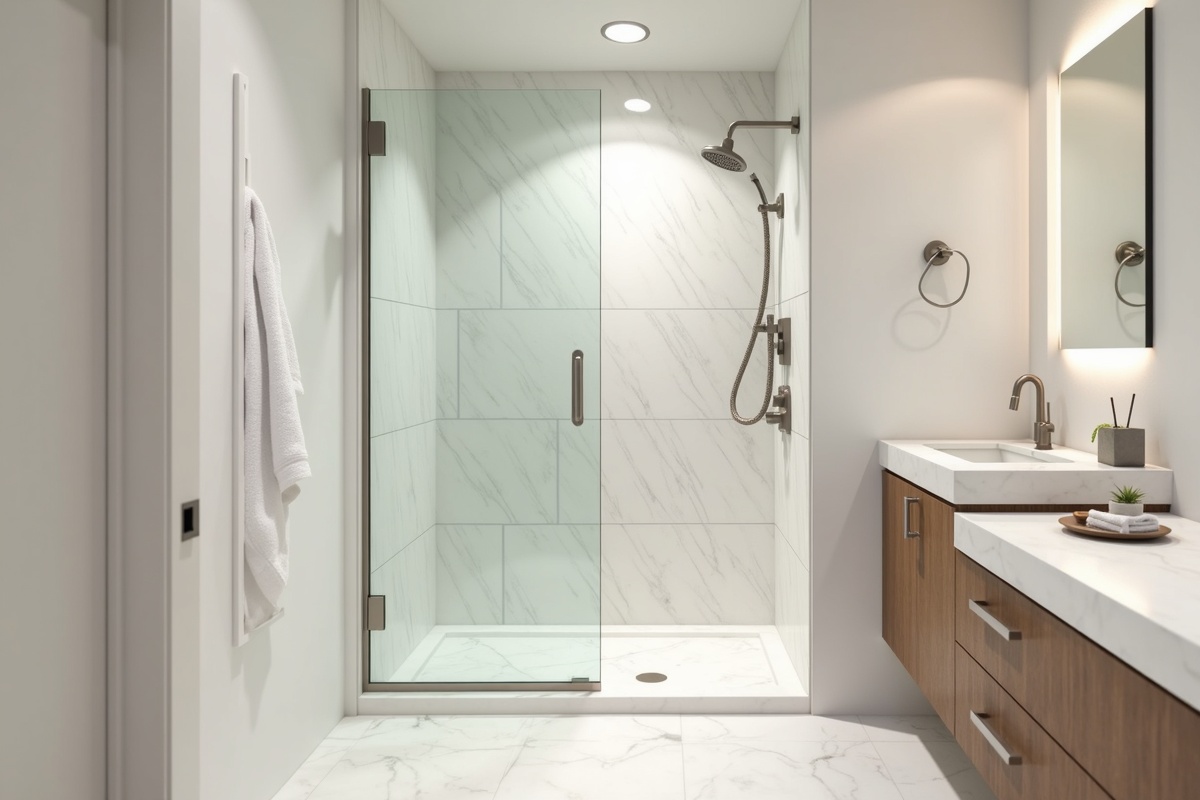
- Single door + fixed panel: The most common frameless configuration for a rectangular shower. The door swings; the panel is stationary. Clean, architectural, and the default master bath choice in DFW.
- Door + return panel: A door on the primary face with a perpendicular return panel creating the enclosure. Common for corner showers.
- Pivot door: Pivots on a single top-and-bottom point, allowing inward and outward swing. Used in larger showers where a wider door is desired.
- Neo-angle enclosure: Three glass panels with two fixed panels and one hinged door, used for diagonal corner shower configurations.
Frameless sliding door options:
- Single slider + fixed panel: One panel slides, one is fixed. Provides access to roughly half the opening. Less common in walk-in showers but available.
- Frameless bypass (two sliders): Two panels, each half the opening width, slide in opposite directions. No header required in the purest frameless versions. Top-hung with minimal visible hardware.
- Barn door style: A single large panel slides on an exposed track mounted above the shower opening. Popular in contemporary and industrial bathroom designs. Provides full opening access when slid to one side.
What DFW Homeowners Typically Choose
In DFW's primary bathroom market, hinged frameless enclosures are the standard. Frisco, Southlake, Plano, McKinney, Keller, and Corinth master bathrooms are overwhelmingly specified with hinged frameless glass — it's what buyers expect, what listing photos feature, and what adds the most resale value.
Sliding systems remain the right choice for two large categories: bathtub combinations (the classic 60" bypass slider) and secondary bathrooms or guest baths where clearance constraints make a hinged door impractical.
The hierarchy for DFW bathroom specifications:
- Master bath, adequate clearance: Frameless hinged — maximum resale value, cleanest aesthetic
- Master bath, tight clearance: Frameless slider or pivot — maintain the frameless quality without clearance conflict
- Secondary bath or guest bath: Semi-frameless hinged or slider — appropriate quality at lower cost
- Bathtub combination: Semi-frameless bypass slider — the natural fit for tub alcoves
- Rental property: Framed slider or framed hinged — cost-appropriate for the use case
Do sliding shower doors leak more than hinged doors?
Not necessarily — leakage is primarily a function of installation quality and seal condition, not door type. Hinged doors seal at the door edges with sweeps and seals; sliding doors seal at the door edges and bottom with wipes and tracks. Both can be installed leak-free when done correctly. Improperly installed or worn seals on either type can cause leaking. The bottom track of sliding doors does channel water, which can overflow if the track fills — a reminder to keep sliding tracks clean and clear of debris.
Can a hinged shower door swing both ways?
Yes — double-action hinges (also called in-swing/out-swing or bi-directional hinges) allow a shower door to swing both inward and outward. This is a popular specification because it provides flexibility (you can open the door inward when space is available) while maintaining the accessibility advantage of outward swing. Double-action hinges are available in the same finish options (chrome, brushed nickel, matte black, brushed gold) as standard hinges, at a modest premium.
How much clearance does a hinged shower door need?
A hinged shower door panel needs clear floor space equal to or greater than the panel width in its swing arc. A 24"-wide door needs approximately 24" of clearance; a 30" door needs 30" of clearance. Standard shower doors are 22"–30" wide. Count from the outside face of the shower threshold to the nearest obstruction (toilet, vanity, wall) to determine available clearance. If you have 24"–30" of clear space, a standard hinged door works. Less than 24" suggests considering a sliding configuration or an inward-swinging door (which swings into the shower instead of out).
Is a sliding shower door ADA compliant?
Sliding shower doors can be ADA compliant when designed with specific features: a clear floor space of at least 36" × 36" adjacent to the opening, hardware operable with one hand without grasping or pinching, and — for zero-barrier compliance — no bottom threshold at the entry. Standard bypass sliding doors with a bottom threshold are not ADA compliant at the entry point. A sliding door without a threshold (top-hung only) on a zero-barrier shower pan meets ADA entry requirements. Consult with your contractor about specific ADA requirements for your project.
Which type works best for a corner shower?
Corner showers (two walls meeting at a 90° angle with two open sides) typically use a hinged door with a fixed panel — a "door + panel" configuration where the panel covers one side of the opening and the hinged door covers the other. Neo-angle corner showers (three walls meeting at 45° angles) use a three-panel hinged configuration. Sliding doors are rarely used on corner showers because the bypass configuration requires a straight opening; corner geometry makes track installation complex. Frameless hinged enclosures are the standard for corner and neo-angle shower configurations in DFW.
Also see our bypass sliding glass shower doors guide and our frameless vs framed shower door comparison.
Infinity Glass & Glazing installs both sliding and hinged frameless shower enclosures throughout DFW — with in-house glass fabrication and professional installation. Serving Corinth, Lewisville, Denton, Flower Mound, Frisco, Southlake, McKinney, Keller, and surrounding areas. Contact us for a free estimate on your shower door project.
Related reading: