There are six main shower door types: sliding (bypass), pivot, hinged, bi-fold, frameless fixed panel, and neo-angle. Each serves a different bathroom size and layout. Choosing the wrong type means either a door that doesn't fit your space or paying for features your bathroom can't accommodate. This guide compares all six side by side.
Many homeowners choose a shower door style because it looks appealing in a showroom — then discover their bathroom can't physically accommodate it. A hinged door in a small bathroom. A pivot door on a tub. A bypass door on a walk-in shower that's too narrow for two panels. The mismatch costs money and frustration.
This guide starts with what your bathroom needs, then matches you to the right type.
How Many Types of Shower Doors Are There?
Six distinct door types cover the full range of residential shower applications. Each has a different opening mechanism, clearance requirement, and ideal use case.
| Sliding (bypass) |
| Pivot |
| Hinged |
| Bi-fold |
| Fixed panel / walk-in |
| Neo-angle |
What Are the Pros and Cons of Sliding Shower Doors?
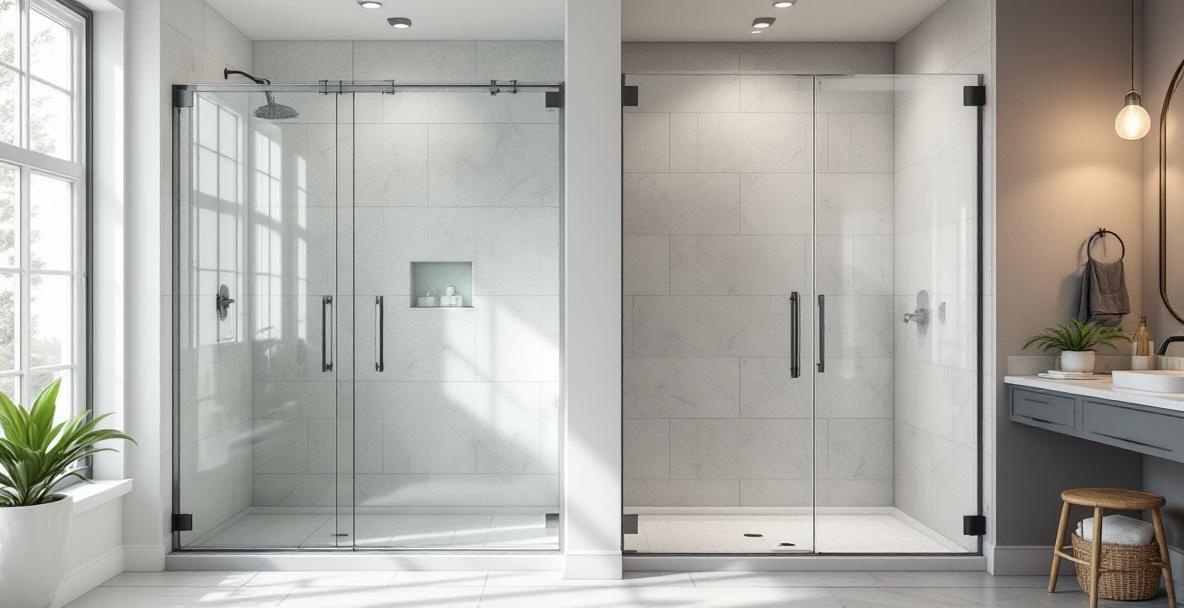
Sliding bypass doors use two or three glass panels that slide along a top track and bottom rail. One panel slides in front of the other to open — you never need clearance in front of the shower for a swinging arc.
Pros:
- No swing clearance required — ideal for bathrooms with limited floor space in front of the shower
- Works well on bathtub-shower combinations (standard 60-inch tub width is the classic application)
- Lower cost than frameless hinged options in comparable configurations
- Available in both framed and semi-frameless versions
Cons:
- The bottom track is the #1 mold and soap scum collection point in any shower enclosure. Research from Schicker Luxury Shower Doors identifies sliding tracks as the primary maintenance pain point in shower doors (NKBA 2026)
- Full frameless bypass configurations are rare and expensive — most sliding doors require at least minimal framing at the top and bottom track
- Access is limited to one side of the opening at a time
- Minimum 48-inch opening for a two-panel configuration to work properly
Cost range (DFW): $300–$1,000 installed for semi-frameless; custom configurations run higher.
Best for: 60-inch bathtub-shower combinations, bathrooms where swing clearance is limited, budget-conscious upgrades. Where there is no door at all, a walk-in fixed panel is the other end of the range. (Whether a frameless door can go on a tub is a separate question — see frameless shower doors on bathtubs.)
When Is a Pivot Door the Right Choice?
Pivot doors rotate on a single pin set at the top and bottom of the door — usually offset to one side. Unlike hinged doors (which mount on wall hinges), pivot doors support their weight through the top and bottom pivot points. This allows very wide, heavy glass panels without multiple wall-mounted hinges.
Pros:
- Handles very large, heavy glass panels that wall hinges can't support
- Sleek, minimal hardware look — no visible hinge plates on the wall
- Works in frameless configurations
- Can swing inward, outward, or both depending on the pivot hardware
Cons:
- Requires clear swing clearance equal to the door width (a 36-inch pivot door needs 36 inches of swing space)
- Weight is carried by a floor pivot — floor must be solid and level
- The offset design leaves a small gap on the non-pivot side that requires a fixed glass return panel for proper sealing
- More complex installation than standard hinged doors
Cost range (DFW): $700–$2,500 installed depending on glass size and hardware.
Best for: Large shower openings (36+ inches), frameless enclosures where a heavy single panel is preferred over multiple hinges, design-forward bathrooms.
What Is the Difference Between Hinged and Pivot Doors?
This is the most common point of confusion in shower door selection.
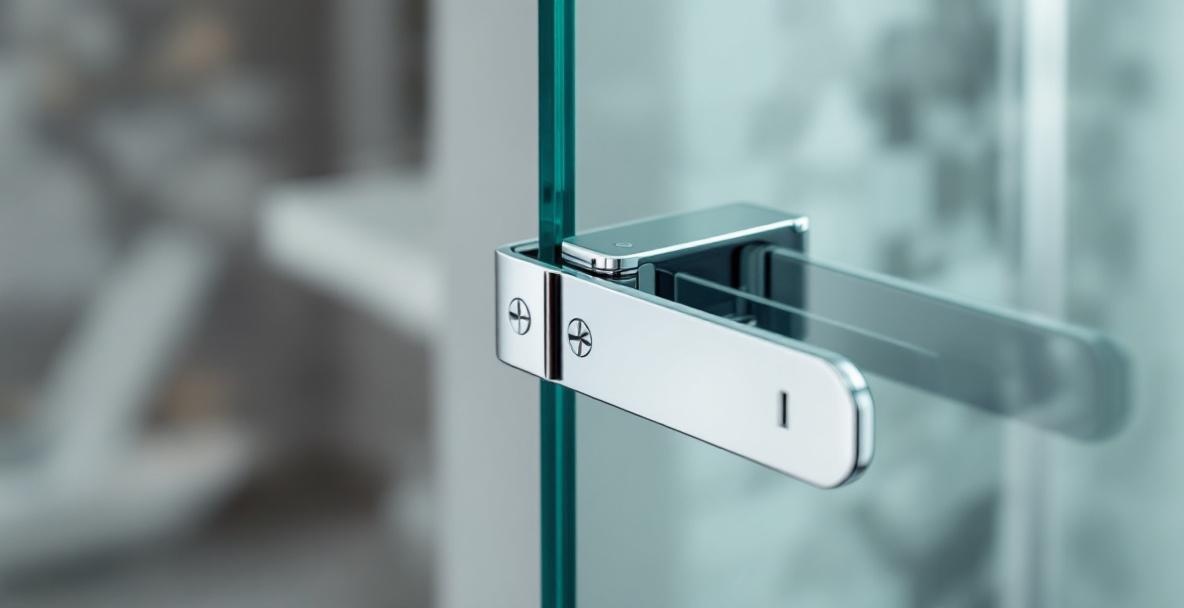
Hinged doors mount on wall-attached hinges — exactly like a standard room door. The hinges attach to the glass and to either a wall or a fixed glass panel. Hinged doors can swing in, out, or both, and are the most common configuration for frameless shower enclosures.
Pivot doors mount on floor and ceiling pins (or a top frame) rather than wall hinges. The door rotates around a vertical axis rather than swinging on side hinges. Pivot doors are used when the glass panel is too large or too heavy for wall-mounted hinges to support safely.
In practice: most frameless single-door shower enclosures use hinges. Pivot hardware is specified for large, heavy panels and certain design-forward configurations. Your glass installer will recommend the appropriate hardware based on door size, weight, and wall conditions.
When Should You Choose a Bi-Fold Shower Door?
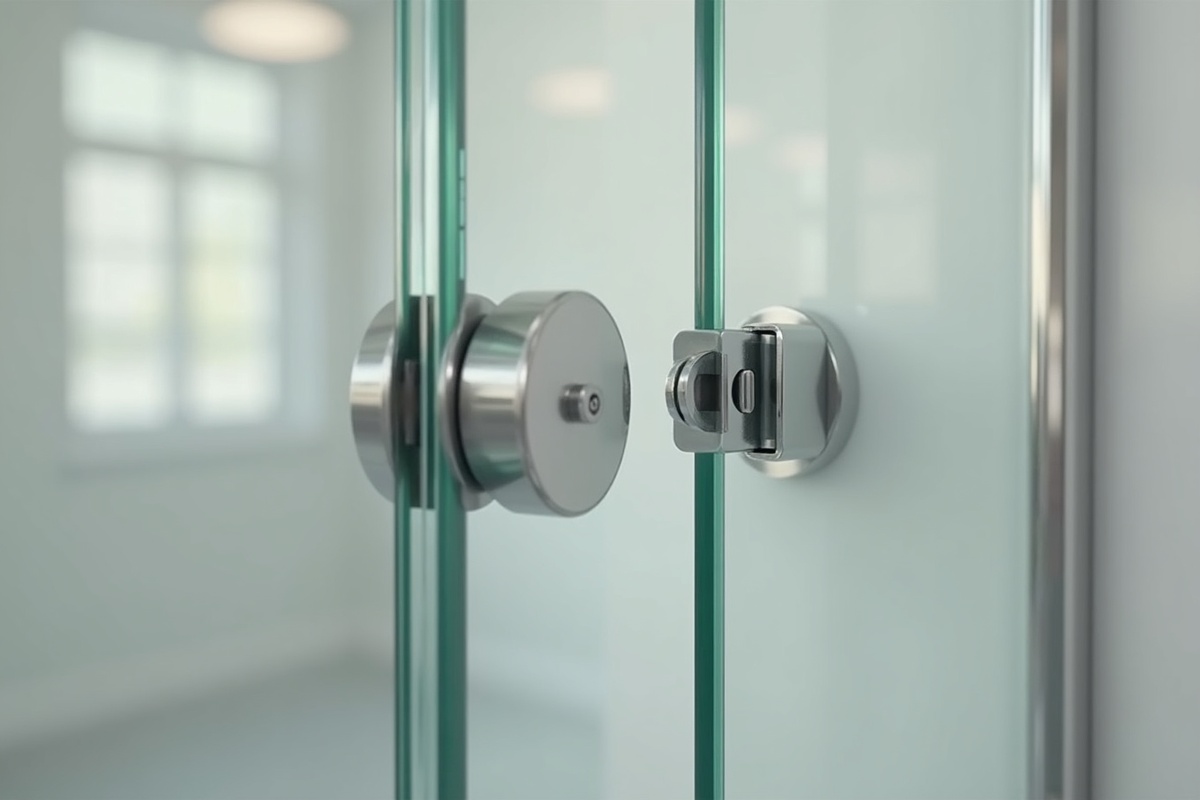
Bi-fold doors fold in half when opening — two panels connected by hinges in the middle, with the outer edge on a track. The result is a door that requires only half the swing clearance of a standard hinged door.
Pros:
- Minimal swing clearance requirement — ideal for very small shower enclosures
- Works in openings as narrow as 22–24 inches
- Less expensive than frameless alternatives
- Keeps water better contained than no-door walk-in configurations
Cons:
- The folding mechanism creates more joints and seams — more potential leak points and cleaning complexity
- Maximum practical width is about 36 inches — wider than that and bi-fold becomes impractical
- Not available in fully frameless configurations — always requires at least a minimal frame or rail system
- Visually busier than hinged or pivot alternatives
Cost range (DFW): $250–$700 installed.
Best for: Small shower stalls (22–32 inch openings), tight bathroom layouts, budget replacement projects.
What Are Frameless Fixed Panels and Walk-In Configurations?
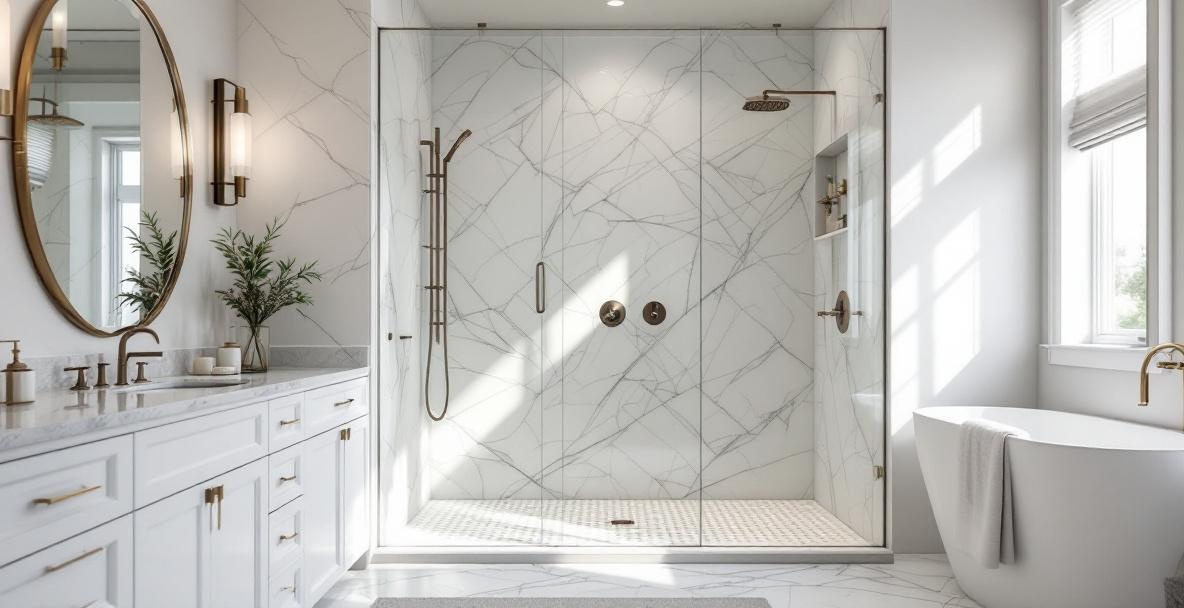
Walk-in shower configurations use one or more fixed glass panels to define the shower space without a swinging door. Water is contained by the glass panel position, the slope of the floor drain, and sometimes a partial return panel on the open side.
Pros:
- Completely barrier-free — no threshold, no door to open
- Accessible design — meets ADA requirements with proper slope and drain placement (ICC 2024)
- The cleanest, most minimalist aesthetic possible
- No hinges, handles, or moving parts to maintain
- Ideal for wet room designs where the entire floor area is the "shower"
Cons:
- Requires careful design to manage water spray — panel position and showerhead placement must work together to prevent water from reaching the open entry
- Minimum 36-inch shower width for effective water containment
- Not suitable for tub-shower combinations
- Higher construction complexity when retrofitting an existing shower
Cost range (DFW): $800–$3,500+ depending on panel size and configuration.
Best for: Walk-in showers, wet room designs, accessible/ADA bathrooms, master suite renovations.
Which Shower Door Type Is Best for Your Bathroom?
45.6%
market share for frameless shower enclosures in 2024, the fastest-growing segment ([Verified Market Reports](https://www.verifiedmarketreports.com/product/frameless-shower-doors-market/))
The right choice depends on your bathroom's physical constraints and your priorities:
Choose sliding (bypass) if: You have a 60-inch tub-shower combination, limited swing clearance, or a moderate budget.
Choose pivot if: You want a large, heavy frameless panel without multiple wall hinges and have 36+ inches of swing clearance.
Choose hinged if: You have a walk-in shower alcove with 30+ inches of swing clearance and want the cleanest frameless look.
Choose bi-fold if: Your shower opening is 22–32 inches and you need a door (not a walk-in) without swing clearance.
Choose fixed/walk-in if: You're designing or renovating a walk-in shower and want a barrier-free, minimal aesthetic.
Choose neo-angle if: You have a corner shower enclosure — these are specifically designed for the angled geometry of corner installations.
Housing stock matters too. Newer builds where we install frameless shower doors in Allen and Flower Mound typically have walk-in alcoves suited to hinged frameless doors, while many 1990s-era Keller master baths still have the 60-inch tub openings where bypass sliders are the practical choice.
What's the difference between a pivot door and a hinged door?
Hinged doors mount on wall-attached hinges like a standard room door. Pivot doors rotate on top and bottom pivot points rather than side wall hinges. Pivot hardware supports heavier, larger glass panels and produces a slightly different swing feel. For most residential frameless shower doors, hinges are the standard choice; pivot hardware is specified for large or heavy panels.
Which shower door type is easiest to clean?
Walk-in fixed panel configurations are the easiest to clean — no moving parts, no tracks, no hardware joints to scrub. Among door types, frameless hinged doors are second easiest because there are no metal channels or tracks trapping water. Sliding bypass doors are the most maintenance-intensive due to the bottom track accumulating soap scum and mildew.
What is the most affordable type of shower door?
Framed bi-fold and framed sliding (bypass) doors are the least expensive, typically $200–$600 installed from big-box stores. Semi-frameless sliding doors run $400–$1,000. Frameless hinged and pivot configurations are the most expensive, starting around $600 and ranging to $3,300+ for custom work.
Can I replace my sliding door with a frameless hinged door?
Yes, in most cases — provided you have adequate swing clearance in front of the shower. The shower opening dimensions must also accommodate a single frameless panel (the sliding door used two panels for width; a frameless door covers the full opening with one). A professional measurement visit will confirm feasibility and exact specifications.
Which shower door type is best for a walk-in shower?
For walk-in showers with adequate floor space, frameless hinged doors deliver the best combination of aesthetics and water containment. For luxury master baths, fixed panel walk-in configurations (no door) are increasingly popular. Bi-fold doors work for smaller walk-in openings where swing clearance is limited.
Also see our shower door buyer guide and our frameless vs. semi-frameless cost comparison.
Infinity Glass & Glazing specifies and installs all shower door types in DFW — from semi-frameless bypass doors to fully custom frameless enclosures. Serving Corinth, Denton, Lewisville, Flower Mound, Frisco, Southlake, Keller, McKinney, and the greater DFW metro. Contact us for a free estimate.
Related reading: