Soap scum on glass shower doors is calcium stearate — formed when calcium ions in hard water react with the fatty acids in bar soap. It bonds chemically to glass and requires an acidic or surfactant-based cleaner to dissolve it. In DFW, where water hardness runs 7–17 grains per gallon, soap scum forms faster than in most U.S. cities and requires a more aggressive routine to control.
Soap scum is the most common complaint about shower door maintenance — and among the most misunderstood. Many homeowners scrub harder or buy stronger products when the real issue is either the wrong cleaner or the wrong frequency. Understanding what soap scum is and how it forms points directly to the most effective removal approach for your situation.
This guide ranks 7 removal methods from mildest to strongest, covers commercial product options for heavy buildup, and explains why DFW hard water makes soap scum a uniquely persistent challenge.
What Is Soap Scum and Why Does It Build Up?
Soap scum is not dirt or surface grime — it's a chemical compound called calcium stearate, formed when the calcium and magnesium ions in hard water react with the fatty acids in bar soap. It's insoluble in water, which is why rinsing alone never removes it. It requires an acid (to dissolve calcium bonds) or a surfactant (to break fatty acid bonds) to clean effectively.
The chemistry explains why soap scum behaves differently from other bathroom buildup:
- Water alone doesn't touch it — soap scum is hydrophobic
- Scrubbing without the right chemical only spreads it
- Once formed, it bonds to glass at the microscopic surface level
- Heat and steam soften it temporarily, making it easier to remove
- Hard water accelerates formation significantly — more calcium means more compound
According to Chemistry LibreTexts, calcium stearate (soap scum) forms almost instantly when hard water contacts bar soap during use. In DFW, where water hardness of 7–17 GPG is documented (Water Fixers of DFW), the rate of soap scum formation is 2–4x higher than in soft-water cities.
Switching to liquid body wash (which doesn't contain the same fatty acids as bar soap) significantly reduces soap scum formation — more on that in the prevention section.
52%
of people say bathroom cleaning is the most dreaded household task — soap scum on shower glass is the top specific complaint ([Apartment Guide](https://www.apartmentguide.com/))
7 Removal Methods Ranked From Mildest to Strongest
Start with the mildest method that matches your buildup level. Escalating to stronger methods immediately risks damaging glass coatings, hardware finishes, and nearby surfaces like natural stone tile. Match the method to the severity.
Method 1: White Vinegar + Water Spray (Light Buildup)
Best for: weekly maintenance cleaning, light haze, 1–2 weeks of buildup.
Mix equal parts white vinegar and warm water in a spray bottle. Spray generously on glass and let sit for 3–5 minutes. The acetic acid dissolves the calcium bonds in light soap scum. Wipe with a microfiber cloth in circular motions, then rinse thoroughly. For stubborn spots, apply undiluted vinegar and wait 5 minutes.
Avoid on: natural stone tile, oil-rubbed bronze hardware, gold fixtures.
Method 2: Dish Soap + Warm Water (Light to Moderate Buildup)
Best for: fresh soap scum, body oil residue, weekly cleaning.
A few drops of dish soap in warm water creates a surfactant solution that cuts through the fatty acid component of soap scum. Apply with a soft cloth, work in circles, rinse completely. Dish soap doesn't address the calcium component as effectively as vinegar but is safe on all hardware finishes.
Method 3: Baking Soda Paste (Moderate Buildup)
Best for: 2–4 weeks of buildup, stubborn spots that spray solutions haven't cleared.
Mix baking soda with enough dish soap to form a spreadable paste. Apply to glass and let sit for 5 minutes. Baking soda is a mild abrasive (much gentler than commercial abrasive powders) that physically lifts soap scum while the dish soap breaks the fatty acid bonds. Scrub gently with a non-scratch pad, rinse thoroughly. This method works well on stubborn localized spots.
Method 4: Vinegar + Baking Soda Combination (Moderate to Heavy Buildup)
Best for: 1–2 months of neglect, widespread haze across the full panel.
Apply baking soda paste first, then spray with undiluted white vinegar. The fizzing reaction is not the cleaning mechanism (CO2 bubbles are cosmetic) — the value is applying both an abrasive and an acid sequentially to the same surface. After fizzing subsides, scrub with a non-scratch pad and rinse. This is more effective than either ingredient alone on combined soap scum and mineral deposits.
Method 5: Commercial Shower Glass Cleaner (Moderate to Heavy Buildup)
Best for: regular deep cleaning, when DIY solutions aren't keeping up.
Products like Method Daily Shower Spray, Scrubbing Bubbles Mega Shower Foamer, and Rejuvenate Soap Scum Remover are formulated specifically for shower glass. They combine surfactants, mild acids, and solvents in ratios optimized for shower glass. Follow product instructions — most require a dwell time of 1–5 minutes before wiping.
Method 6: Bar Keepers Friend / Oxalic Acid Cleaner (Heavy Buildup)
Best for: 2–6 months of neglect, heavy combined soap scum and mineral deposit layer.
Bar Keepers Friend (oxalic acid-based) is the preferred step before escalating to stronger mineral removers. Wet the glass, apply Bar Keepers Friend powder or cream, let sit 2 minutes maximum, scrub with a non-scratch pad, rinse completely. Oxalic acid is more aggressive than acetic acid and dissolves calcium bonds more effectively. Important: Do not use on nearby natural stone surfaces, and rinse hardware thoroughly after use.
Method 7: Professional-Grade Calcium/Lime Remover or Steam Cleaning (Severe/Calcified Buildup)
Best for: 6+ months of neglect, calcified deposits that resist all other methods.
Products like CLR (Calcium Lime Rust), Lime-A-Way, or Wet & Forget Shower target calcified mineral-soap scum compounds with stronger acid concentrations. Follow directions precisely — most specify no more than 2 minutes of contact time on glass. Rinse immediately and thoroughly. For the most severe calcified buildup, professional steam cleaning (which uses heat to soften and loosen calcified soap scum mechanically) followed by chemical treatment is the most effective option.
| Vinegar + water spray |
| Dish soap + water |
| Baking soda paste |
| Vinegar + baking soda |
| Commercial spray cleaner |
| Bar Keepers Friend |
| CLR / steam cleaning |
Best Commercial Products for Heavy Buildup
When DIY solutions have been tried and the soap scum persists, these commercial products are the most effective options specifically for glass shower doors:
For soap scum (fatty acid-dominant buildup):
- Scrubbing Bubbles Mega Shower Foamer — enzyme-based, effective on fresh and moderate soap scum
- Rejuvenate Soap Scum Remover — acidic formula, works on combined soap scum and mineral deposits
- Method Daily Shower Spray — pH-balanced for daily use, prevents buildup when used consistently
For combined soap scum + hard water deposits (most common in DFW):
- Bar Keepers Friend Soft Cleanser — oxalic acid, best all-around option for most DFW bathrooms
- CLR Calcium Lime Rust Remover — use as directed, most aggressive widely-available option
- Bio-Clean Hard Water Stain Remover — specifically formulated for glass surfaces with mineral and soap scum combination
Professional restoration option: When commercial products don't cut through years of calcified buildup, a professional glass restoration service can polish the surface with a cerium oxide compound. This removes etching and embedded mineral/soap scum residue that no chemical can dissolve. Cost: $150–$400 depending on glass area.
Removing Severe or Calcified Soap Scum
Calcified soap scum — soap scum that has been on glass for months and has undergone chemical bonding with mineral deposits — requires mechanical action (gentle abrasive or steam) in addition to chemical treatment. No spray-on product alone dissolves calcified deposits effectively; the combination of dwell time, heat, and physical agitation is required.
For severe buildup, work in sections rather than treating the entire panel at once:
- 1
Apply heat first
Run the shower on hot for 5 minutes before cleaning. Steam softens calcified soap scum and makes it more receptive to chemical treatment. Work on the glass while it's still warm.
- 2
Apply a strong cleaner and let it dwell
Apply CLR, Lime-A-Way, or Bar Keepers Friend to a section of the glass. Set a timer — most products have a maximum contact time of 2 minutes for glass. Do not exceed the recommended dwell time.
- 3
Agitate with a non-scratch pad
Use a white or blue non-scratch scrubbing pad in firm circular motions. Do not use green or gray pads (too abrasive for glass). A cocktail of heat plus chemical plus physical action loosens calcified deposits efficiently.
- 4
Rinse immediately and thoroughly
Rinse the section completely before moving to the next. Strong acids left on glass longer than directed can begin to etch the surface.
- 5
Evaluate and repeat if needed
Some severely calcified deposits require 2–3 treatment sessions, allowing the glass to dry between sessions so you can assess progress. Don't try to remove years of buildup in one aggressive session.
Never mix CLR or any acid-based cleaner with bleach or ammonia-based products. This creates toxic chlorine gas. Clean with one product, rinse completely, then use another if needed — never simultaneously.
Why DFW Hard Water Makes Soap Scum Worse
Standard soap scum cleaning advice is written for average U.S. water hardness — around 60–120 mg/L (3.5–7 GPG). DFW water hardness runs 120–300+ mg/L (7–17 GPG) depending on municipality. This isn't a minor difference; it fundamentally changes how quickly soap scum forms and how difficult it is to remove.
At DFW hardness levels:
- Soap scum forms with every shower — no grace period
- Calcium stearate bonds are denser and harder than in soft water areas
- The "light buildup" window (where vinegar alone works) is much shorter — days, not weeks
- Chemical cleaners need longer dwell times to break through the denser calcium bonds
DFW-specific adaptations:
- Move from weekly to twice-weekly cleaning cycles if you use bar soap
- Consider switching to liquid body wash entirely — it dramatically reduces calcium stearate formation
- Apply a hydrophobic coating to your glass — coatings reduce the surface area where soap scum can bond, making removal significantly easier
- Use a calcium-specific cleaner (Bar Keepers Friend or CLR) monthly rather than the quarterly intervals that work in softer-water cities
7–17
grains per gallon — DFW water hardness level that accelerates soap scum formation and makes standard cleaning schedules inadequate ([Water Fixers of DFW](https://www.waterfixersofdfw.com/))
How to Prevent Soap Scum From Returning
Prevention is dramatically more efficient than removal. These habits stop soap scum from forming:
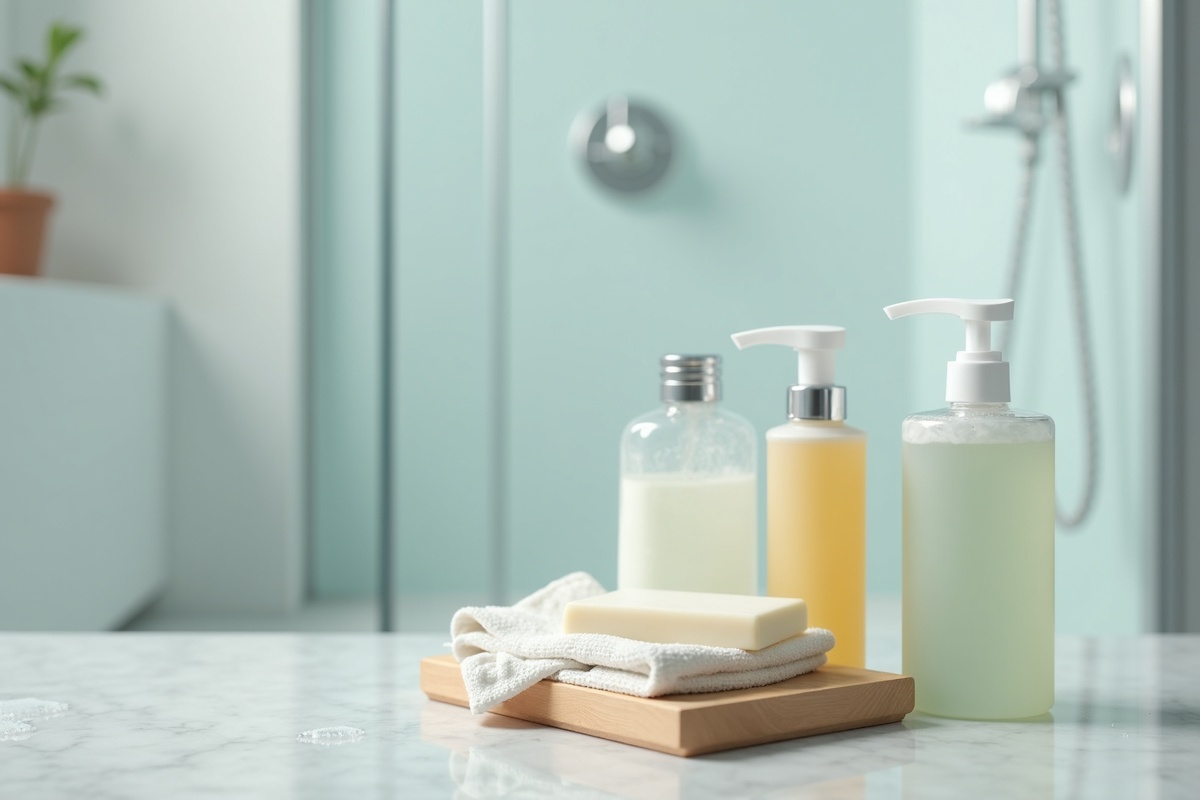
Switch to liquid body wash. Bar soap contains stearic acid (a saturated fatty acid) that reacts with calcium in hard water to form calcium stearate. Liquid body wash is formulated differently and produces minimal soap scum even in hard water. This single change is the most impactful prevention measure available.
Squeegee after every shower. Removing standing water removes the calcium content before it can react with soap residue on the glass surface. The squeegee is the most effective preventive tool. See our glass shower door squeegee guide for full technique guidance.
Apply a hydrophobic glass coating. Factory-applied or retrofit coatings (Diamon-Fusion, EnduroShield) create a molecular barrier on the glass surface that makes it significantly harder for calcium stearate to bond. Glass with a quality coating is dramatically easier to clean and resists soap scum accumulation.
Rinse the glass after every shower. A quick rinse with the showerhead before stepping out dilutes soap concentration on the glass surface, reducing the available fatty acids available to react with minerals.
Run the exhaust fan. Lower bathroom humidity slows the evaporation process and reduces the concentration of minerals at the glass surface.
When to Call a Professional Glass Cleaner
Some situations call for professional intervention rather than continued DIY effort:
- Visible etching: If the glass has a permanent haze that doesn't change with cleaning, the surface has been etched by mineral or acid damage — only glass polishing (cerium oxide compound) can restore clarity
- Years of buildup: Decades of soap scum combined with mineral deposits may be beyond household chemical treatment
- Specialty glass: Low-iron glass, textured glass, or specialty coatings require professional cleaning products and techniques
- Upcoming sale or renovation: Professional glass restoration before listing a home or completing a bathroom renovation delivers the cleanest possible result
Professional glass cleaning for a standard frameless shower enclosure in DFW costs $150–$350 depending on glass area and severity of buildup. Restoration of etched glass (polishing) runs $200–$500.
Does a Magic Eraser work on soap scum on glass?
Magic Erasers (melamine foam) can remove light to moderate soap scum from glass through their mild abrasive action. They work best on fresh or light buildup. Do not use on treated or hydrophobic-coated glass — the abrasive action degrades protective coatings. On standard tempered glass, occasional careful use is generally safe. For heavy or calcified buildup, chemical cleaners are more effective than the Magic Eraser's mechanical action alone.
Is soap scum the same as hard water stains?
No — they're distinct compounds. Soap scum is calcium stearate, formed from the chemical reaction between calcium ions and fatty acids in bar soap. Hard water stains are calcium carbonate and magnesium deposits left when water evaporates. In practice, DFW shower glass typically has both — they accumulate simultaneously and require different chemical approaches. Vinegar dissolves both; oxalic acid (Bar Keepers Friend) targets mineral deposits more specifically; surfactant cleaners target soap scum's fatty acid component more specifically.
Does switching to liquid body wash reduce soap scum?
Yes, significantly. Bar soap contains stearic acid and other fatty acids that react with the calcium in hard water to create calcium stearate (soap scum). Liquid body wash is formulated with different surfactants that don't undergo the same reaction with hard water minerals. DFW homeowners who switch from bar soap to liquid body wash report a dramatic reduction in glass buildup — though mineral deposits (from hard water alone) still form and still require regular squeegeeing and cleaning.
Can soap scum permanently damage shower glass?
Yes, if left long enough. Soap scum itself doesn't etch glass, but the hard water minerals it traps and concentrates against the glass surface do cause etching over time. Severe, long-term buildup also creates a surface that's increasingly difficult to clean without abrasives — and abrasive cleaning eventually scratches and permanently dulls the glass. The combination of soap scum and mineral deposits left for years on DFW glass can result in permanent haze that requires professional polishing to restore.
How often should you clean to prevent buildup?
In DFW's hard water environment: squeegee after every shower (prevents 90% of mineral and soap residue deposition), light clean with vinegar solution or shower glass cleaner weekly, and deep clean with Bar Keepers Friend or a calcium remover monthly. If you use bar soap rather than liquid body wash, bi-weekly deep cleaning is recommended. Consistent daily squeegeeing is the variable that matters most — it determines how frequently and aggressively you need to clean.
Also see our glass shower door cleaning tips and our glass shower door squeegee best practices guide.
Infinity Glass & Glazing installs frameless shower enclosures with optional factory-applied hydrophobic coatings that dramatically reduce soap scum formation throughout the DFW metro. Contact us for a free estimate on your new frameless shower door or glass restoration service.
Related reading: