Commercial storefront glass repair in DFW is almost always a replacement, not a repair — tempered safety glass cannot be re-cut or re-drilled once it is tempered, so the damaged panel is measured, ordered, and swapped, typically 3-10 business days from field measurement to installation. Commercial glass damage costs US businesses $1.2 billion annually in direct replacement costs (GlassBuild America 2024), and for Dallas-Fort Worth restaurants, retail, and office tenants, a broken storefront is both a security issue and a revenue-blocking event until it is resolved.
A cracked or broken storefront panel puts a business on a clock. Open storefronts invite theft, weather damage, and slip-and-fall liability, so the opening usually needs securing before the replacement glass is ready. For DFW property managers, retail operators, restaurant owners, and general contractors, the practical question is what the replacement process actually involves and how long each stage takes.
This guide explains the commercial storefront repair process, pricing, permitting, and insurance considerations so DFW businesses know what to expect when storefront glass is damaged. For new builds and full replacements, our storefront glass installation service handles the frame, the entry door and the glass as one system.
If the damage is to the door rather than a fixed pane — a door that slams, drags or no longer latches, or cracked glass in the door itself — see commercial glass door repair for closers, pivots, hinges and door glass.
Why Storefront Glass Repair Should Never Be Delayed
Delayed storefront glass repair exposes DFW businesses to theft, weather intrusion, liability, and revenue loss. A cracked panel can fail unexpectedly, an open storefront invites unauthorized entry, and insurance claims often require immediate securing of the premises to maintain coverage.
Three reasons to repair storefront glass immediately:
Security. An open or boarded-but-unrepaired storefront signals vulnerability. DFW retail crime trends and opportunistic smash-and-grab incidents mean any unsecured commercial space is at elevated risk.
Weather and interior damage. DFW thunderstorms, hail, and wind-driven rain cause interior merchandise and fixture damage within hours of a glass failure. Drywall, flooring, and inventory losses compound quickly.
Revenue continuity. For restaurants and retail, a boarded storefront reduces foot traffic even when the business is technically open. Reputation recovery takes longer than glass replacement.
Liability. Pedestrians near a cracked but not yet failed panel create negligence exposure if injury occurs. Per Texas premises liability doctrine, reasonably prompt repair is the property owner's obligation.
What Types of Commercial Storefront Glass Damage Are Most Common?
The four most common types of commercial storefront glass damage in DFW are: full-panel breakage (usually from impact), spontaneous tempered glass failure, cracks from thermal stress or building movement, and scratches or surface damage. Each requires different response protocols and has different repair or replacement implications.
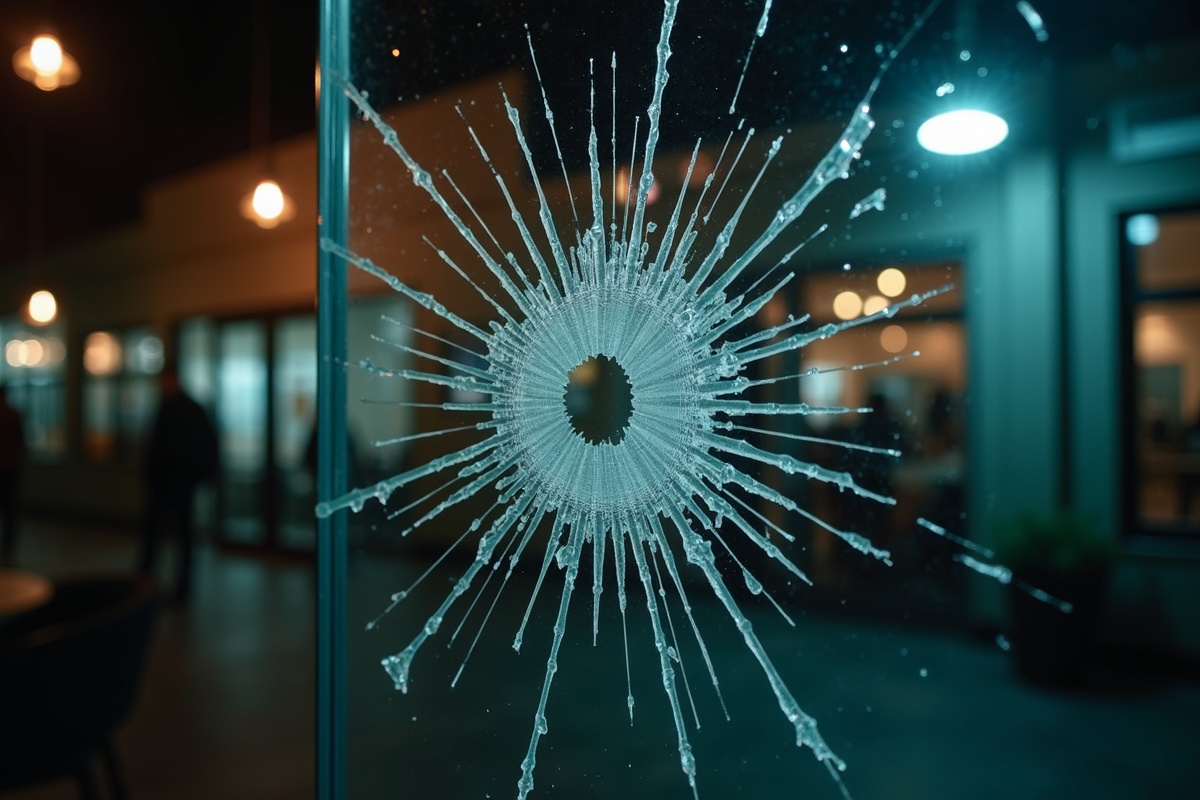
Impact breakage. Vehicle impact, vandalism, break-in attempts, fallen signage, and hail all produce immediate full or partial glass failure. For tempered storefront glass, impact typically shatters the entire panel into small granular pieces (by design per IBC safety code), leaving an open opening.
Spontaneous tempered failure (NiS inclusion). Rare but real — nickel sulfide inclusions in tempered glass can cause spontaneous breakage years after installation. Pattern is distinctive: panel breaks with no visible external cause.
Thermal or stress cracks. Large storefront panels can crack from uneven solar heating, building movement, or improper installation (glass-to-frame contact). These cracks often start small and propagate.
Scratches and surface damage. Graffiti, acid etching, and construction damage do not break the panel but reduce its appearance. Minor scratches can sometimes be polished; deep damage requires panel replacement.
How Is Commercial Storefront Glass Repaired or Replaced?
Commercial storefront glass is almost always replaced rather than repaired — tempered safety glass cannot be re-cut, drilled, or edge-polished once tempered, and any damage compromises the safety performance of the panel. The process is: secure the opening, field measurement, fabrication of replacement glass (3-10 days), then final installation.
- 1
Secure the opening
Handled by a board-up service, not by us — remaining broken glass is cleared and the opening is closed with plywood or security panels until the replacement glass arrives. Line this vendor up before you need one. - 2
Field Measurement and Specification
Exact opening dimensions are field-measured. Glass type (clear, tinted, low-E, laminated), thickness (1/4 in., 3/8 in., 1/2 in.), and any special specifications (hurricane-rated, bullet-resistant, etc.) are confirmed. - 3
Fabrication
Replacement glass is cut, tempered (and laminated if specified), and quality-checked. DFW fabrication turnaround is typically 3-7 business days for standard specifications, 10-15 days for custom or imported specifications. - 4
Installation Day
Any temporary board-up is removed, the storefront frame is prepped, the new glass panel is set, gaskets and seals are installed, and the frame is wiped down. Typical install time: 1-3 hours per panel. - 5
Final Inspection
Contractor confirms panel is fully seated, seals are complete, and the storefront is fully functional. Documentation and warranty paperwork is provided for insurance.
The reason this is a replacement rather than a repair sits in step three. Tempering is the last operation in fabrication, and it locks the panel's dimensions permanently — the surface is under compression, so any later cut, drill, or edge grind releases that stress and the whole sheet fragments. That is why tempered glass cannot be cut to size after the fact, and it is why field measurement has to be exact before anything goes into the oven.
How Much Does Storefront Glass Repair Cost in DFW?
Standard commercial storefront glass replacement costs $500-$2,500 per panel in DFW, including materials, fabrication, and installation (Angi 2025). Large custom panels, laminated or hurricane-rated glass, and installs scheduled around an occupied building add to that baseline. These are published industry ranges, not an Infinity quote — every job is measured and priced individually.
| Service | DFW Cost Range | Typical Timeline | |
| Standard tempered panel (up to 4x8 ft) | $500-$1,500 | 3-7 days fabrication | |
| Large tempered panel (8x10 ft+) | $1,500-$3,500 | 5-10 days fabrication | |
| Laminated security glass | $1,200-$4,500 | 7-14 days fabrication | |
| Low-E insulated glass unit | $1,800-$5,000 | 10-14 days fabrication | |
| Custom tinted or specialty | $2,500-$7,500+ | 10-21 days fabrication |
Cost drivers:
- Panel dimensions. Very large panels (10+ ft) require specialty transportation and additional install labor.
- Glass type. Standard clear tempered is the baseline. Low-E, laminated, tinted, patterned, or fire-rated glass all add cost.
- Frame repair. If impact damaged the aluminum storefront frame, frame repair or replacement adds to cost.
- Scheduling around occupancy. Installations booked outside normal business hours so an occupied store or office is not disrupted typically carry a premium.
- Hoist or lift requirement. Second-story or above-grade glass may require boom lifts or rigging.
Storefront replacement is priced per panel. Interior work is priced per square foot, which is a different calculation entirely — if the project also involves office walls or partitions, our commercial glass partition cost guide covers that side.
What Types of Glass Are Used in Commercial Storefronts?
Commercial storefronts in DFW use four primary glass types: 1/4 in. tempered (small panels), 3/8 in. tempered (medium panels), 1/2 in. tempered (large panels or door lites), and laminated safety glass (enhanced security applications). All must meet IBC safety glazing requirements per Section 2406 (IBC 2024).
Per IBC safety code, tempered glass used in commercial storefronts breaks into small granular pieces rather than sharp shards, minimizing laceration hazard during failure. This is why Texas building code requires tempered (or laminated) glass in all storefront applications below a certain height.
Tempered glass. 4x stronger than annealed of the same thickness. Breaks into small dice when failed. Cannot be cut, drilled, or edge-polished after tempering — any modifications must happen pre-temper.
Laminated glass. Two or more glass lites bonded with PVB or EVA interlayer. When broken, the interlayer holds glass fragments in place — delivers security against smash-and-grab entry, hurricane impact resistance, and acoustic benefits. Typical construction: 1/4 in. + 0.060 in. PVB + 1/4 in.
Low-E coated glass. Microscopically thin metallic coating that reflects radiant heat. Meets Texas Energy Code commercial requirements for SHGC and U-factor. Typical in energy-efficient storefront replacements.
Insulated glass units (IGU). Two glass lites separated by an air or argon gap, sealed at the edge. Provides superior thermal performance for conditioned commercial spaces.
How to Choose the Right Commercial Glass Company for DFW Repairs
A qualified DFW commercial glass contractor for storefront repair has: established supplier relationships for fast tempered-glass turnaround, commercial insurance with adequate liability coverage, experience with Texas building code and DFW permitting, and references from similar commercial properties. Low-bid vendors without local fabrication relationships often quote longer lead times on the replacement panel.
Evaluation checklist:
- Glass lead time. Ask how long a standard tempered storefront panel takes from measurement to delivery, and whether they hold supplier relationships locally.
- Fabrication relationships. Regional DFW fabricators deliver faster than out-of-market suppliers. A contractor with standing accounts at the regional shops gets glass sooner than one shopping the order around.
- Commercial insurance. Verify general liability, workers comp, and commercial auto. Request COI naming the property owner or manager as additional insured.
- Permitting experience. Glass replacement typically does not require a building permit in DFW municipalities, but structural modifications to storefront framing do. A contractor familiar with local AHJs coordinates this.
- References. Request comparable commercial project references within 12 months.
- Warranty. Industry-standard warranty: 1 year on installation, manufacturer warranty on glass (typically 5-10 years).
Insurance and Documentation for Commercial Glass Damage Claims
Most commercial property insurance policies cover storefront glass damage under the main policy or a separate plate glass endorsement. To support a clean claim, document the damage with photos before any work is performed, keep the board-up invoice separate from the replacement invoice, and save all fabrication and installation paperwork.
Insurance documentation workflow:
- Photos of damage. Wide shots, close-ups, and panel dimensions before any work.
- Police report (if applicable). Required for theft, vandalism, or vehicle impact claims.
- Board-up invoice. Itemized separately — board-up is typically covered even if the cause is excluded.
- Replacement invoice. Detailed line items for glass type, dimensions, labor, and any frame repair.
- Manufacturer documentation. Glass type specification, tempering certificate, warranty paperwork.
Claim timeline expectations: insurer acknowledgement in 1-3 business days, adjuster assignment in 3-7 days, claim payment in 10-30 days depending on complexity and deductible.
Also see our commercial glass installation guide for DFW for the storefront systems we install.
Infinity Glass & Glazing handles commercial storefront glass replacement across DFW — Dallas, Fort Worth, Corinth, Denton, Plano, Frisco, Lewisville, and Las Colinas. We field-measure the opening, order the tempered panel to spec, and install it, with documentation your insurer will accept. Scheduled work, Monday through Friday 7:00 AM to 4:00 PM, with installation booked outside those hours when an occupied building calls for it. Request a repair estimate or call (940) 279-1197.
How fast can a broken storefront panel be replaced in DFW?
Field measurement is usually scheduled within a business day or two, and tempered replacement glass typically takes 3-10 business days to fabricate, followed by a 1-3 hour install. Infinity does not run an emergency or after-hours call-out service — if the opening needs securing immediately, use a board-up service for that first, then the permanent replacement follows on the schedule above.
Does commercial storefront glass repair require a permit in Dallas?
Direct glass replacement in an existing frame typically does not require a building permit in Dallas or most DFW municipalities. Replacing the storefront frame itself, modifying opening size, or structural changes to the storefront system do require permits. A qualified commercial contractor confirms requirements with the local AHJ before work begins.
Can tempered storefront glass be repaired or does it need full replacement?
Tempered storefront glass cannot be repaired once cracked or broken — the entire panel must be replaced. Tempered glass cannot be re-cut, edge-polished, or drilled after tempering, and any damage compromises its safety performance. Minor surface scratches can sometimes be polished, but structural cracks require full replacement.
Will my business insurance cover storefront glass replacement?
Most commercial property insurance policies cover storefront glass damage under the main policy or a separate plate glass endorsement, subject to deductible. Causes like theft, vehicle impact, vandalism, and weather are typically covered. Spontaneous tempered breakage coverage varies by policy. Document damage with photos before any work and keep board-up and replacement invoices itemized separately.
What is the standard glass thickness used in commercial storefronts?
DFW commercial storefronts typically use 1/4 in. tempered glass in small lite applications, 3/8 in. tempered in standard panels, and 1/2 in. tempered in large panels or door lites. Laminated safety glass is specified for enhanced security or hurricane-impact requirements. All must meet IBC Section 2406 safety glazing requirements for commercial occupancy.
Related reading: