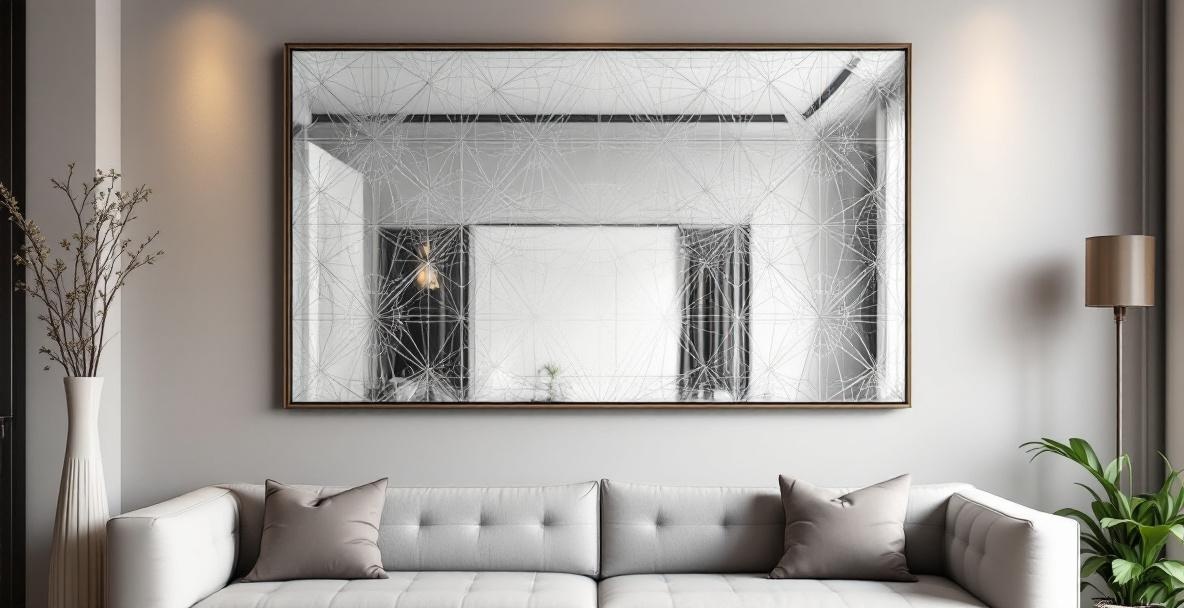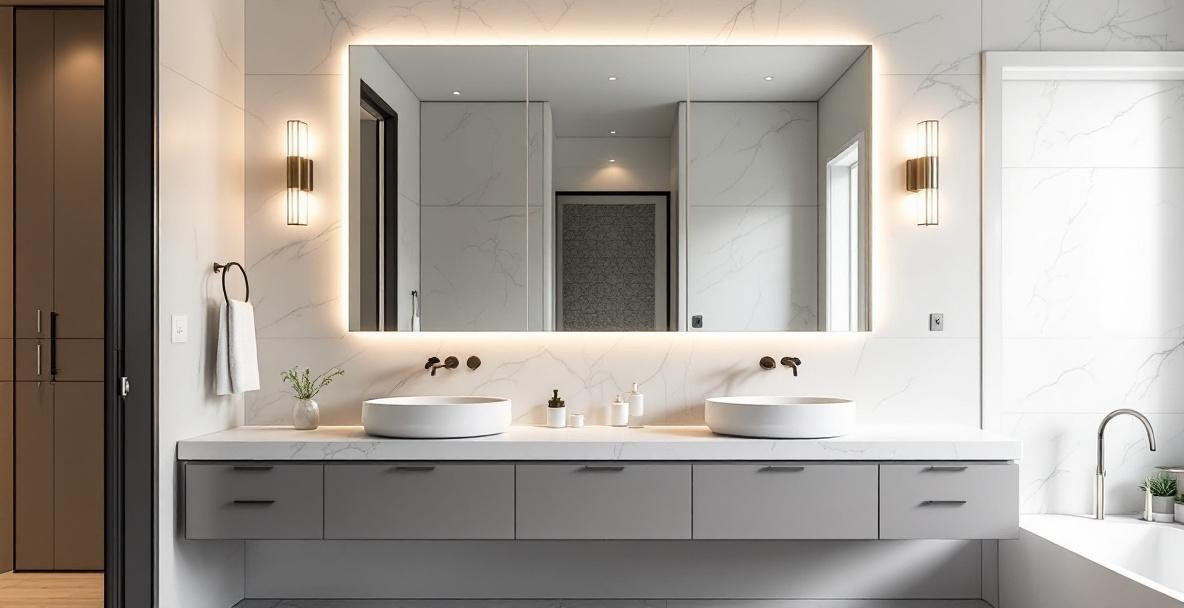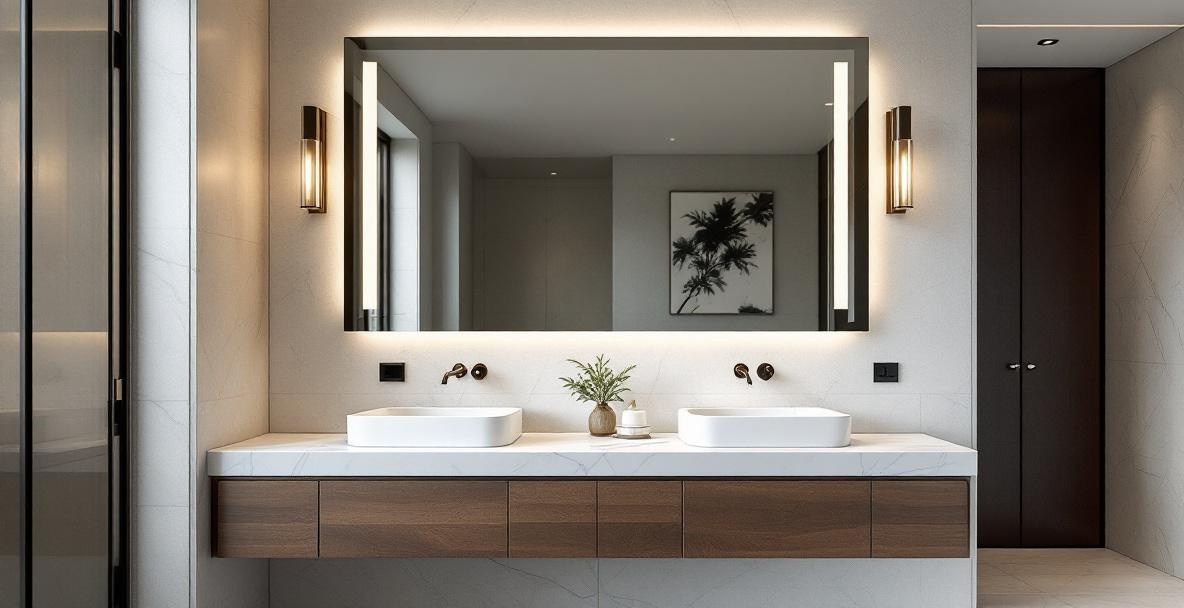
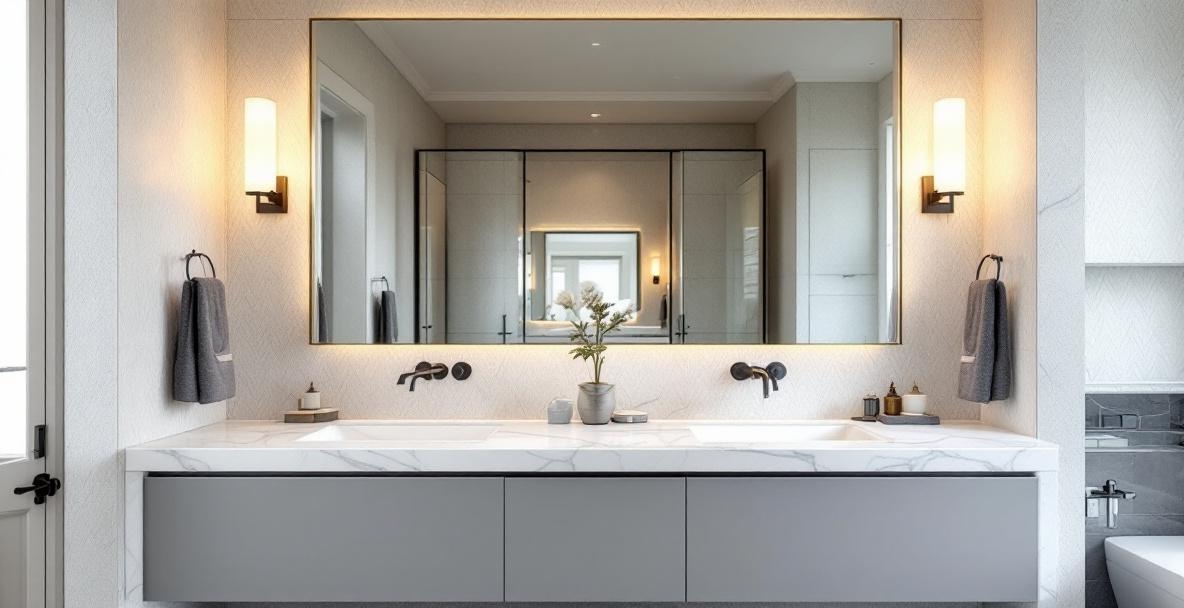
Frameless mirror installation in Dallas-Fort Worth means a custom-cut mirror with polished edges, mounted directly to your wall using mirror mastic adhesive and mechanical anchors — no frame required. Infinity Glass & Glazing fabricates frameless mirrors in any size at our Corinth shop and installs across the full DFW metroplex. Most residential projects are completed within 3-7 business days.
When homeowners search for frameless mirror installation "near me," they're looking for something specific: a mirror that disappears into the wall, where the glass itself is the statement and no frame interrupts the reflection. That result requires two things — a properly fabricated mirror with polished edges, and an installation method that holds it securely without hardware visible from the front.
Both are available locally throughout DFW. This guide explains how frameless mirrors differ from framed, how installation works, and what to expect from a professional installation in your area.
[INTERNAL-LINK: Custom mirrors in Dallas -> /blog/custom-mirrors-dallas-tx]
What Makes a Mirror "Frameless"?
A frameless mirror is a cut piece of mirror glass with polished or beveled edges, mounted directly to the wall surface without any surrounding frame structure. The edge finish — flat polish, bevel, or pencil polish — determines how the perimeter looks. Without a frame to conceal the edge, the edge quality is fully visible and aesthetically significant.
Frameless vs. framed mirrors:
Framed mirrors have a border of wood, metal, or composite material that covers the cut edge of the glass. The frame does the aesthetic work and conceals any edge imperfections. Installation is straightforward — hang from wall hardware like a picture.
Frameless mirrors expose the glass edge entirely. The edge must be professionally polished to a smooth, clean surface. Installation uses mirror mastic adhesive (a non-corrosive adhesive that bonds to the mirror backing without damage) plus J-clips or standoffs for security. The result: a mirror that appears to float on the wall with no visual border interrupting the reflection.
The practical implications:
- Edge quality is visible — professional polishing is mandatory
- Installation requires mirror-specific adhesive chemistry (not standard construction adhesive)
- Large panels need mechanical anchoring in addition to adhesive
- No hanging hardware is visible from the front
What Are the Differences Between Frameless Mirror Edge Profiles?
Three edge profiles are available for frameless mirrors: flat polish (clean, minimal), beveled (decorative, light-catching), and pencil polish (slightly softened). The edge profile is a fabrication decision made before cutting and cannot be changed after the glass is cut and installed.
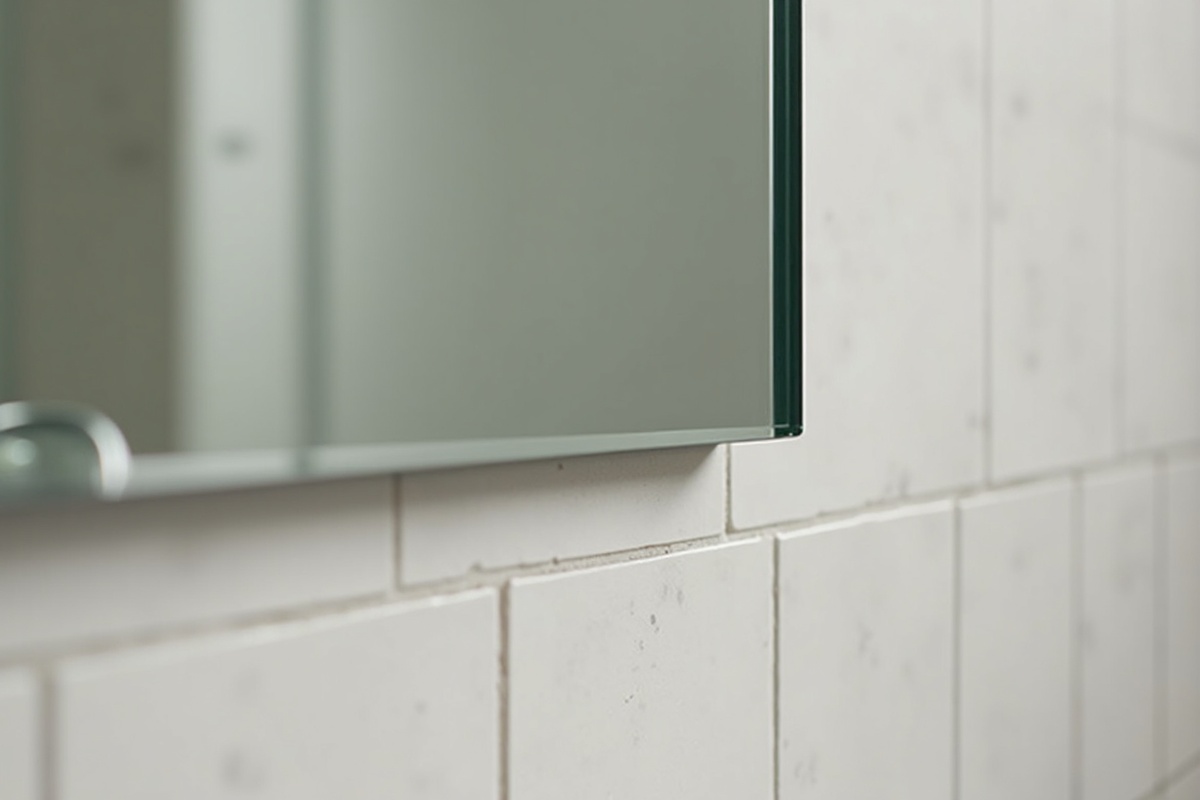
Flat polish: The standard for contemporary and minimalist applications. The cut edge is polished smooth and flat — the entire edge face is one uniform plane. At close range, the polished edge has a clean, bright appearance. The transition from glass face to polished edge is a clean 90-degree arris.
Beveled edge: A 45-degree chamfer is ground around the perimeter of the mirror, creating an angled surface that catches and refracts light differently than the main mirror face. Available in widths from 1/4-inch (subtle accent) to 1-1/2 inches (decorative statement). Best for transitional and traditional bathrooms, or for any mirror where the perimeter is at eye level and visible from close range.
Pencil polish: A slight radius ground into the edge, creating a very subtle rounding at the arris. Less common than flat polish or bevel. Produces a slightly softer transition from edge to face.
1/4-1.5 in
available bevel width range for frameless mirror edge treatment
How Is a Frameless Mirror Installed?
Frameless mirror installation uses mirror mastic adhesive applied to the back of the panel, pressed against the wall, and held in position while the adhesive cures — 24-48 hours. For panels over 15-20 lbs, J-clips or standoff hardware provide mechanical support in addition to the adhesive.
Installation steps:
-
Wall prep: Surface cleaned of dust, oil, and any flaking paint. Stud locations marked for mechanical anchors on heavier panels.
-
Dry fit: Mirror positioned against wall without adhesive to confirm placement, check level, and mark final position.
-
Adhesive application: Mirror mastic applied to back of mirror in a serpentine or dot pattern — providing coverage for adhesion while leaving some void space for thermal movement.
-
Set mirror: Mirror pressed to wall at marked position. Level checked immediately.
-
Support during cure: For panels over 15 lbs, temporary bracing or permanent J-clips hold the mirror in position while adhesive cures.
-
Cure time: 24-48 hours. Shower use should be avoided during cure for bathroom installations.
Critical adhesive note: Standard construction adhesive (Liquid Nails, PL Premium) contains solvents that attack mirror backing — causing "black edge" desilvering within 1-3 years (Cardinal Glass 2025). Only mirror-specific, solvent-free mastic should be used. This is the single most common DIY frameless mirror installation error.
Are Frameless Mirrors Safe in Bathrooms?
Yes — frameless mirrors are safe in bathrooms when properly fabricated and installed. The glass is standard mirror (not tempered) in most bathroom applications, which means it can break into shards if impacted. This is why proper mechanical anchoring is important — a falling large mirror is a safety hazard. Well-installed frameless mirrors with proper adhesive and J-clip support have the same safety profile as any heavy wall-hung fixture.
Safety considerations for bathroom frameless mirrors:
Weight and anchoring: A 36x36-inch mirror weighs approximately 12 lbs. A 60x48-inch mirror weighs approximately 32 lbs. Both can be safely mounted with proper adhesive and mechanical clips into studs or masonry anchors. DIY installations that rely only on adhesive on drywall without stud anchoring create a risk (CPSC 2025).
Edge safety: Polished edges are smooth and safe to touch. Improperly polished edges (sometimes seen in DIY cut mirror) have micro-chips or rough patches that can cut. Professional polishing removes these hazards.
Bathroom humidity: Bathroom humidity doesn't affect the glass itself, but it does affect the mirror backing (silver layer) if moisture penetrates the edge. Quality edge polishing seals the edge face; silicone caulk applied at the mirror perimeter seals the gap between mirror and tile. Together, these protect the backing from moisture penetration.
Where Can You Get Frameless Mirror Installation Near You in DFW?
Infinity Glass & Glazing provides frameless mirror fabrication and installation throughout the Dallas-Fort Worth metroplex — including Corinth, Dallas, Fort Worth, Denton, Frisco, McKinney, Lewisville, Flower Mound, Highland Village, Southlake, and Keller.
The process for scheduling:
- Contact us with your wall dimensions and intended location (bathroom vanity, bedroom wall, gym, etc.)
- Get a quote — for standard rectangular mirrors, we can quote from your measurements without an on-site visit
- Confirm order — mirror is fabricated at our Corinth shop within 3-5 business days
- Schedule installation — typically same-week for residential projects once the mirror is ready
For complex installations (arched tops, large panels, multi-mirror configurations), an on-site measurement visit is recommended before fabrication begins.
Get frameless mirrors installed anywhere in DFW. Contact Infinity Glass & Glazing or call (940) 279-1197 for a free quote.
Are frameless mirrors safe in bathrooms?
Yes, when properly installed. Frameless mirrors use polished glass edges (safe to touch) and are mounted with mirror-specific adhesive plus mechanical clips for panels over 15 lbs. The risk is improper installation — relying only on standard construction adhesive on drywall without stud anchoring. Professional installation with proper adhesive chemistry and mechanical support makes frameless mirrors as safe as any heavy wall fixture.
Can a frameless mirror be installed without drilling into the wall?
For small mirrors (under 10-12 lbs), adhesive-only installation is reasonable with proper mirror mastic. For larger panels, some adhesive-only systems claim to hold heavy mirrors, but they represent a safety risk if the adhesive ever partially releases. Professional installation for large frameless mirrors always includes mechanical anchoring — either J-clips into studs or standoffs into masonry.
What is the difference between a beveled and polished edge on a frameless mirror?
A polished (flat polish) edge is ground smooth and flat — the entire edge face is one clean plane. A beveled edge has an additional 45-degree chamfer around the perimeter that catches and refracts light, creating a decorative prismatic effect visible at the mirror perimeter. Beveled edges are more decorative; flat polish is cleaner and more contemporary.
What size frameless mirror works best over a vanity?
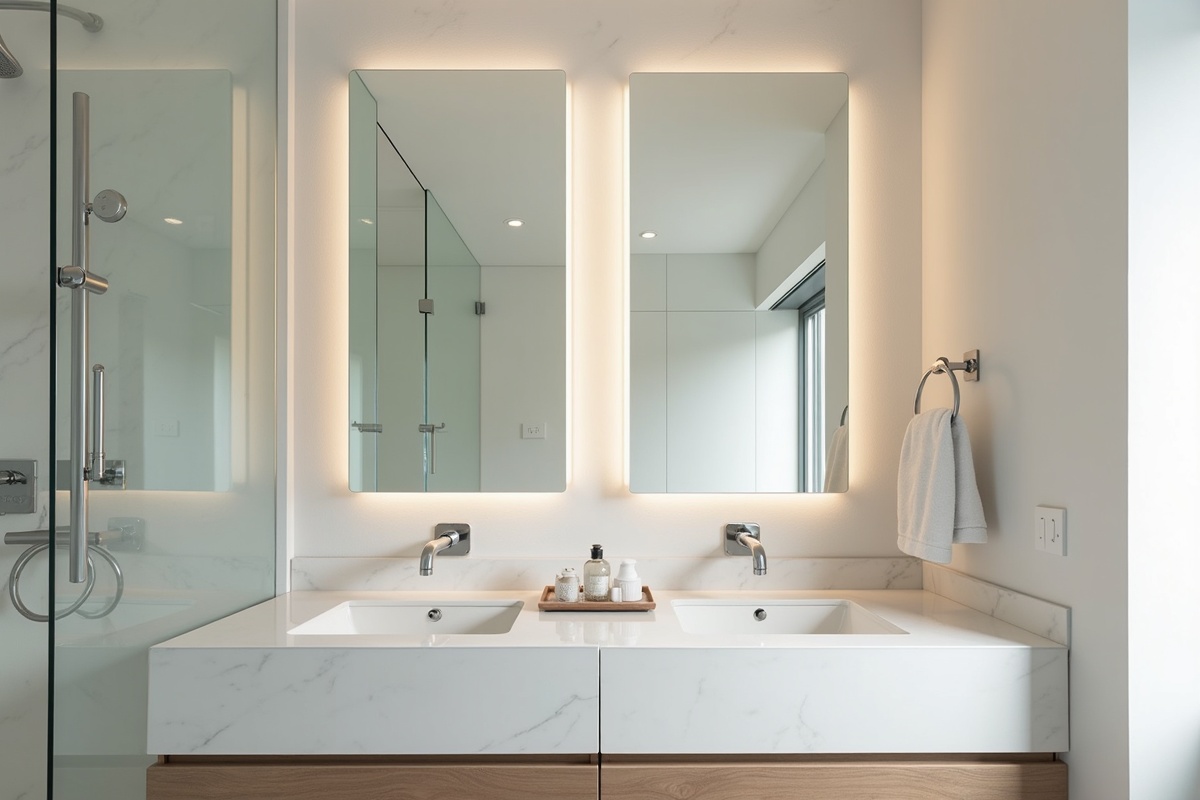
A vanity mirror should span 80-90% of the vanity cabinet width (leaving 2-4 inches on each side) and be 28-42 inches tall depending on ceiling height and fixture placement (NKBA 2025). For a 60-inch double vanity, target a 52-56-inch wide mirror. For a 48-inch single vanity, target a 40-44-inch mirror. Custom fabrication gets you exactly these dimensions — stock mirrors rarely match.
Related reading: custom mirrors in DFW and our decorative mirror installation.
Related reading: