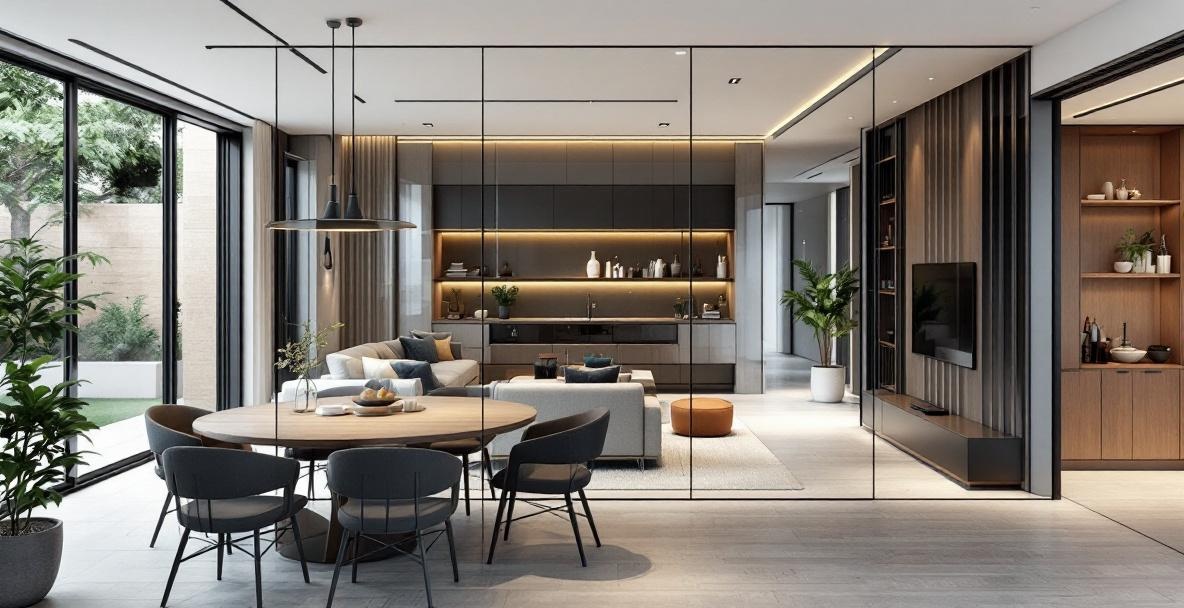
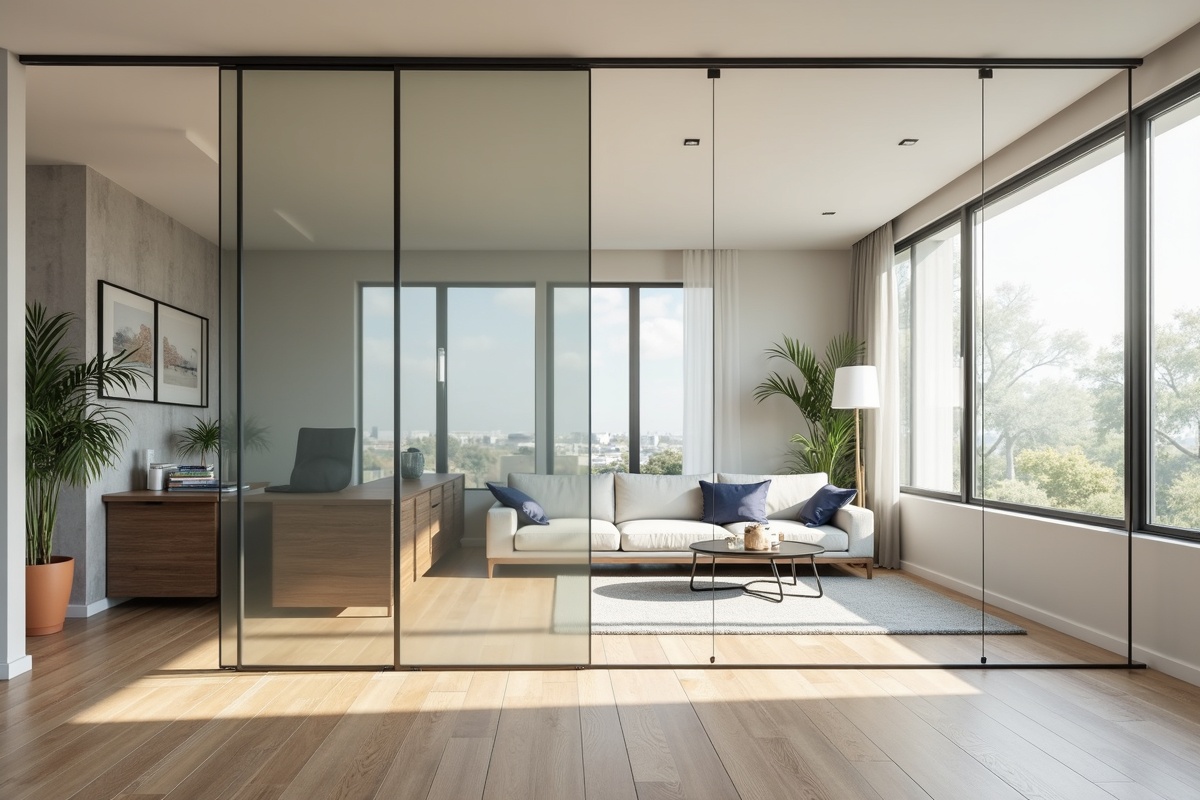
Glass room dividers in Dallas cost $60–$180 per square foot installed for permanent framed or frameless systems (HomeGuide 2025). Sliding glass room dividers run $100–$250 per square foot. The primary advantage over solid walls: glass dividers define spaces without blocking light or creating the enclosed, subdivided feeling that drywall creates.
Open-plan living and working spaces offer light and visual connection, but they lack the acoustic separation and zone definition that people actually need — a quiet space to work from home, a separation between an active kitchen and a formal dining room, a private conference room in an open office. Glass room dividers solve this problem by creating defined spaces that maintain visual openness and light transmission.
In Dallas homes, glass room dividers appear most often between home offices and living areas, between dining rooms and living rooms, and in converted garages and bonus rooms. In Dallas offices, they're the standard approach for open-plan buildouts that need conference rooms without full drywall construction.
[INTERNAL-LINK: Glass partitions for Dallas offices -> /blog/glass-partitions-office-dallas]
What Types of Glass Room Dividers Are Available in Dallas?
Four glass room divider configurations cover most Dallas residential and commercial applications: fixed framed panels (permanent installation in an aluminum or steel frame), fixed frameless panels (glass in floor and ceiling track without a visible perimeter frame), sliding single-panel (one panel that slides to open the space), and sliding multi-panel (accordion-style panels that fold and stack to open the full width).
Fixed framed glass panels:
- Glass set in a perimeter aluminum or steel frame anchored to floor and ceiling
- Most structurally straightforward and cost-effective
- Frame visible on all sides of each panel
- Available with door openings integrated into the panel system
- Cost: $60–$100/sq ft installed
- Best for: office buildouts, permanent home office separations
Fixed frameless glass panels:
- Glass set in a floor track (head track) and ceiling track with no visible side frame between panels
- Maximum visual transparency — panels appear to float between floor and ceiling
- More precision-dependent installation than framed systems
- Cost: $100–$180/sq ft installed
- Best for: high-end residential applications, premium office environments
Sliding single glass panel:
- One glass panel on a top-mount track that slides to open the space fully
- When open, panel stacks against a wall; when closed, panel spans the opening
- No swing clearance required — valuable in tight layouts
- Cost: $150–$250/sq ft for the panel + track system
- Best for: home offices, media rooms, rooms where the opening is needed periodically
Sliding multi-panel / folding systems:
- Multiple panels on a shared track that fold and stack to fully open a wide opening
- Can open an entire wall — creates a full indoor-outdoor or room-to-room connection
- Most complex system; highest cost
- Cost: $200–$400+/sq ft for full folding wall systems
- Best for: entertainment spaces, large conference rooms, patio-to-interior connections
$60–$180
per square foot installed for glass room dividers in Dallas — system type and frame specification are primary cost drivers
How Do Glass Room Dividers Compare to Drywall?
Glass room dividers cost 2–3x more than drywall upfront but deliver advantages that drywall cannot: natural light transmission, visual connectivity between zones, and (for demountable systems) zero-cost future reconfiguration.
| Cost per sq ft |
| Natural light |
| Visual connection |
| Reconfiguration |
| Acoustic STC |
| Permit required |
| Timeline |
The business case for glass over drywall in Dallas homes:
-
Light-critical rooms: In a home where a home office conversion would block natural light from adjacent spaces, a glass divider preserves the light and the sense of openness.
-
Resale value: Glass room dividers are a visible, premium feature in DFW real estate that drywall walls are not. They photograph well and signal a designed, considered renovation.
-
Reversibility: Fixed framed systems are roughly as permanent as drywall. Demountable systems can be removed completely with minimal wall damage — a significant advantage for homeowners who may want to reconfigure or restore the space.
What Glass Options Are Available for Room Dividers?
Three glass options cover most Dallas room divider applications: clear tempered (full transparency), frosted or satin (translucent privacy with light transmission), and filmed/patterned glass (partial privacy with decorative options).
Clear tempered glass:
- Full visual transparency — the divider reads as a glass barrier, not a wall
- Light flows completely through
- Best when visual connectivity between spaces is the design goal
- Required to be tempered (safety glass) in floor-to-ceiling room divider applications
Frosted or satin glass:
- Diffuses vision while transmitting light — the zone behind reads as lit and occupied, but specific details aren't visible
- Common for home offices where the worker wants privacy without total isolation
- Available in multiple frost densities from light diffusion to near-opaque
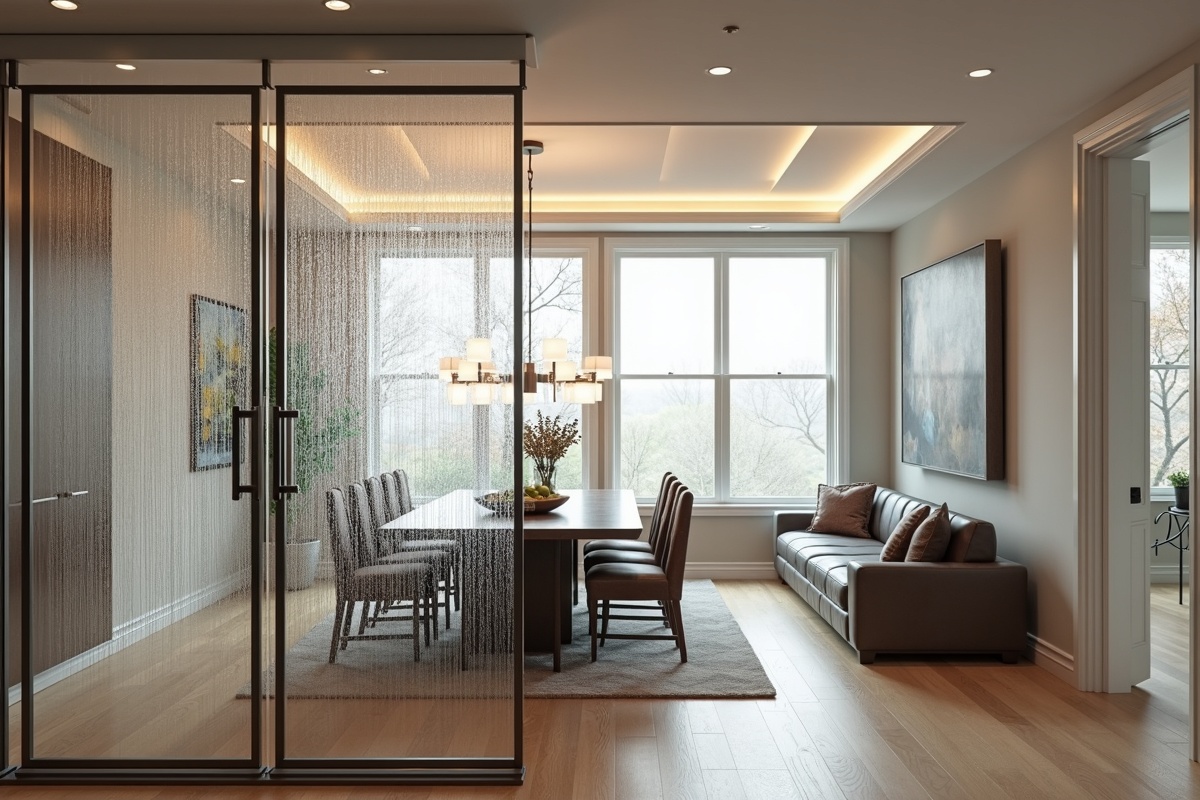
Reeded or textured glass:
- Textured glass that diffuses vision through the surface pattern
- Creates a decorative visual element in addition to the privacy function
- The reeded glass trend has made this the most design-forward option for DFW residential room dividers in 2025–2026 (Houzz 2025)
How Long Does Glass Room Divider Installation Take in Dallas?
A standard glass room divider installation in Dallas takes 3–5 weeks from initial contact to completed installation — approximately 1 week for measurement and design, 2–3 weeks for glass fabrication, and 1–2 days of on-site installation for a standard residential opening.
Timeline breakdown:
Days 1–3: On-site measurement, design consultation (glass type, frame option, door or no door, hardware finish).
Days 3–7: Quote and design approval.
Weeks 2–4: Glass fabrication. Standard tempered panels fabricate in 2–3 weeks. Specialty glass (reeded, laminated) takes 3–5 weeks.
Installation day: Track anchoring (floor, ceiling, walls), glass panel setting, hardware installation, door hanging if applicable. A standard 10-foot opening residential divider typically installs in one day.
Infinity Glass & Glazing installs glass room dividers across DFW — frameless, framed, and sliding systems for Dallas homes and commercial spaces. Serving Corinth, Dallas, Fort Worth, Frisco, McKinney, Lewisville, and surrounding areas. Get a free estimate or call (940) 279-1197.
How much does a glass room divider cost in Dallas?
Glass room dividers in Dallas cost $60–$180 per square foot installed for fixed framed or frameless systems. Sliding single-panel systems run $150–$250/sq ft. Full folding wall systems run $200–$400+/sq ft. A standard 10-foot wide, 9-foot tall residential glass room divider in a framed system typically costs $5,400–$9,000 installed.
Can a glass room divider include a door?
Yes — most glass room divider systems accommodate integrated door openings. The door can be a swinging glass panel (frameless patch-fitting or framed), a sliding glass panel on a separate track within the system, or a pocket door. Door hardware finishes match the room divider frame system for a unified appearance.
Do glass room dividers provide sound isolation?
Single-pane glass room dividers achieve STC 38–44, which prevents conversational speech from being intelligible through the partition (GlassBuild America 2025). This is adequate for most residential applications. For home offices requiring conference call privacy, double-glazed panels can achieve STC 44–52. Gaps at the floor, ceiling, and wall connections are the primary acoustic weak point — proper sealing is critical.
What is the difference between a glass room divider and a glass partition?
In practice, they describe the same type of installation — a glass wall system that separates interior spaces. "Room divider" is more commonly used in residential contexts; "glass partition" is more common in commercial/office contexts. The systems, glass specifications, and installation methods are essentially identical.
Related reading: office glass partitions in Dallas and our residential glass wall panels.
Related reading: