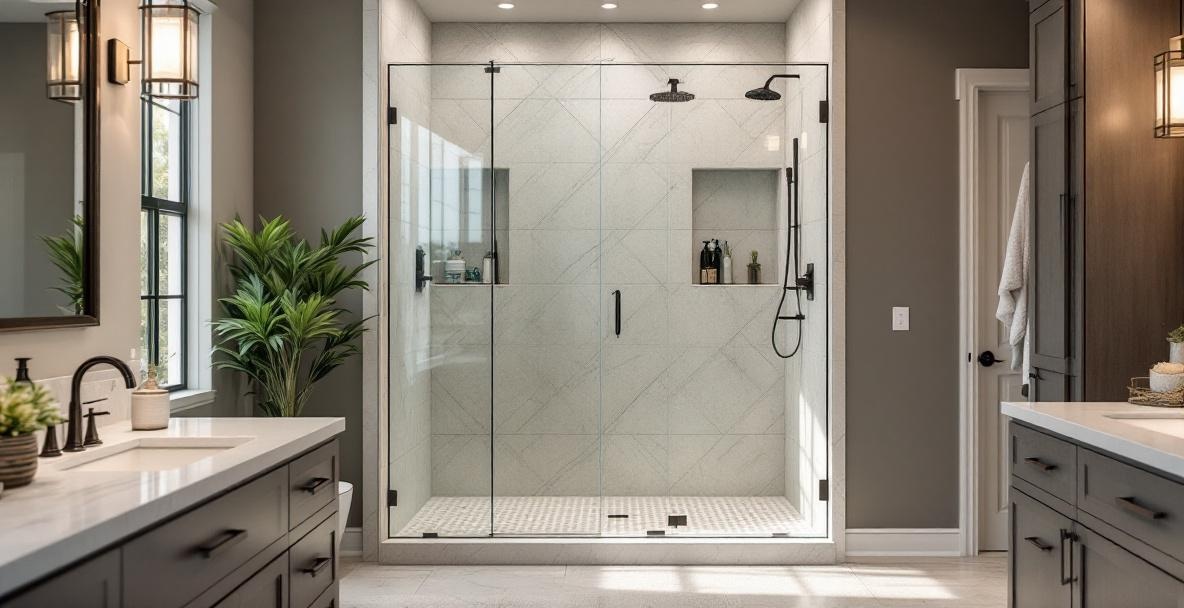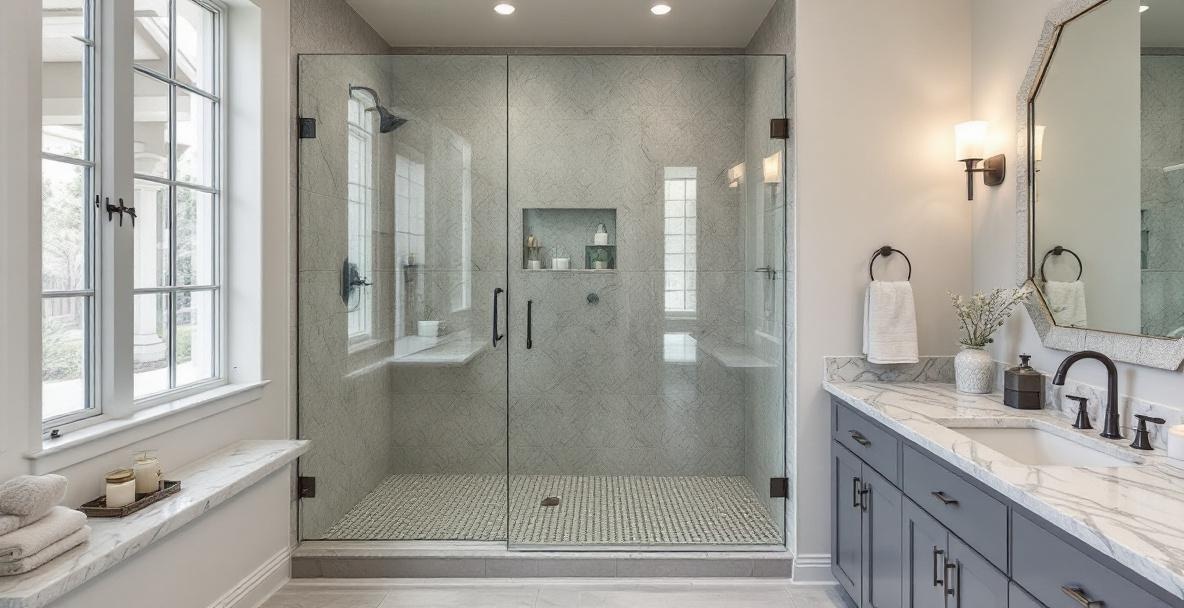
Hinged frameless shower doors deliver the cleanest look in modern bathroom design. They require 3/8-inch to 1/2-inch tempered glass to support their own weight without a frame, and the IRC mandates outward-swinging doors with a minimum 22-inch opening (IRC Section R308). Proper hinge installation requires 1/8-inch to 3/16-inch reveal gaps for smooth operation (Basco).
A hinged frameless door is a single panel of heavy tempered glass attached to the wall (or an adjacent panel) with metal hinges. No frame, no track, no rail -- just glass, hinges, and a handle. It swings open like a traditional door, creating a wide opening that makes stepping in and out effortless.
This is the premium option in shower door design, and it's what most homeowners picture when they think "luxury bathroom." But getting it right requires understanding the code requirements, hardware options, and installation details that make the difference between a door that operates flawlessly and one that sags or leaks.
TL;DR: Hinged frameless shower doors use 3/8-inch to 1/2-inch tempered glass mounted on wall or glass-to-glass hinges. IRC code requires outward-swinging doors and a minimum 22-inch opening. Proper installation demands 1/8-inch to 3/16-inch reveal gaps at the hinge side (Basco).
[INTERNAL-LINK: frameless shower doors overview -> /blog/frameless-shower-doors-dallas-tx]
What Is a Hinged Frameless Shower Door?
A hinged frameless shower door is a single panel of 3/8-inch to 1/2-inch tempered glass mounted on pivot hinges without any surrounding metal frame. The glass is thick enough to be structurally self-supporting, and the hinges bear the full weight of the panel -- typically 60 to 100 pounds.
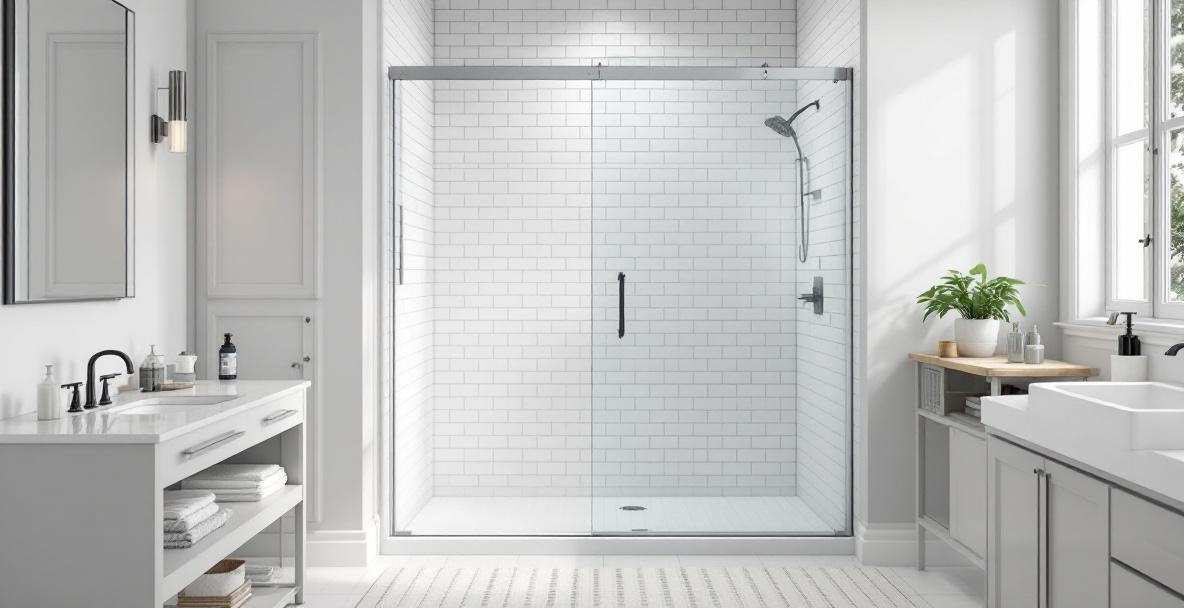
Unlike bypass doors that slide on tracks or framed doors that rely on aluminum channels for support, a hinged frameless door has no structural frame at all. The glass edges are polished smooth and left exposed. The only hardware is the hinges (usually two or three, depending on door height and weight) and a handle or knob.
This minimalist approach is what gives frameless doors their signature clean look. But it also means the engineering has to be precise. The hinges must be rated for the door's weight, the wall must be reinforced to support the load, and the glass must be cut and drilled to exact specifications before tempering.
Why Frameless Requires Heavier Glass
Framed doors can use 1/4-inch glass because the aluminum frame provides structural support. Remove the frame, and the glass must support itself. That's why frameless doors require a minimum of 3/8-inch tempered glass -- and 1/2-inch is recommended for larger doors or heavier-use applications.
3/8 inch to 1/2 inch
tempered glass thickness required for frameless hinged shower doors
Citation capsule: Hinged frameless shower doors require 3/8-inch to 1/2-inch tempered glass because the panel must be structurally self-supporting without a metal frame, with each door panel typically weighing 60 to 100 pounds depending on dimensions and glass thickness.
[INTERNAL-LINK: our services -> /services]
How Do Hinged Frameless Doors Compare to Sliding?
Hinged doors provide a wider opening and a more premium aesthetic, while sliding doors save space and cost less. The IRC requires hinged shower doors to swing outward with a minimum 22-inch opening (IRC Section R308), which means you need adequate floor clearance.
The choice between hinged and sliding is fundamentally about space. Can your bathroom accommodate a swinging door? If yes, hinged frameless is the premium option. If not, sliding is the practical solution.
| Opening Width |
| Floor Clearance |
| Glass Thickness |
| Hardware |
| Best For |
| Cost (installed) |
| Aesthetic |
| Maintenance |
The Clearance Reality
A 30-inch wide hinged door needs at least 30 inches of clear floor space in front of it. In many DFW bathrooms, that space is occupied by a toilet, vanity, or opposing wall. Measure before you fall in love with the idea of a hinged frameless door -- the layout has to support it.
[INTERNAL-LINK: bypass sliding doors -> /blog/bypass-sliding-glass-shower-doors]
What Hinge Types Are Available?
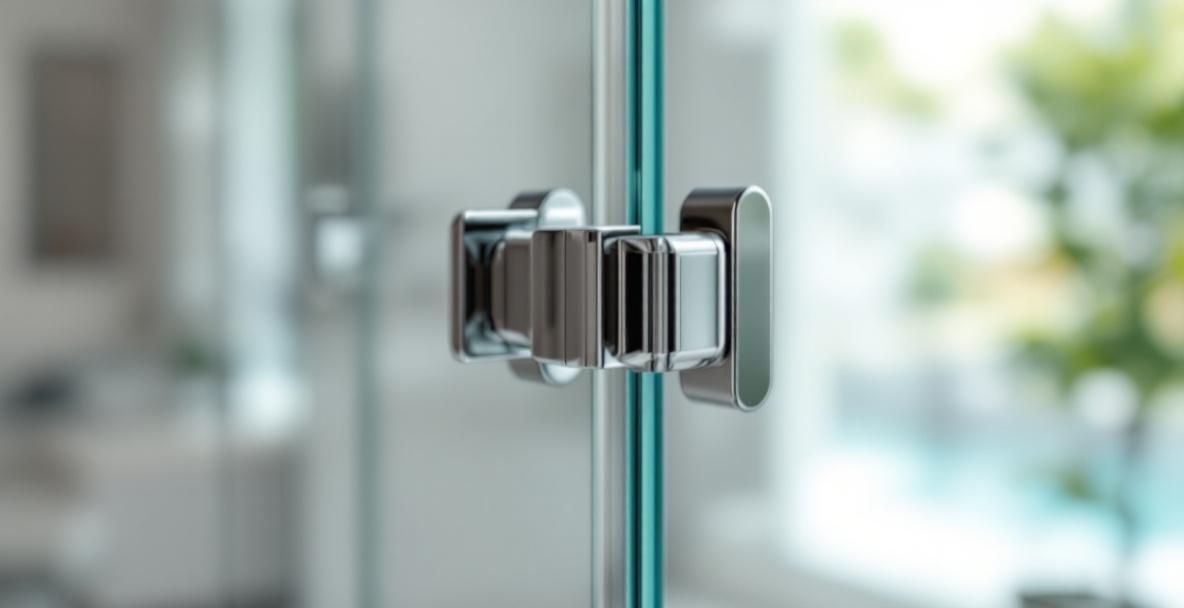
Shower door hinges come in three main configurations: wall-to-glass, glass-to-glass, and pivot. Each serves a different enclosure layout, and the choice depends on whether your door mounts to a wall, to an adjacent glass panel, or to the floor and header.
Wall-to-Glass Hinges
The most common type. One side of the hinge attaches to the wall (through tile, into studs or blocking), and the other side clamps onto the glass edge. These are used when the door panel is adjacent to a solid wall.
- Pros: Strongest mounting, simplest installation
- Cons: Requires solid wall structure (studs or blocking behind tile)
Glass-to-Glass Hinges
Used when the door panel attaches to an adjacent fixed glass panel rather than a wall. Both sides of the hinge clamp onto glass. These are common in corner enclosures where one fixed panel and one door panel meet at a 90-degree angle.
- Pros: Allows door mounting without a wall
- Cons: Fixed panel must be thick enough and properly supported to bear the door's weight
Pivot Hinges
Pivot hinges mount at the top and bottom of the door rather than on the side edge. The door rotates on a central axis. These create a dramatic, wide-swing opening and are often used in high-end residential and commercial applications.
- Pros: Dramatic opening, can swing both directions
- Cons: More complex installation, requires floor and header mounting points
How Much Do Hinged Frameless Shower Doors Cost?
A single hinged frameless shower door costs $900 to $2,500 installed in DFW, depending on glass thickness, door dimensions, hardware finish, and edge finishing. Custom frameless enclosures with hinged doors and fixed panels range from $1,400 to $3,300+ (HomeGuide, 2026).
Price Factors
- Glass thickness -- 1/2-inch glass costs 20-30% more than 3/8-inch
- Door dimensions -- taller and wider doors require heavier glass and more robust hinges
- Hardware finish -- chrome is the most affordable; matte black and brushed gold are premium
- Edge finishing -- flat polished edges are standard; mitered edges for corner joints add cost but create a seamless appearance
- Number of panels -- a simple door-only installation costs less than a door-and-panel or full enclosure
- Hinge type -- glass-to-glass hinges cost more than wall-to-glass because they require additional engineering
What You're Paying For
The cost difference between a $900 hinged door and a $2,500 one is almost never the glass alone. It's the combination of thicker glass, premium hardware finishes, precision edge work, and in-house fabrication versus outsourced cutting. A $900 door might use 3/8-inch glass with chrome hardware. A $2,500 door might use 1/2-inch low-iron glass with matte black hardware and mitered edges.
$900-$2,500
installed cost range for a single hinged frameless shower door in DFW
What Clearance Do Hinged Frameless Doors Require?
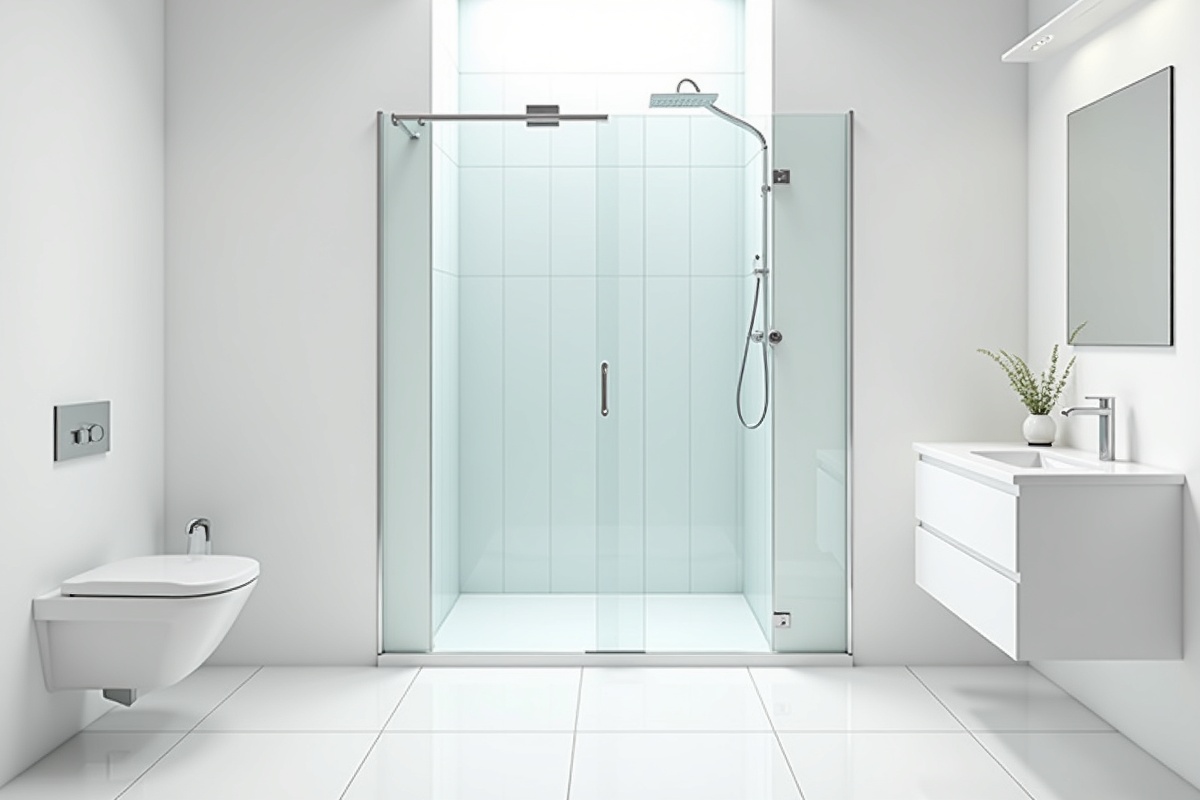
The International Residential Code (IRC) requires shower doors to swing outward and provide a minimum 22-inch opening (IRC Section R308). In practice, most hinged frameless doors are 24 to 36 inches wide, requiring that much clear floor space for the swing arc.
This is the measurement that determines whether a hinged door works in your bathroom. And it's not just about the floor -- you also need to check for clearance above (ceiling height) and to the sides (adjacent walls, vanities, or fixtures).
Clearance Measurements to Take
- Floor clearance -- measure from the shower opening outward by the full width of the door. This entire arc must be clear of obstructions.
- Door width -- standard hinged frameless doors are 24, 28, 30, 32, or 36 inches wide. Wider doors are possible but require heavier hinges.
- Ceiling height -- most glass panels are 72 to 80 inches tall. Ensure your ceiling allows for the panel height plus hardware.
- Hinge-side reveal -- proper installation requires a 1/8-inch to 3/16-inch gap between the door edge and the wall or panel it hinges against (Basco). This gap prevents binding and allows smooth operation.
Citation capsule: The International Residential Code requires hinged shower doors to swing outward with a minimum 22-inch opening for emergency access, and proper hinge installation requires 1/8-inch to 3/16-inch reveal gaps between the door edge and adjacent surfaces for smooth, bind-free operation, according to Basco.
How Are Hinged Frameless Doors Installed?
Professional hinged frameless door installation takes 2 to 4 hours on-site, following 1 to 3 weeks of custom fabrication. The critical steps are reinforcing the wall for hinge mounting, setting precise reveal gaps, and aligning the door so it swings freely without dragging.
- 1
Wall Preparation
The installer verifies that studs or solid blocking exist behind the tile where the hinges will mount. If the wall is hollow at the hinge points, blocking must be added before installation can proceed. - 2
Hinge Mounting
Hinges are positioned on the wall and drilled through the tile into the stud or blocking. Each hinge must be perfectly plumb -- if they're off by even a fraction, the door will swing unevenly or not close properly. - 3
Glass Hanging
The door panel is lifted into the hinges and secured. This is a two-person minimum job -- a 30-inch by 72-inch panel of 3/8-inch glass weighs approximately 75 pounds. The panel must be perfectly vertical when mounted. - 4
Reveal and Alignment
The installer adjusts the hinges to achieve the correct 1/8-inch to 3/16-inch reveal gap on the hinge side. The door should swing freely without touching any adjacent surface and return to center when released. - 5
Seals and Final Adjustments
Door sweeps, drip rails, and edge seals are installed to contain water spray. The handle or knob is attached. Silicone is applied where glass meets tile at fixed panels.
[ORIGINAL DATA] We've installed thousands of hinged frameless doors across DFW. The most common installation error we see from other companies is inadequate wall reinforcement. Hinges that are only anchored into tile and drywall -- without hitting studs or blocking -- will eventually loosen and cause the door to sag. We always verify wall structure before starting.
Why Do Mitered Edges Improve Hinged Enclosures?
On hinged frameless enclosures with fixed panels, mitered edges at the 90-degree corners create a flush, seamless joint with no visible gap. A 45-degree mitered edge produces an invisible seam where two glass panels meet (IDEAL Shower Doors), eliminating the need for thick silicone beads at the joint.
Standard butt joints leave a visible gap between panels -- typically 1/8 inch to 1/4 inch -- filled with silicone. Over time, that silicone yellows, collects mold, and needs replacement. Mitered joints minimize this gap dramatically.
Where Mitered Edges Apply on Hinged Enclosures
- 90-degree corner joints -- where two fixed panels meet at a corner
- Panel-to-panel transitions -- where a fixed panel meets another fixed panel in an inline configuration
- Notched areas -- where glass wraps around a bench or half-wall
Mitered edges don't apply to the hinge side of the door itself -- that edge needs a flat, polished finish for the hinge clamp to grip properly. But everywhere else on a multi-panel enclosure, mitering creates a visibly superior result.
[PERSONAL EXPERIENCE] At Infinity Glass & Glazing, mitered corners are standard on every corner enclosure we build. We've been cutting 45-degree miters in-house for over 30 years using CNC edging equipment. It's one of the details that separates our work from the competition -- and once you see the difference side by side, it's impossible to unsee.
Get a Hinged Frameless Door That Lasts
A hinged frameless shower door is the premium choice for any bathroom with the space to accommodate it. The combination of heavy tempered glass, minimal hardware, and a wide-swinging opening creates an experience that cheaper alternatives simply can't match. But the quality of the installation determines whether that door operates smoothly for 20+ years or starts sagging within two.
If you're considering a hinged frameless door for your DFW home, schedule a free in-home measurement or call (940) 279-1197. We'll evaluate your space, discuss glass thickness and hardware options, and give you an honest recommendation -- even if that means suggesting a different door type for your layout.
Do hinged frameless shower doors swing in or out?
Building code (IRC Section R308) requires shower doors to swing outward for safety. If someone falls inside the shower, an outward-swinging door can still be opened for emergency access. Some pivot hinges allow both inward and outward swing, but the door must be able to open outward.
How heavy is a hinged frameless shower door?
A standard 30-inch by 72-inch panel of 3/8-inch tempered glass weighs approximately 75 pounds. The same panel in 1/2-inch glass weighs about 100 pounds. The hinges must be rated for the full weight of the door, and the wall must have solid blocking behind the tile to support it.
Can a hinged frameless door be installed on a bathtub?
Yes, but it's less common than on walk-in showers. The door must swing outward (away from the tub), which requires floor clearance. The tub rim also needs to be level and stable enough to support a bottom seal. For tub-shower combos with limited clearance, a bypass sliding door is usually more practical.
What is the standard width for a hinged frameless shower door?
Standard widths are 24, 28, 30, 32, and 36 inches. The IRC requires a minimum 22-inch opening. Wider doors are possible but require heavier-duty hinges and more robust wall reinforcement. Most DFW homeowners choose 28 to 32-inch doors for walk-in showers.
Related reading: frameless shower door hardware and our shower door buyer guide.
Related reading: