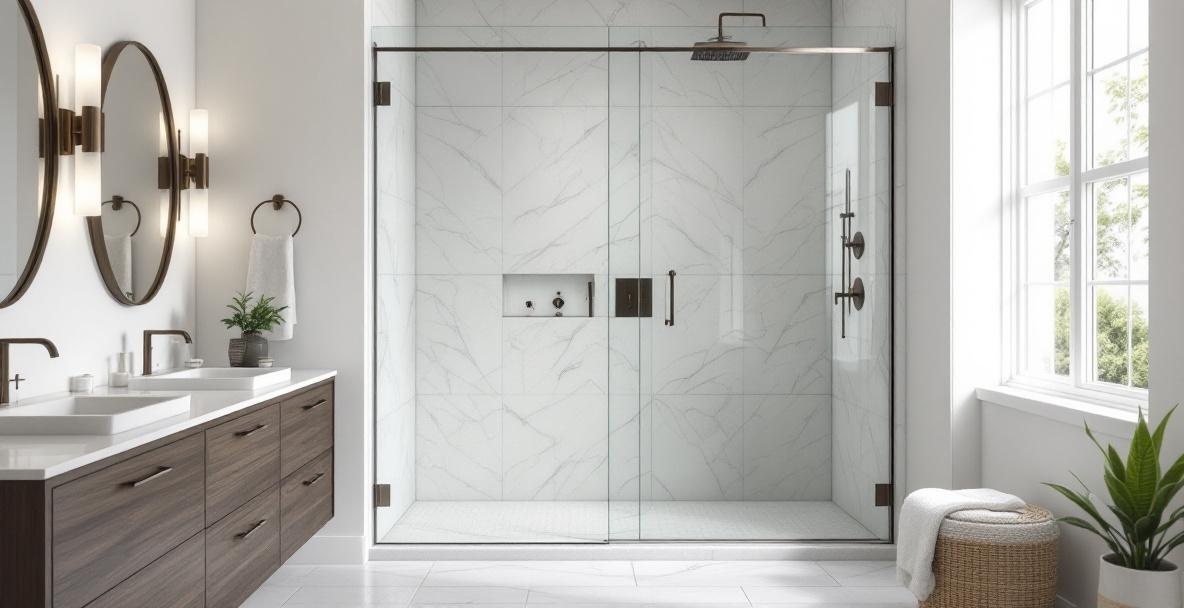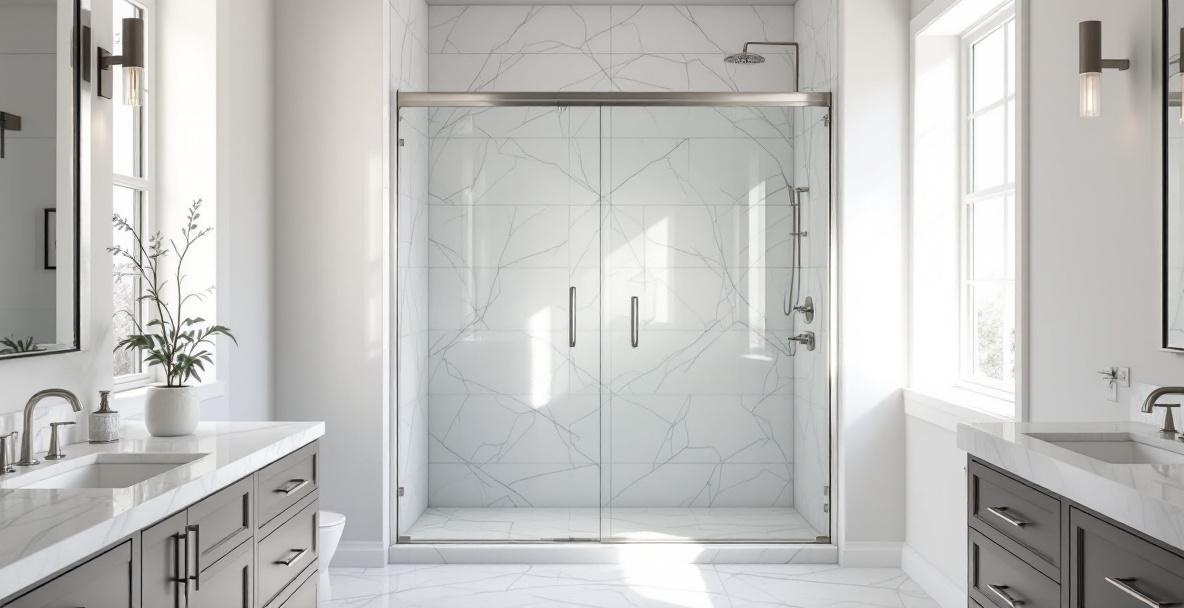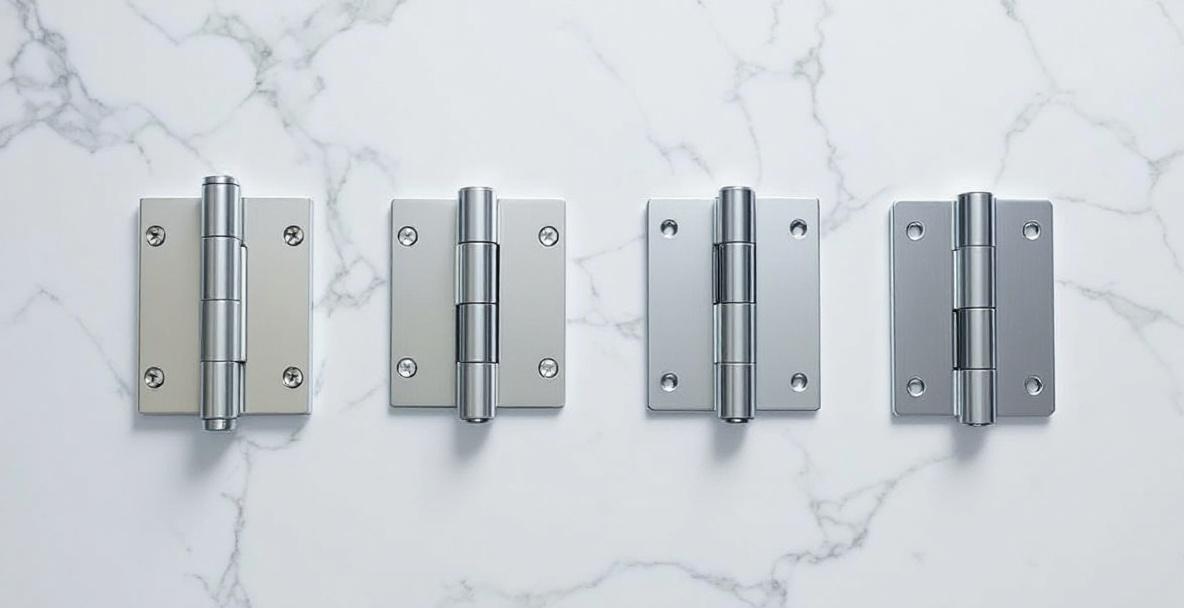

Precision glass cutting for shower doors means holding dimensional tolerances of +/- 1/16 inch or tighter on every panel cut. At this tolerance, panels fit against wall surfaces with a controlled, even gap for silicone sealing. At looser tolerances — common in outsourced production — gaps become uneven, seals fail at corners, and doors swing off-plumb. The cut quality is the foundation everything else is built on.
Every piece of glass in your shower started as a flat sheet that had to be reduced to an exact size. That reduction — the cut — sounds simple. But glass doesn't cut like wood or metal. It scores and breaks along a scribed line, and the break quality depends on the tool, the technique, the glass temperature, and the edge finishing that follows.
For shower applications, the cut determines fit. Fit determines seal quality. Seal quality determines whether your shower leaks at the corners in three years. Precision at the start of fabrication cascades through every stage.
[INTERNAL-LINK: In-house fabrication benefits -> /blog/shower-glass-fabrication-in-house]
How Is Glass Cut for Shower Doors?
Glass is cut by scoring the surface with a hardened wheel, then applying controlled pressure to break along the score line — a process called "scribing and breaking." For precision work, a CNC scoring table controls the wheel path automatically, holding dimensional tolerances that manual scribing cannot match consistently.
Two cutting methods are used in glass fabrication:
Manual scribing: A glass cutter runs a carbide or diamond-tipped wheel along a straightedge, scribing a line in the glass surface. The glass is then tapped from below or clamped across the score and snapped. An experienced glazier can hold tolerances around +/- 1/8 inch with manual scribing — fine for many applications, marginal for tight-tolerance custom work (Cardinal Glass 2025).
CNC (Computer Numerical Control) cutting table: A flat-bed cutting table uses a software-controlled arm to scribe the glass to exact programmed dimensions. The same table may also apply controlled breaking pressure automatically. CNC tables hold tolerances of +/- 1/32 to 1/16 inch consistently, regardless of the operator's experience level or fatigue (Grand View Research 2025).
After breaking, the cut edge is raw — slightly rough, potentially chipped at the surface, and unsafe to touch without protection. This edge goes through multiple polishing stages before the glass is used.
+/- 1/16 in
precision tolerance of CNC-cut shower glass — vs. +/- 1/8 in typical of manual scribing
Why Do Tolerances Matter for Shower Enclosures?
A 1/8-inch tolerance error across three panels in a corner enclosure can accumulate to 3/8-inch of misfit — enough to make a door swing off-plumb, leave visible gaps at the wall, or prevent a seal from seating correctly. In glass work, tolerances are additive. Precision at each step keeps the finished installation tight.
Where tolerance errors show up in finished work:
Door swing: A door panel that's 1/4 inch too short on one edge hangs with a visible tilt when closed. The bottom seal doesn't make even contact with the threshold, creating a gap where water escapes.
Wall gaps: Panels that don't match the wall profile (because walls aren't perfectly plumb) leave uneven silicone gaps. A tight tolerance cut with a slight compensating angle produces an even gap; a panel cut square to nominal dimensions against an out-of-plumb wall leaves a large gap on one end.
Mitered corners: Mitered joints require the miter angle to be within +/- 0.5 degrees across the full panel thickness. At the wrong angle, the two miter faces don't meet flush — leaving a gap that must be filled with silicone, defeating the purpose of the joint.
Hardware alignment: Holes drilled for hinges and clamps must align with wall anchors within 1/8 inch in both axes. A panel that's cut too short places all hardware positions in the wrong location relative to the installed position.

What Happens During Edge Polishing?
Edge polishing transforms a raw, sharp-edged cut into a smooth, safe, optically refined surface through progressive grinding with diamond abrasive wheels. A typical flat polish uses three to five polishing stages. Mitered edges require additional angle-specific polishing stages after the miter cut.
Edge polishing stages for flat polish:
- Rough grind (coarse diamond wheel): Removes chips and irregularities from the raw break. Flattens the edge face.
- Medium grind: Removes scratch marks from the coarse stage. Begins to produce a smooth surface.
- Fine grind: Removes medium-stage marks. Edge is now uniformly smooth.
- Polishing: The edge reaches full optical clarity — flat, bright, and safe to handle without gloves.
- Arrising (chamfer): A light chamfer is applied to the arris (the edge between the polished face and the flat glass surface) to remove any remaining sharp angles.
For mitered edges (45-degree cuts), the same stages apply but the polishing wheel must be positioned to work the angled face. The polished miter face must match the quality of the flat-polished edge it connects to for the joint to close cleanly.
How Does Precision Cutting Enable Mitered Corners?
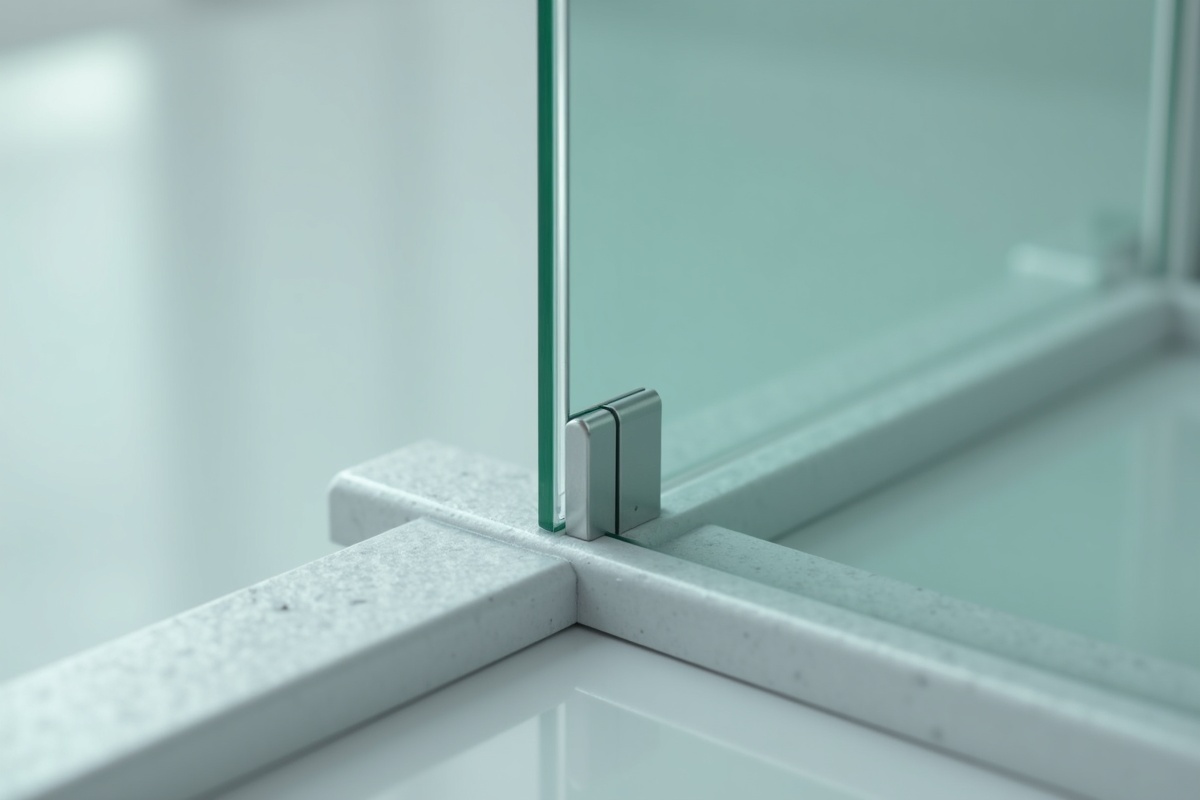
Mitered corners are only possible when the initial cut holds a consistent 45-degree angle across the full thickness of the glass — typically 3/8 to 1/2 inch. A manual cut at 45 degrees drifts across the cut length; a CNC cut holds the angle within fractions of a degree from start to finish. This is why mitered corners are exclusive to shops with proper CNC capability.
The geometry of a mitered corner:
When two glass panels meet at a 90-degree corner, a mitered joint means each panel is cut at a 45-degree angle from the face. The two angled faces press together, and the corner shows only glass — no silicone line, no metal clamp, no visible joint.
For this to work:
- Both panels must be cut to exactly 45 degrees
- Both miter faces must be polished to matching quality
- The miter faces must be square to the panel face (not angled or twisted)
- The corner must be properly supported by hardware that holds both panels at the correct angle
Manual cutting cannot hold 45 degrees consistently across a 72-inch panel in 1/2-inch glass. The score line drifts, and the resulting miter face is slightly concave or convex along its length — the two faces won't close flush.
CNC cutting holds the angle consistently. The result is a miter face that closes to a hairline gap when pressed together, requiring only a thin layer of UV-cure glass adhesive to bond.
What Goes Wrong With Imprecise Cuts?
Imprecise cuts produce three categories of problems: panels that don't fit the opening correctly, hardware that doesn't align with wall anchors, and corner joints that fail to close. Each requires a remedy at installation — shimming, oversizing hardware holes, or excessive silicone — that compromises the finished appearance and longevity.
Common problems from loose-tolerance fabrication:
Undersized panels: A panel cut 1/4 inch short on width leaves a gap on one side after installation. The installer fills this with extra silicone, which is visible and less durable than a proper edge seal.
Oversized panels: A panel cut slightly wide won't seat against the wall without forcing it. The installer may notch the edge, shim the wall, or adjust hardware — none of which are ideal solutions.
Off-angle cuts: If the cut face isn't square to the glass surface, the edge polish doesn't fully clean up the break surface, and the edge contact against wall or hardware surface is uneven.
Chipped edges: Chips at the break line are normal on rough cuts but must be fully removed during polishing. Chips that remain create stress concentration points — potential crack initiation sites over years of thermal cycling and door movement.
Drilled holes off-spec: If measurement error places a hinge hole 3/8 inch from its designed position, the hardware is installed off-spec. The hinge stresses differently than designed, and over time, the glass develops minor stress around the hole.
Precision fabrication is what Infinity Glass & Glazing's in-house shop in Corinth is built for. Every panel is CNC-cut, edge-polished, and inspected before leaving our facility. Mitered corners are available on all corner enclosures. We serve the full DFW metroplex. Get a free estimate or call (940) 279-1197.
Can you cut tempered glass for a shower door?
No — tempered glass cannot be cut, drilled, or altered after tempering. Any attempt to cut tempered glass will cause it to shatter into small granules (which is how it's designed to fail safely) (CPSC 2025). All cutting, drilling, and edge finishing must be completed before tempering. This is why measurements must be accurate before fabrication begins — there's no adjusting the glass after tempering.
What is the standard tolerance for custom shower glass fabrication?
Quality in-house fabricators hold tolerances of +/- 1/16 inch (1.5mm) on cut dimensions using CNC equipment. Manual scribing typically holds +/- 1/8 inch. For mitered corners, angle tolerance should be within +/- 0.5 degrees. Ask any shop about their stated tolerance range before commissioning work.
Why do some shower glass panels have a slight green tint at the edges?
Standard float glass contains iron oxide, which gives the glass a green tint most visible at cut edges and in thick glass panels. The thicker the glass (1/2-inch shows more than 3/8-inch), the more visible this tint. Low-iron glass (Starphire, Optiwhite) removes this tint for true optical clarity. If edge tint bothers you aesthetically, specify low-iron glass.
How do you know if a shower glass installation was done correctly?
Check four things: silicone seams should be uniform in width with no thick patches; the door should swing freely and close against the seal without binding; the bottom seal should contact the threshold evenly across its full width; and mitered corners (if present) should be closed to a hairline with no visible gap. Any silicone patch work, shimming, or visible gaps indicate a fit problem that should be addressed before acceptance.
Related reading: in-house glass fabrication and our frameless shower doors in DFW.