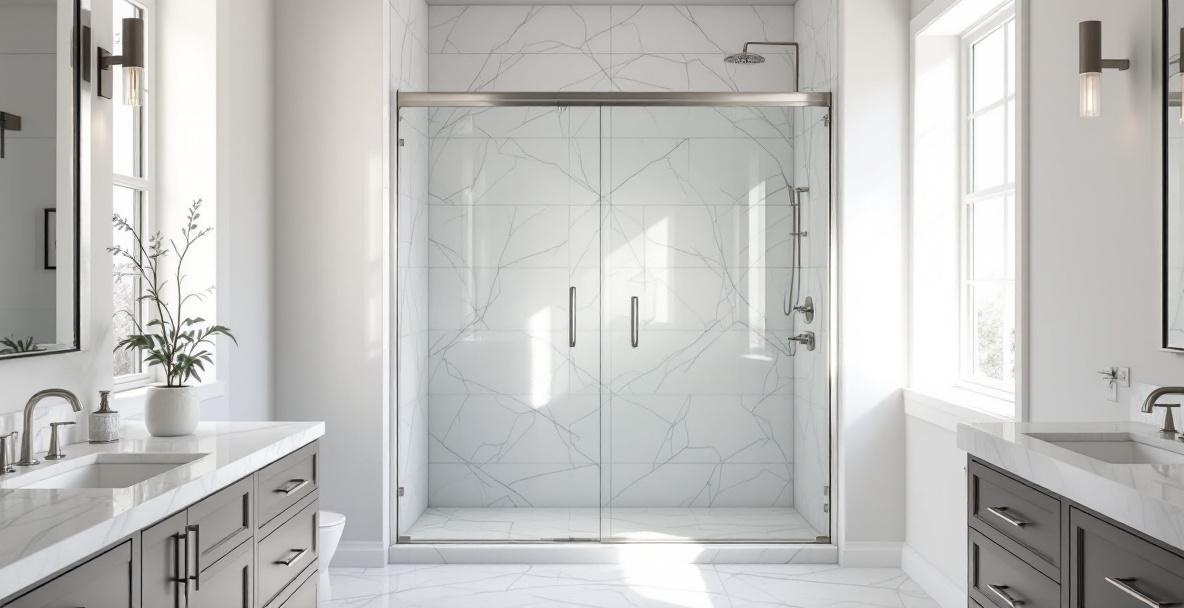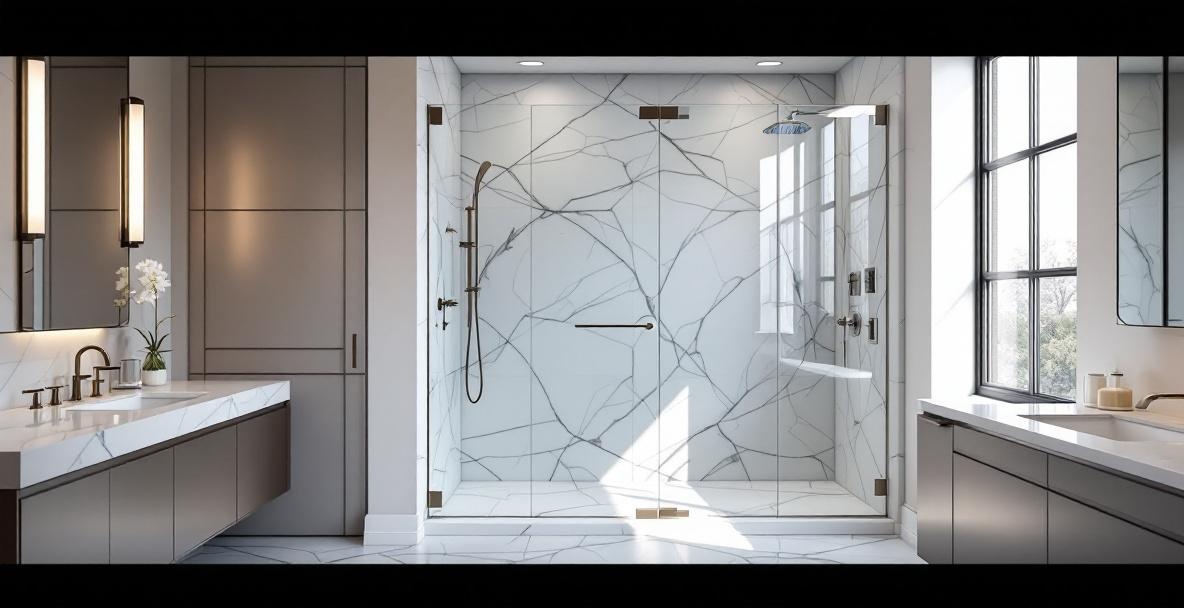
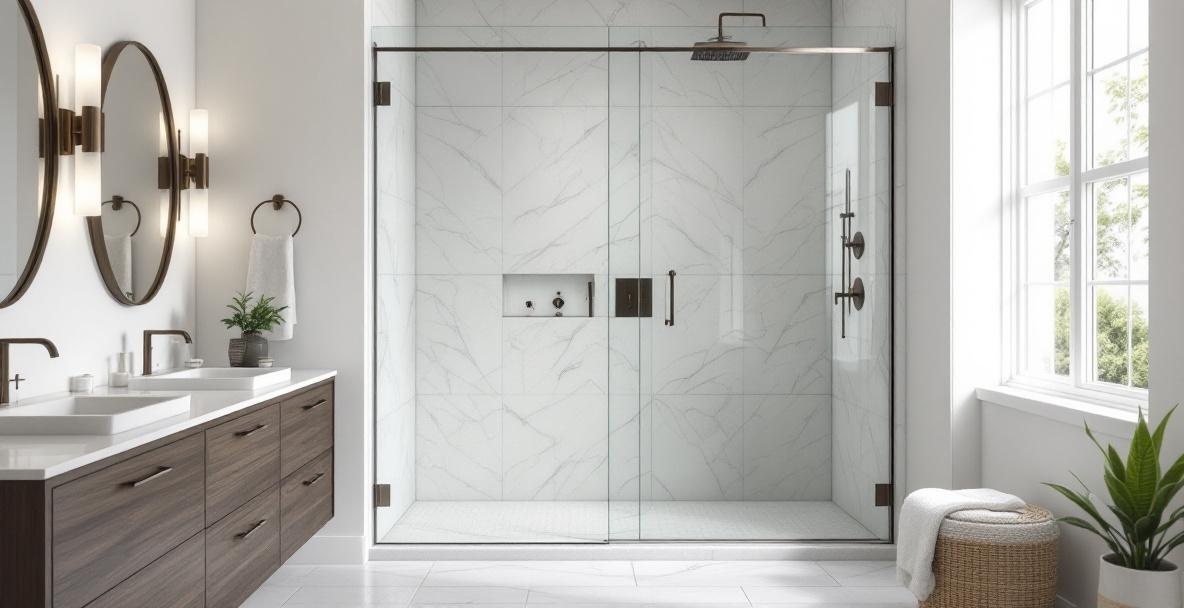
In-house glass fabrication means one company measures, cuts, edge-finishes, and installs your shower glass — no third-party shop between the measurement and the final product. The quality difference is real: tighter tolerances, faster turnarounds, direct accountability, and the ability to do mitered corners that outsourced production simply can't match.
Most homeowners shopping for a frameless shower door ask about glass type and hardware finish. They rarely ask the one question that has the biggest impact on the finished product: "Do you fabricate the glass yourselves?"
The answer separates two fundamentally different kinds of glass companies. One measures your opening, sends the specs to a glass warehouse, picks up the cut panels a week later, and installs them. The other measures, cuts, polishes, and installs — all under one roof. The difference shows up in fit, precision, turnaround time, and the ability to offer premium finishes like mitered corners.
[INTERNAL-LINK: Custom frameless shower design process -> /blog/custom-frameless-shower-design]
What Happens When Glass Is Fabricated In-House?
In-house fabrication gives the installing company direct control over every step of glass production — from the initial cut through edge polishing, drilling, and quality inspection. No specs get lost in translation between a salesperson and an outside shop. No tolerances accumulate across multiple handoffs. The person who measured your shower is responsible for every piece of glass that comes out of fabrication.
The full workflow at an in-house shop:
Step 1 — Field measurement: A fabrication technician (not a sales rep) measures your shower opening with calibrated tools, checks wall plumb on every axis, and notes any variations from square. Those measurements go directly to the cutting floor.
Step 2 — Glass cutting: CNC or manual glass cutters score and break the glass to exact dimensions based on field measurements. Tolerances at quality in-house shops run +/- 1/16 inch or less (Cardinal Glass 2025).
Step 3 — Edge polishing: Cut edges are belt-polished to a smooth, clean finish — required for any glass that will be seen or handled. Mitered edges (for glass-to-glass corner joints) are cut and polished in this phase. Only in-house shops with proper equipment can produce consistent mitered corners.
Step 4 — Drilling: Hardware holes are drilled at precise locations before tempering. Once glass is tempered, it cannot be cut, drilled, or altered without shattering.
Step 5 — Tempering: Glass is sent to a tempering oven (either in-house or through a closely controlled partner). Tempered glass is 4-5x stronger than standard glass and breaks into small granules rather than dangerous shards if it does break (CPSC 2025).
Step 6 — Quality inspection: Finished panels are inspected for chips, scratches, optical distortions, and dimensional accuracy before leaving the shop floor.
Step 7 — Installation: The same team that fabricated the glass installs it. Any fit issues are resolved immediately — the fabricators are on-site.
1/16 in
typical tolerance on in-house CNC-cut shower glass — tighter than outsourced production averages
What Gets Lost When Glass Is Outsourced?
Outsourcing glass fabrication introduces tolerances, delays, and communication gaps that in-house production eliminates. Specs travel from measurer to salesperson to production order to outside shop to delivery. At each step, small errors can compound into a panel that doesn't fit correctly, needs shimming, or requires a re-order.
The practical problems with outsourced fabrication:
Tolerance stacking: A measurement at 32.375 inches might be spec'd as 32-3/8 on a production order, cut at 32-5/16 by the outside shop, and installed with a slightly uneven silicone gap that the installer tries to cover with extra caulk. Each decision moves the result further from the ideal.
No miter capability: Mitered corners require a precise 45-degree cut across the full edge thickness, then edge-polishing of the miter face. Most glass distribution warehouses don't offer this as a standard service. If you want mitered corners, you need a fabricator with in-house miter capability.
Slower turnarounds: Outsourced production depends on the outside shop's schedule, queue, and delivery logistics. In-house shops can prioritize jobs and control their own timeline.
Accountability gaps: If a panel arrives with the wrong dimensions or a chipped edge, the company that outsourced it has to go back to the outside shop for a replacement. In-house shops cut a new piece immediately and reschedule the install without waiting on a third party.
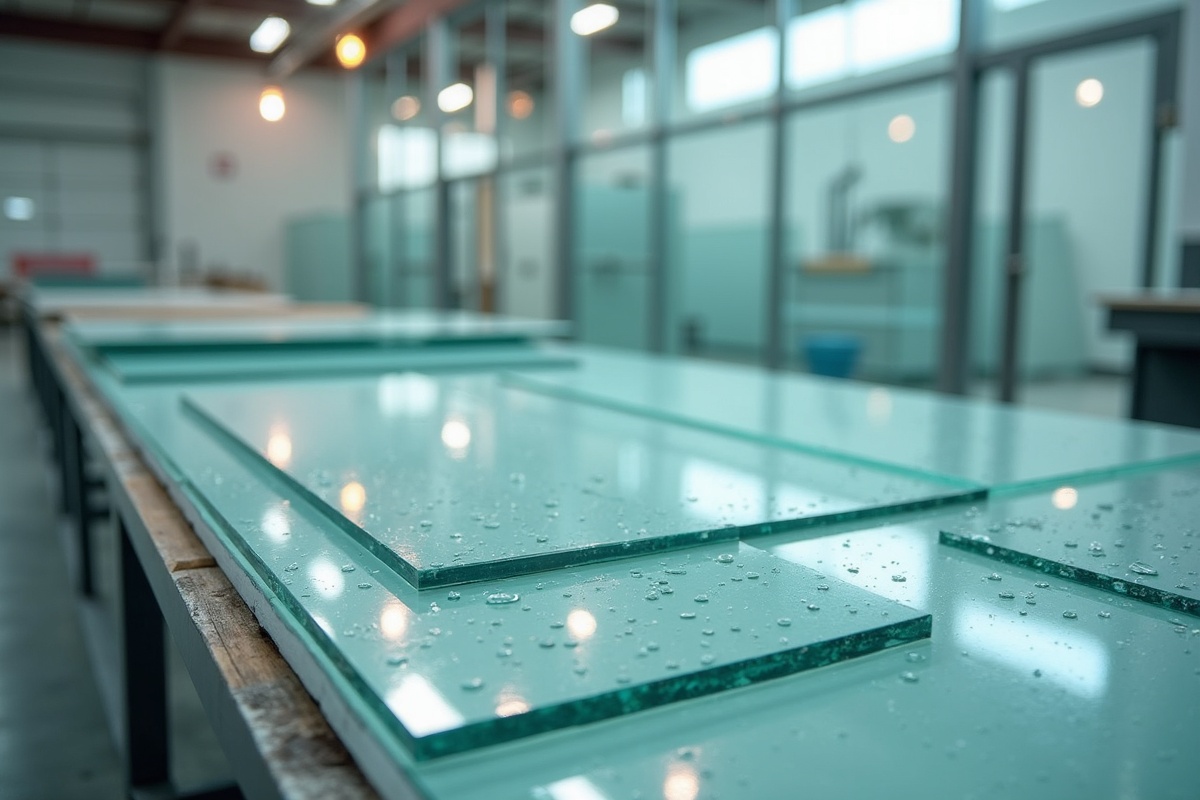
What Premium Options Require In-House Fabrication?
Mitered corners are the most significant premium option that requires in-house capability — no glass warehouse offers custom miter finishing as a standard service. Beyond miters, in-house shops also offer tighter dimensional tolerances, same-day re-cuts for any panels with issues, and more flexible edge profile options.
Premium options exclusive to in-house fabricators:
Mitered corners: Where two glass panels meet at a corner, a mitered joint creates a glass-to-glass surface with no silicone line and no metal clamp. Each panel is cut at a 45-degree angle and the miter face is polished to match the overall surface finish. Requires CNC cutting equipment and skilled finishing.
Non-standard edge profiles: Standard edge polish is a flat 90-degree finish. Some in-house shops can produce pencil-polish (slightly rounded), ogee, or other profiles for decorative applications.
Tight dimensional tolerance: For openings where out-of-square walls require compensating cuts (e.g., a panel that's 32.25 inches at the bottom and 32.125 inches at the top), in-house fabrication can accommodate that taper precisely. Outsourced production typically cannot.
Rapid re-cut: If a panel arrives with a chip, scratch, or dimension error, an in-house shop can produce a replacement panel the same day. An outsourced shop must wait for the supplier's next production cycle.
How Does In-House Fabrication Affect Installation Quality?
When the same company fabricates and installs the glass, fit issues are solved at the source — not patched at installation. If a panel is slightly short, the fabricator adjusts. If a hinge hole is 1/4 inch off, it's caught in fabrication quality check, not discovered when the hardware doesn't align on the wall.
The installation quality difference shows up in four places:
Silicone seams: Properly fabricated glass fits tightly against wall surfaces with a controlled, consistent gap for silicone. Glass that doesn't fit correctly leaves uneven gaps that the installer fills with excessive silicone — visible as thick, uneven caulk lines.
Hardware alignment: Hinges and clamps that were drilled to spec in fabrication align with wall anchors correctly. Off-spec holes require shimming or elongated slots that aren't visible but add stress concentration points in the glass.
Door swing and seal: A door panel that's correctly dimensioned swings true on its hinges, with the bottom seal touching the threshold evenly across its full width. Undersized panels swing open and leave gaps at one end of the seal.
Corner joints: Mitered corners that are precisely cut close to a hairline. Imprecise miters leave gaps that must be filled with silicone, defeating the purpose of the miter joint entirely.
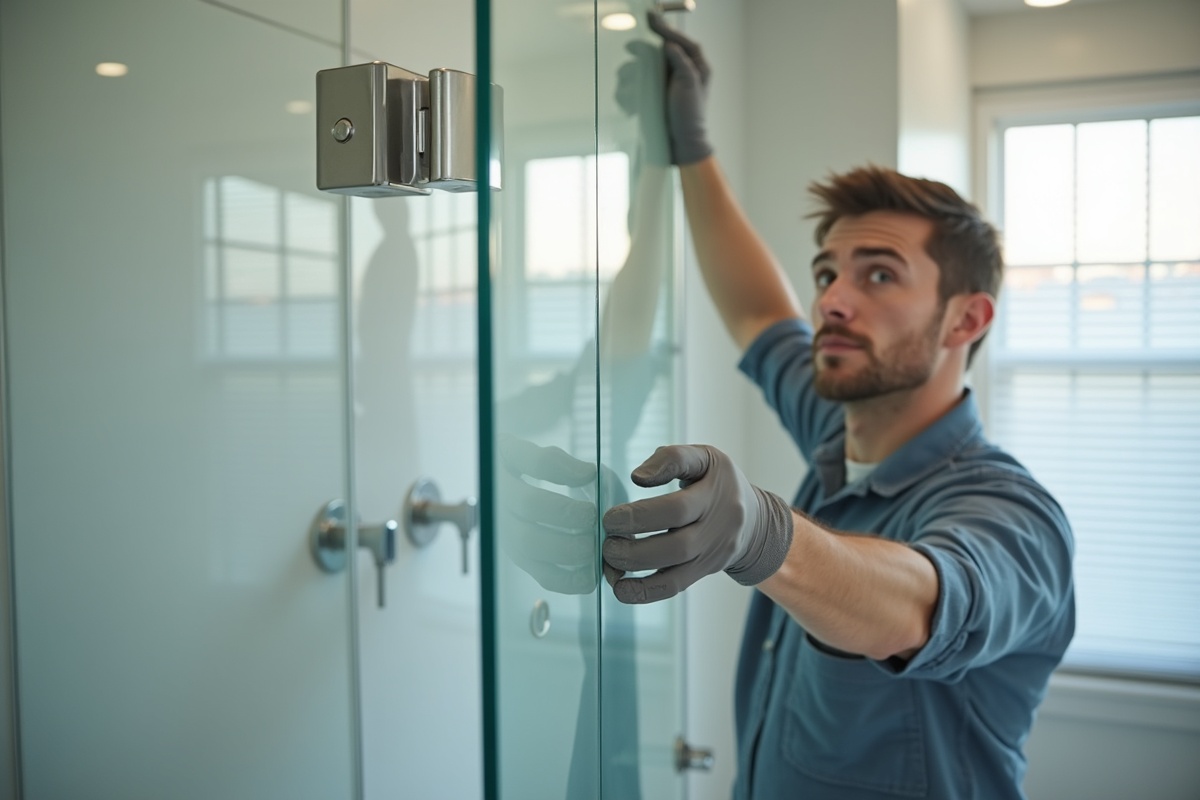
Also see our precision glass cutting and our frameless shower doors in DFW.
Ready to work with an in-house fabricator for your DFW shower project? Infinity Glass & Glazing serves Corinth, Dallas, Fort Worth, Denton, Frisco, McKinney, Lewisville, Flower Mound, Southlake, and Keller. Schedule a free in-home measurement or call (940) 279-1197.
Why do some shower glass companies outsource fabrication?
Fabrication equipment — CNC glass cutters, edge polishers, drill presses — requires significant capital investment. Smaller companies or retail-focused shops choose to outsource cutting to glass warehouses and focus on sales and installation. The tradeoff is less control over tolerances, longer turnaround times, and limited ability to offer premium options like mitered corners.
How can I tell if a glass company fabricates in-house?
Ask directly: "Do you cut and edge-finish glass in your own facility?" Follow up with "Can you do mitered corners?" A company that fabricates in-house will answer both questions immediately and confidently. They may also offer to show you their shop. A company that outsources will either admit it or give vague answers about "working with local suppliers."
Does in-house fabrication cost more than outsourced?
Not necessarily — and sometimes it costs less. In-house fabricators eliminate the markup that an outside glass warehouse charges to the installer. The cost difference depends on the market and the shop's equipment. What in-house fabrication consistently delivers is better quality and faster turnaround — those benefits often come at parity with outsourced pricing.
What is the turnaround time difference between in-house and outsourced fabrication?
In-house shops typically complete fabrication in 3-5 business days and can expedite for simple jobs. Outsourced fabrication adds time for the specification handoff, outside shop queue, and delivery — typically adding 2-5 business days to the total timeline. For a standard project, in-house can mean installation in 7-10 days vs. 14-21 days for outsourced (Grand View Research 2025).