
Custom Shower Enclosures — Dallas–Fort Worth
Mitered Corner Shower Enclosure Installation in Dallas–Fort Worth
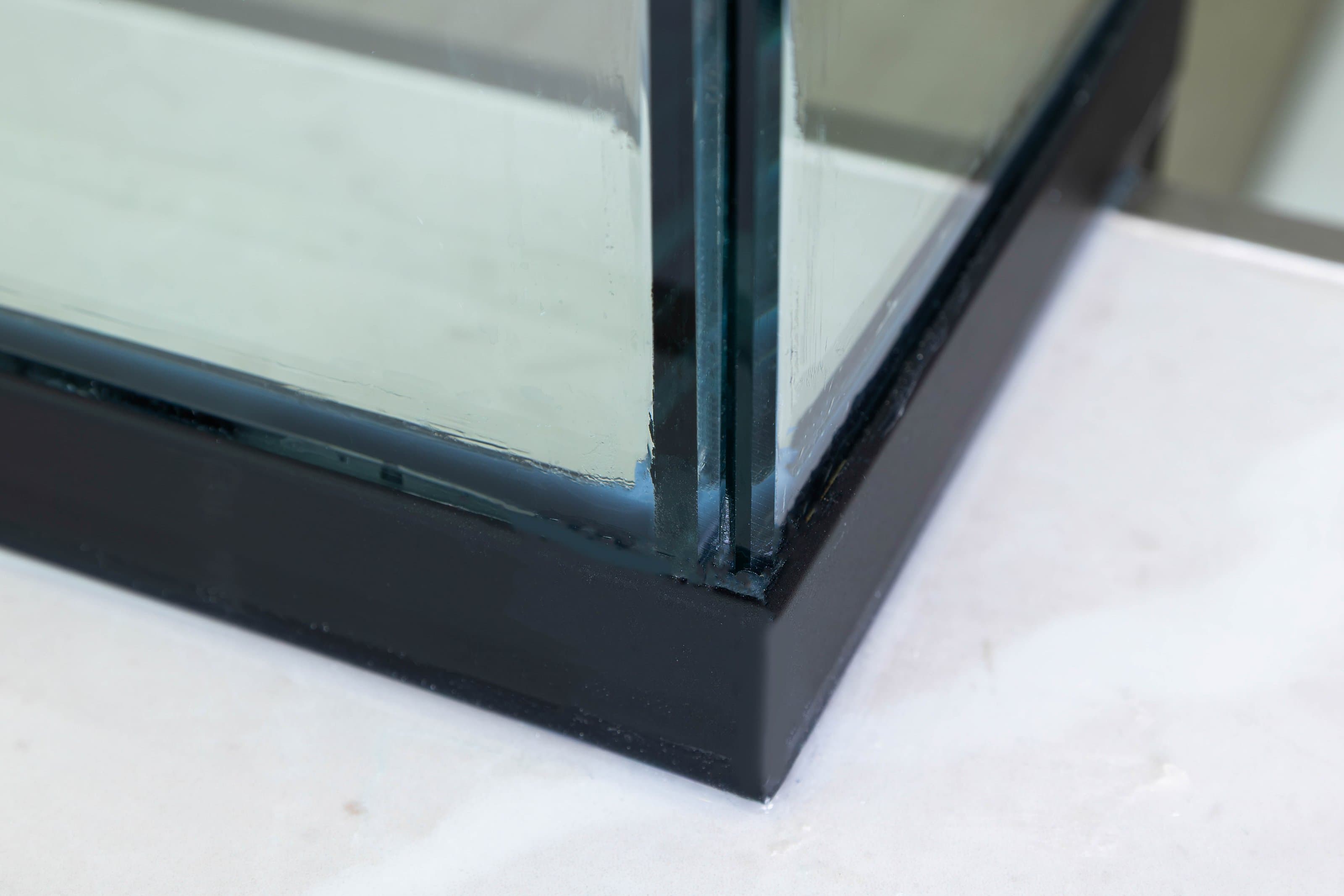
A mitered corner shower enclosure joins two panels of glass at a 45-degree cut, so the corner meets flush with nothing between the panes — no vertical metal post, no thick bead of silicone, and no interruption in the line of the glass.
It is the detail we are known for, and it is our standard rather than an upgrade line item. The cut has to be accurate to the degree, which is why it starts with measuring the opening as built rather than off a drawing.
The corner, cut both ways
The difference is easiest to see in cross-section. Toggle between the two and look at what happens where the panels meet.
Precision Mitered Corner
Both panels are cut at a precise 45° angle, creating a flush, nearly invisible seam where they meet at the corner. Stronger bond, better water resistance, and a premium look that elevates the entire enclosure. This is our standard — not an upgrade.
What the detail actually buys you
No corner post
A butt joint needs one panel to press flat against the edge of the other, and most installers hide that meeting with a metal channel. A miter removes the need for it — the two panes carry the corner themselves.
A seam instead of a gap
Because both edges are cut to 45 degrees, they close against each other. There is no void to pack with silicone, which is the part of a standard corner that yellows, shrinks and eventually collects mildew.
Cut to the degree
Two 45-degree edges only meet cleanly if both are accurate. A degree of drift on either panel opens a visible wedge at the top or bottom of the corner — the reason this is the detail that separates shops.
Measured as built
Finished walls are rarely square and rarely plumb. We measure the opening after tile rather than from the plan, then order the glass cut to those angles, because a miter has no tolerance to absorb the difference.
Where it applies
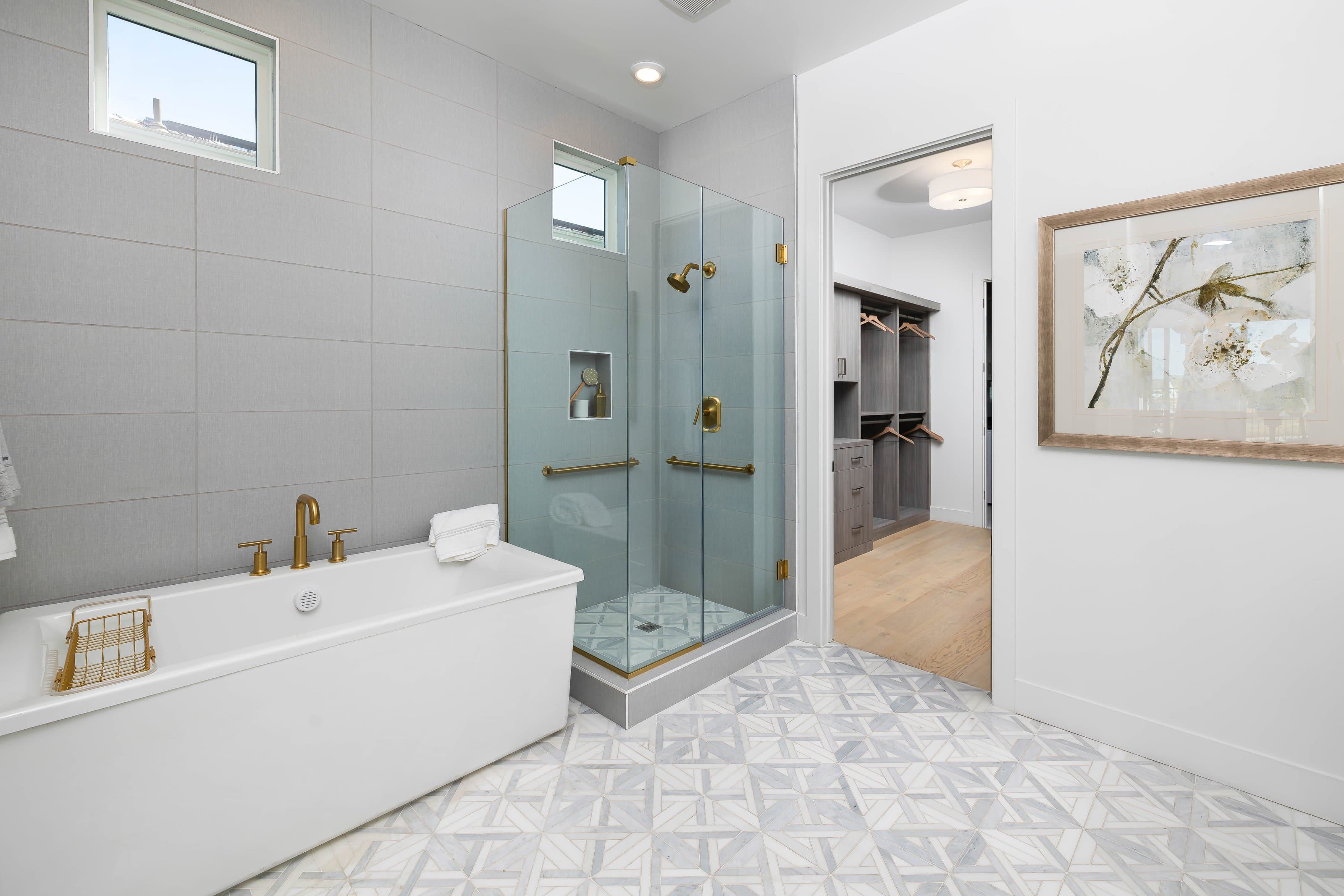
Any layout where two panels of glass meet in open space is a candidate — corner showers, walk-in enclosures with a return panel, and glass-to-glass returns around a bench or a half wall. Alcove builds and single doors against a wall have no glass-to-glass corner, so the question does not come up. Glass is ordered to the measured angles from Guardian, we set and bond the corner ourselves, and one company owns the job from the measure through the warranty.
Who builds it
Donavon Wheeler runs the DFW operation out of Corinth and measures these openings himself — on a mitered build the measure is the job, because the angle the glass gets cut to is decided there. Infinity is family-owned with 30+ years of custom glass behind it, and precision mitered corner work is the detail the shop is known for. We are fully insured and estimates are free.
In March 2026 we built and installed a three-panel frameless walk-in enclosure for a Phillips Creek Ranch primary bath in Frisco — 1/2-inch low-iron glass, brushed nickel hinges and clips, and two precision-mitered corners. The measure ran Monday morning, shop drawings were approved Wednesday, and the install was a full day on site. All enclosure glass meets the 2024 IRC 308 safety glass standard, tempered and tagged to ANSI Z97.1.
Questions we get about mitered corners
What is the difference between a mitered corner and a butt joint?
On a butt joint, one panel of glass presses flat against the edge of the other and the gap left at the corner is filled with silicone — usually with a metal channel over it to tidy the join. On a mitered corner, both panels are ground to a 45-degree angle so the edges close against each other and form the corner themselves. There is no post and no silicone-filled void. It is a fabrication difference, not a hardware upgrade, which is why it has to be specified before the glass is cut.
Is a mitered glass corner as strong as a corner with a post?
Yes, when it is cut and set correctly. The corner is bonded with structural silicone along the full length of the mitered faces rather than packed into a gap, so the joint is continuous instead of relying on a metal channel to hold alignment. What it will not tolerate is a bad cut — an inaccurate miter concentrates stress at one end of the joint.
Can a mitered corner be added to a shower enclosure I already have?
Not to the existing panels. The 45-degree angle is ground into the edge of the glass during fabrication, so it cannot be cut into tempered glass that is already installed — tempered glass cannot be modified after it is treated without shattering. If you want a mitered corner in a shower that currently has a post or a channel, it means new panels for that corner. We can measure the opening and tell you what is involved.
Do you use mitered corners on every frameless shower enclosure?
Wherever the layout has a glass-to-glass corner and the customer wants it, yes — it is our standard detail rather than a premium add-on. Not every enclosure has one, though. A single door with a fixed panel against a wall has no glass-to-glass corner to miter, and neither does an alcove build. It applies to corner showers and walk-in layouts where two panels meet in open space.
The corner is one decision inside a larger build — our frameless shower doors and walk-in shower enclosures cover the rest of it, and glass thickness is worth settling before the corner detail, because it changes how the miter is ground.
Send us the corner
Tell us the layout and where the panels meet, and we will tell you whether the corner can be mitered and what it changes. Free estimates, fully insured.