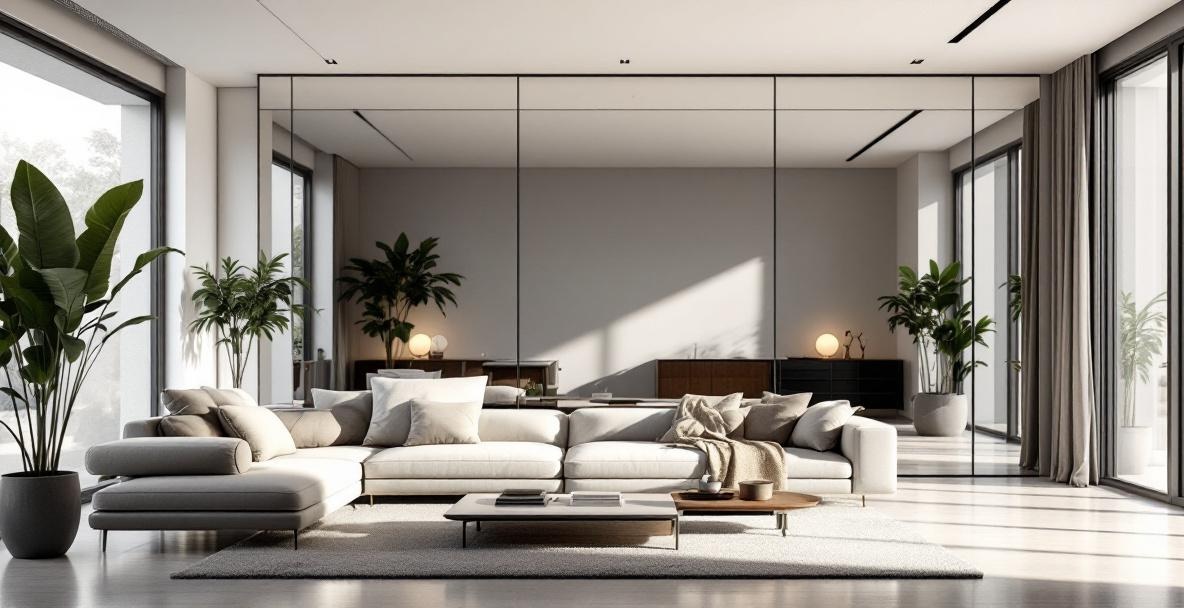
Full wall mirror installation uses multiple mirror panels installed side-by-side to cover an entire wall from floor to ceiling, creating a seamless reflection that dramatically expands perceived space and multiplies light. A typical 12-foot wall at 8-foot ceiling height requires three to four 36-48-inch wide panels. Installed cost runs $600-$1,800+ for most residential applications.
No single renovation creates a more dramatic room transformation per dollar than a full wall mirror installation. In a 10x12-foot bedroom, a full-wall mirror on one end makes the room appear twice as deep. In a gym, it provides full-body form visibility. In a dance or yoga studio, it serves a critical functional role. In any room, it multiplies whatever natural and artificial light exists.
The logistics are straightforward: mirror panels, precisely cut and polished, installed with mechanical anchoring and mirror mastic. The result looks high-end but is a standard service any quality glass shop can deliver.
[INTERNAL-LINK: Professional wall mirror installation -> /blog/wall-mirror-installation-dfw]
Why Full Wall Mirrors Make Any Space Feel Twice Its Size
Full wall mirrors create the visual illusion of doubled depth by reflecting the room back on itself. The reflection shows a mirror image of the actual room, and the brain processes this as additional physical space. In combination with light multiplication (mirrors reflect 95%+ of light that strikes them), the effect transforms spatially constrained rooms into airy, expansive spaces.
The physics of perceived space expansion:
When you stand in a room with a full-wall mirror at one end, you see the room in front of you and the same room reflected behind you — but your brain doesn't automatically process this as "reflection." At a slight angle, the reflected room appears as a continuation of the physical space. The depth perception effect is strongest with floor-to-ceiling coverage because partial mirrors (that don't extend to the floor) break the spatial continuity — the missing floor reflection reminds the eye that it's looking at a mirror.
Light multiplication works the same way: every photon that strikes the mirror is reflected back into the room (DOE 2025). In a room with windows on the opposite wall, a full-wall mirror effectively doubles the usable light in the space. In a gym or studio with overhead lighting, mirrors distribute that light more evenly across the full room volume.
2x
perceived room depth created by a floor-to-ceiling full wall mirror — the most dramatic spatial effect per dollar in interior design
Where Do Full Wall Mirrors Work Best?
Five room types benefit most from full-wall mirror installations: home gyms, yoga and dance studios, master bedrooms, dining rooms with limited natural light, and commercial spaces like hotel lobbies and retail fitting rooms.
Home gyms: The primary functional application. Full-body form visibility during lifting, cardio, and bodyweight training prevents injury and improves technique. The space expansion effect also makes basement and garage gyms more tolerable to use.
Dance and yoga studios: Form visibility is central to these disciplines. Dance requires precise body position awareness; yoga benefits from alignment checking throughout a practice. Studios without mirrors limit both student progress and instructor effectiveness.
Master bedrooms: A full-wall mirror on the wall opposite the bed creates significant visual depth and light multiplication. In bedrooms where morning light is limited, this can dramatically improve the feel of the space. In Dallas-area master bedrooms where large square footage is common, full-wall mirrors create visual drama proportional to the space.
Dining rooms with limited natural light: A full-wall mirror in a north-facing or interior dining room multiplies whatever light exists — from overhead fixtures, candles, or borrowed light from adjacent rooms.
Commercial spaces: Hotel lobbies use full-wall mirrors for spatial expansion in high-volume public spaces. Retail fitting rooms use narrower mirrors for flattering full-length views. Restaurant designs often use mirror panels for intimacy and depth effects.
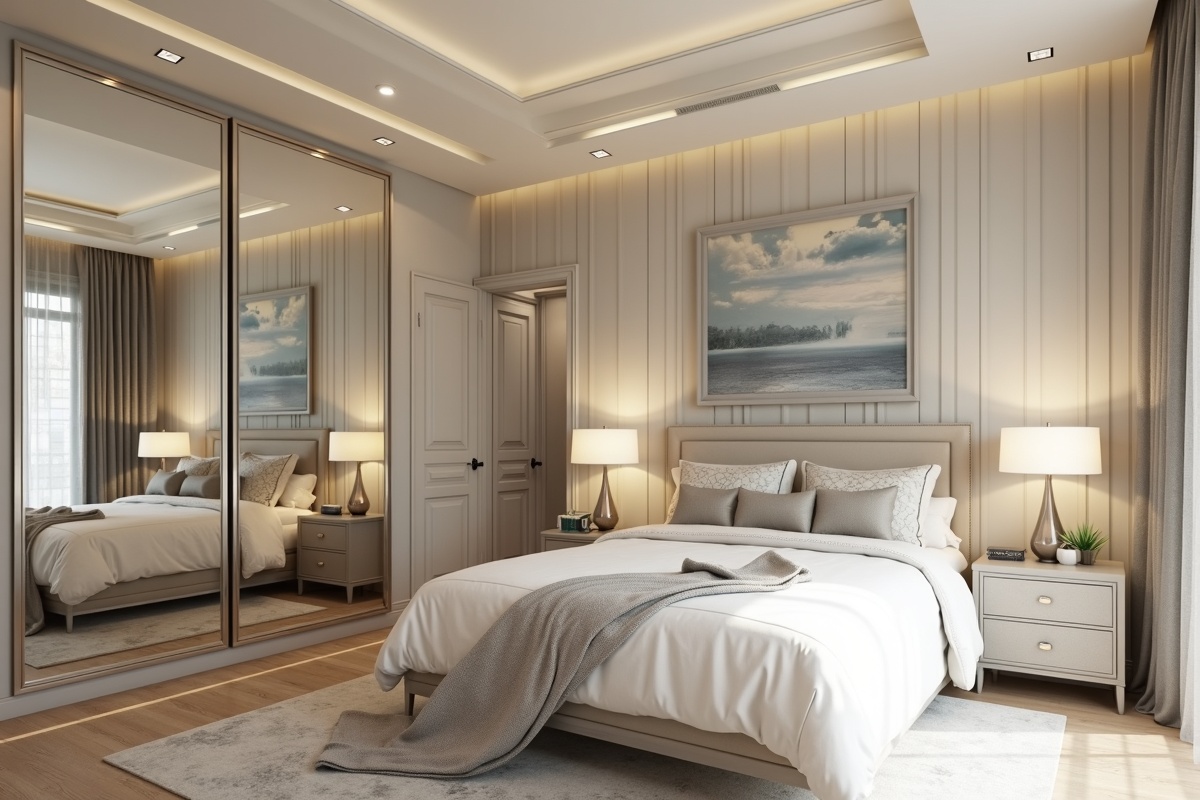
How Is a Full Wall Mirror Installed?
Full wall mirror installation requires pre-planning, careful panel sizing, sequenced installation with temporary support, and proper adhesive and mechanical anchoring throughout. The work typically takes 3-6 hours for a standard 12-foot residential wall.
Pre-installation planning:
Panel sizing: Most full-wall installations use panels 36-48 inches wide. This balances manageability (a 48-inch wide, 8-foot tall mirror panel in 1/4-inch glass weighs approximately 52 lbs — manageable for two installers) with seam frequency (fewer seams look cleaner).
Seam placement: Panels are cut so that seams align at visually neutral positions — typically avoiding centering a seam at eye level where it's most visible. Many installations run panels from the floor at 1/2-inch clearance to the ceiling at 1/2-inch clearance, with horizontal edges only at the top and bottom.
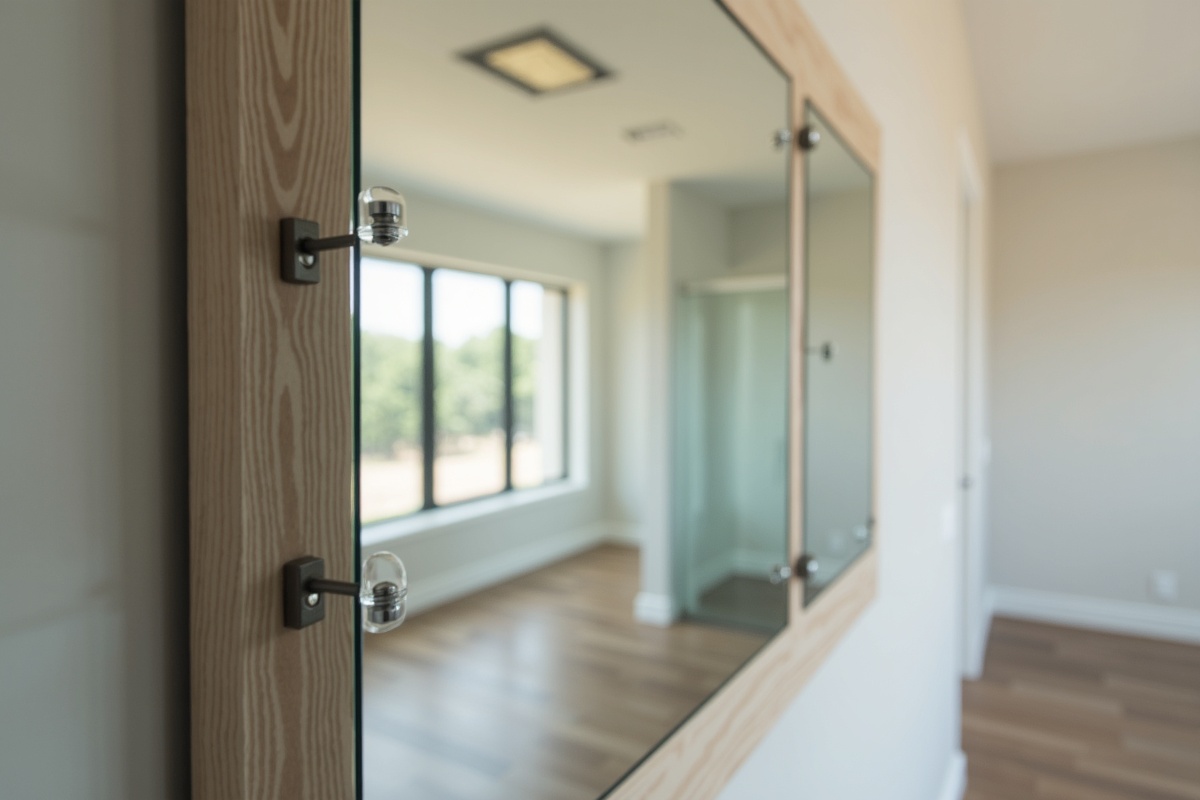
Anchor planning: Stud locations are mapped. For each panel, at least two J-clip anchor points per panel top are identified at stud locations. Panels over the same stud position share anchoring convenience.
Installation sequence:
- Layout lines: Level horizontal reference lines marked at panel top height; vertical reference lines at panel edges.
- First panel set: Starting at one wall, first panel adhesive applied, set against reference lines, temporary brace or J-clip holds position while adhesive begins to grip.
- Subsequent panels: Each panel set sequentially, checking for flush face alignment with the previous panel (critical for seam appearance).
- Seam control: 1/8-inch or smaller gap maintained between panels. No silicone in the seam (silicone would be visible and collect dirt). Some installers use invisible UV-cure adhesive at the seam to stabilize panel-to-panel alignment.
- Top and bottom treatment: Where mirrors meet crown molding, baseboard, or drywall, a thin bead of clear silicone seals the gap against moisture and dust accumulation.
What Happens When a Wall Is Wider Than One Mirror Panel?
Multiple panels are installed side-by-side when the wall is wider than standard single-panel limits — which is essentially always for full-wall applications. The seam between panels is the critical quality point: panels must be aligned flush with each other to maintain a continuous-looking reflection.
Seam quality factors:
Panel face flush alignment: If one panel projects even 1/16 inch in front of the adjacent panel, the seam will be visible as a "step" in the reflection — appearing as a bright line that breaks the illusion of a single surface. Both panels must be set exactly in the same plane.
Gap control: A 1/16-to-1/8-inch gap between panels is standard. Tighter gaps risk panel-to-panel contact when panels expand thermally — which can crack both panels. Wider gaps are more visible as a dark line in the reflection.
Level alignment: If two adjacent panels are slightly different heights, a horizontal "step" appears in the reflection at the panel top or bottom. This is prevented by careful reference line installation and panel shimming during setting.
Mirror backing treatment at seams: The silvered backing on cut edges is exposed at the seam. Some installers apply a thin strip of mirror-edge sealant to protect this exposure from moisture.
How Much Does Full Wall Mirror Installation Cost?
Full wall mirror installation in DFW costs $600-$1,800+ for standard residential applications — $6-$10 per square foot for glass plus $200-$500 labor (HomeGuide 2025). A 12x8-foot wall (96 sq ft) runs approximately $700-$1,200 total. Large studio or commercial installations scale with area and complexity.
Cost estimates by wall size:
- 8x8-foot wall (64 sq ft): $500-$900 total
- 10x8-foot wall (80 sq ft): $600-$1,100 total
- 12x8-foot wall (96 sq ft): $700-$1,200 total
- 16x8-foot wall (128 sq ft): $900-$1,500 total
- Commercial studio (400-800 sq ft of mirror coverage): Quoted per project
Infinity Glass & Glazing installs full wall mirrors throughout DFW — home gyms, bedrooms, studios, and commercial spaces. Serving Corinth, Dallas, Fort Worth, Denton, Frisco, McKinney, Lewisville, and surrounding areas. Get a free estimate or call (940) 279-1197.
Why do full wall mirrors make a space feel twice its size?
Full wall mirrors create a visual depth illusion — the reflected room appears as a continuation of the physical space. Floor-to-ceiling coverage is critical for the effect because partial mirrors break spatial continuity at the floor line, reminding the eye it's looking at a reflection rather than additional space. Light multiplication (mirrors reflect 95%+ of light) further brightens and expands the feel of the room.
How many panels does a full wall mirror installation require?
Panel count depends on wall width divided by panel width. Standard residential panels are 36-48 inches wide. A 12-foot wall uses three 48-inch panels or four 36-inch panels. Taller ceilings or very wide walls may require more panels. Panel width is chosen based on manageability — panels over 60 inches wide become difficult for two-person teams to handle safely.
How much does full wall mirror installation cost in DFW?
Full wall mirror installation in DFW typically costs $600-$1,800 for standard residential walls, depending on wall dimensions and glass specification. Materials (1/4-inch clear mirror) run $6-$10 per square foot. Labor runs $200-$500 for a standard single-wall residential installation. Commercial and studio installations are quoted per project.
Are full wall mirrors safe for home gyms?
Yes, with proper installation. Full wall gym mirrors should use both adhesive and mechanical J-clip anchoring — not adhesive alone. J-clips anchor into wall studs or masonry anchors and prevent panel movement under gym vibration (CPSC 2025). For commercial applications or areas where heavy equipment could impact the mirror, tempered mirror glass (which breaks into granules rather than shards) is the appropriate safety specification.
Related reading: custom mirrors in DFW and our gym mirror installation.