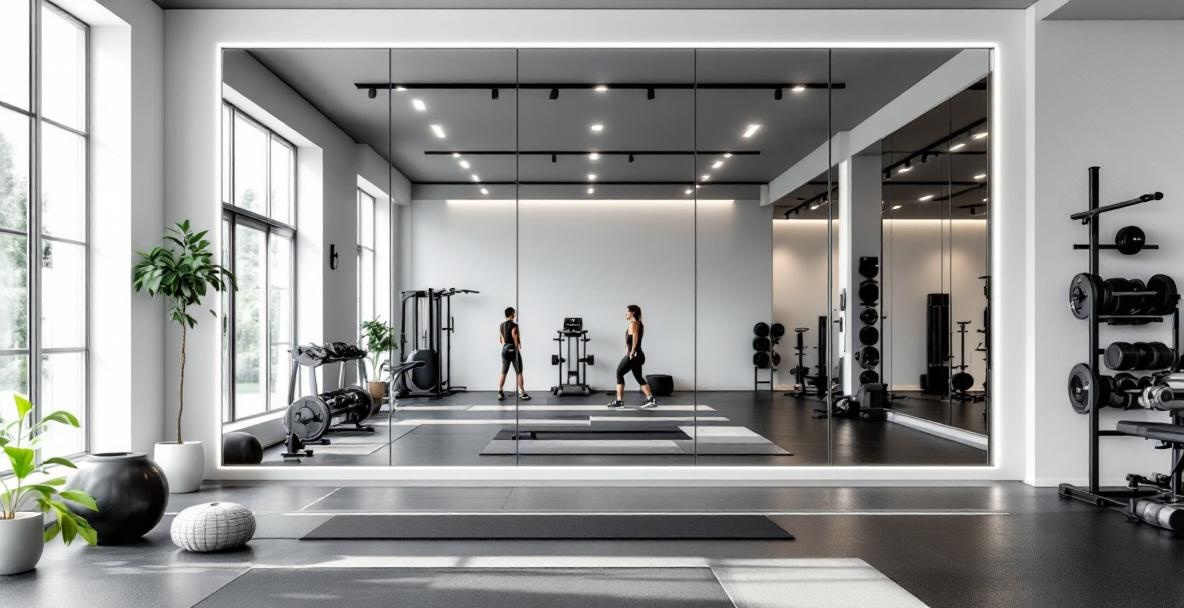
Gym mirror installation in Dallas covers home gym walls, professional fitness studios, yoga studios, dance spaces, and commercial fitness centers — any space where a full-wall or large-format mirror is needed for form visibility, spatial expansion, or lighting. Panels are typically 1/4-inch mirror glass in 3-5 foot widths installed floor-to-ceiling, with tight seams between panels. Infinity Glass & Glazing installs gym mirrors across the DFW metroplex.
Gym mirrors are not decorative objects. They're functional tools — for checking form during lifts, tracking alignment in yoga and pilates, providing dancers with visual feedback, and making a space feel twice as large. Getting the installation right means proper panel sizing, secure mounting, and seams that align cleanly enough that they don't distract from the reflection.
This guide covers why gym mirrors matter, what makes gym mirror glass different, how home and commercial installations differ, and what to expect from a professional installation in Dallas.
[INTERNAL-LINK: All wall mirror installation DFW -> /blog/wall-mirror-installation-dfw]
Why Every Gym Needs Proper Wall Mirrors
Gym mirrors serve three functional purposes: form feedback for the person training, spatial expansion for smaller spaces, and light multiplication in typically dim rooms. A full-wall mirror installation transforms the functional quality of a gym or studio regardless of the equipment it contains.
Form feedback: In resistance training, proper form prevents injury. A lifter who can see their squat depth, back angle, and knee tracking in real time makes immediate corrections that a spotter or coach can't always catch quickly enough (CPSC 2025). Full-wall mirrors on the primary lifting face allow this feedback on every rep.
In group fitness, yoga, and dance, mirror feedback is central to the practice methodology. Instructors use mirrors to monitor the whole class simultaneously; students use them to self-correct without waiting for instructor guidance.
Spatial expansion: A full-wall mirror in a 10x12-foot home gym doubles the perceived depth of the room. Psychologically, the larger perceived space makes the room feel less constraining — particularly important in basement gyms or converted bedrooms where ceiling height and natural light are limited.
Light multiplication: Gym mirrors reflect light from windows and fixtures across the room, reducing dark corners and improving overall illumination. In basement gyms with limited natural light, this effect is significant.
2x
perceived room depth with a full-wall mirror installation — important for smaller home gyms
What Makes a Gym Mirror Different From a Regular Mirror?
Gym mirrors use the same basic silvered glass as regular mirrors but are specified and installed differently — panels are typically 3-5 feet wide for manageability and seam control, mounted floor-to-ceiling for maximum coverage, and secured with J-clips or standoffs rather than adhesive only, for safety under heavy use conditions.
Specification differences:
Glass type: Standard 1/4-inch clear mirror is appropriate for most residential and studio gym applications. For commercial gyms with heavy traffic and impact risk, tempered mirror glass (which breaks into granules rather than shards if impacted) is the professional specification.
Panel width: Full-wall gym mirrors are installed as multiple panels rather than one large piece — because a single 8-foot mirror panel would be impractical to transport and handle. Standard panel widths are 3-4 feet (for residential home gyms) and 4-5 feet (for commercial/studio applications). Panels are installed with minimal seam gaps (typically 1/8-inch or less).
Mounting method: Unlike decorative mirrors that use adhesive only, gym mirrors use a combination of adhesive and mechanical J-clips or standoffs. J-clips at the top and bottom of each panel prevent movement under vibration from jumping, cardio equipment, and general gym activity.
Height: Floor-to-ceiling coverage is standard for gym applications. This means panels run from just above the baseboard to within 2-4 inches of the ceiling, maximizing the reflection area for full-body form checking.
Home Gym Mirror Installation: What to Know
Home gym mirrors in Dallas typically cover one full wall — 8-16 feet wide and 7-9 feet tall depending on ceiling height — installed as 3-6 panels. The work takes 2-4 hours for a standard home gym. Most installations are in basements, converted bedrooms, three-car garage bays, or dedicated gym additions.
Home gym installation specifics:
Most common wall: the primary lifting wall — the wall you face when performing most exercises. In a home gym with a squat rack, this is typically the wall behind the rack. In a multipurpose home gym, it's the longest wall.
Typical panel count: For a 12-foot wall at standard 8-foot ceiling height: 3 panels at 4-foot widths, each panel approximately 7.5 feet tall. That's roughly 90 square feet of mirror.
Basement gyms: Very common in DFW newer construction. Basement walls are concrete block or poured concrete — excellent structural support for mirror mounting. Concrete anchors or shot anchors are used for J-clip mounting points.
Garage gyms: Concrete block or drywall over metal studs (in newer construction). Metal studs require toggle anchors rated for the mirror weight. Drywall in garage applications may not be moisture-rated — this should be assessed before mirror installation.
Commercial Gym and Studio Mirror Installation
Commercial gym mirror installations differ from residential in scale, glass specification, and safety requirements — commercial spaces use tempered mirror glass, more robust J-clip and track mounting systems, and larger panel widths for higher daily traffic applications. Studios — yoga, dance, pilates, martial arts — have their own requirements based on class activity and floor vibration.
Commercial installation considerations:
Tempered glass: For commercial fitness spaces with high foot traffic and equipment proximity to walls (free weight areas especially), tempered mirror glass is the appropriate safety specification (IBC/ICC 2021). Tempered glass breaks into small granular pieces rather than large shards if impacted — critical when free weights could potentially contact the mirror.
Extended mounting: Commercial installations often include a bottom J-channel (a track at floor level that the panels sit in), rather than just adhesive and clips. This is more secure under vibration from cardio equipment and group fitness classes.
Mirror protection: For areas directly behind weight racks, some commercial installations add protective barriers (rubber bumpers, equipment spacing). Mirrors within reach of barbells or dumbbells are an impact risk.
Seam alignment: In commercial studios where participants stand very close to the mirror (yoga, dance), seam alignment is critical. Off-alignment seams break the reflection at eye level, which is distracting during movement-based practices. Professional installation with careful panel alignment minimizes this.
How Much Does Gym Mirror Installation Cost in Dallas?
Gym mirror installation in Dallas costs $400-$1,800+ for a standard home gym one-wall installation, including glass fabrication and professional installation (HomeGuide 2025). Cost scales with wall area and panel count. Commercial studio installations run higher based on room size, glass specification, and mounting complexity.
Cost breakdown for residential home gym:
- Glass cost: Approximately $6-$10 per square foot for 1/4-inch clear mirror cut to size
- Labor: $200-$500 for a standard 1-wall residential installation (2-4 hours of work)
- Mechanical hardware: J-clips, anchors, and J-channel — $50-$150 for a typical wall
Typical total project costs:
- Small home gym wall (8x8 feet, ~64 sq ft): $400-$750
- Medium home gym wall (12x8 feet, ~96 sq ft): $600-$1,100
- Large home gym or two walls: $1,000-$1,800+
- Commercial yoga or dance studio (full room): Quoted per project
Safety Standards for Gym Mirror Mounting
Gym mirrors must be mechanically secured — adhesive alone is not a safe mounting method for mirrors in spaces with floor vibration, equipment proximity, and regular impact risk. Industry best practice requires J-clips or standoff hardware at the top and bottom of every panel, anchored into structural elements (studs, concrete) rather than drywall anchors alone.
Safety mounting standards:
Mechanical fastening required: Every panel should have at minimum two top J-clips or standoffs anchored into structural elements. Adhesive provides primary holding but can fail under sustained vibration.
Anchor substrate: For concrete walls (basements, garages): masonry anchors. For wood stud walls: screws into studs. For metal stud walls: rated toggle anchors. Drywall anchors alone are inadequate for commercial applications and should be minimized in residential too.
Bottom support: A J-channel track at the bottom provides a horizontal stop that prevents any panel movement even if adhesive partially releases — particularly important in commercial spaces.
Clearance from equipment: Mirrors should be mounted at least 12 inches away from any equipment that could contact them during normal use. For cable systems and racks, 18-24 inches of clearance from the mirror face is recommended.
Infinity Glass & Glazing installs gym mirrors in home gyms, yoga studios, martial arts schools, and commercial fitness spaces throughout DFW — Corinth, Dallas, Fort Worth, Denton, Frisco, McKinney, Lewisville, Flower Mound, Southlake, and Keller. Get a free gym mirror estimate or call (940) 279-1197.
Why do gyms need full-wall mirrors?
Gym mirrors serve three practical purposes: real-time form feedback for injury prevention, spatial expansion that makes smaller spaces feel larger, and light multiplication that improves room illumination. Resistance training, yoga, dance, and martial arts practices all benefit from continuous self-monitoring that full-wall mirrors enable. No coaching substitute provides the same instantaneous, comprehensive feedback.
What makes gym mirror glass different from regular mirrors?
Gym mirrors use the same basic silvered glass as regular mirrors but are specified as multiple manageable panels (not one large piece), mounted floor-to-ceiling for maximum coverage, and secured with mechanical J-clips in addition to adhesive. For commercial applications, tempered mirror glass (which breaks safely into granules rather than shards) is the professional safety specification.
How much does gym mirror installation cost in Dallas?
Home gym mirror installations in Dallas typically cost $400-$1,100 for a standard single-wall installation, including glass fabrication and professional mounting. Cost depends on wall dimensions, glass specification, and anchor substrate. Commercial studio installations are quoted per project based on room size and specification requirements.
How long does gym mirror installation take?
A standard home gym one-wall installation (3-4 panels, floor-to-ceiling) takes 2-4 hours from arrival to completion. Larger installations — two walls, commercial studios, or full room coverage — take longer based on panel count. Same-day completion is the norm for residential projects with pre-cut panels.
Related reading: full-wall mirror installation and our custom mirrors in DFW.
Related reading: