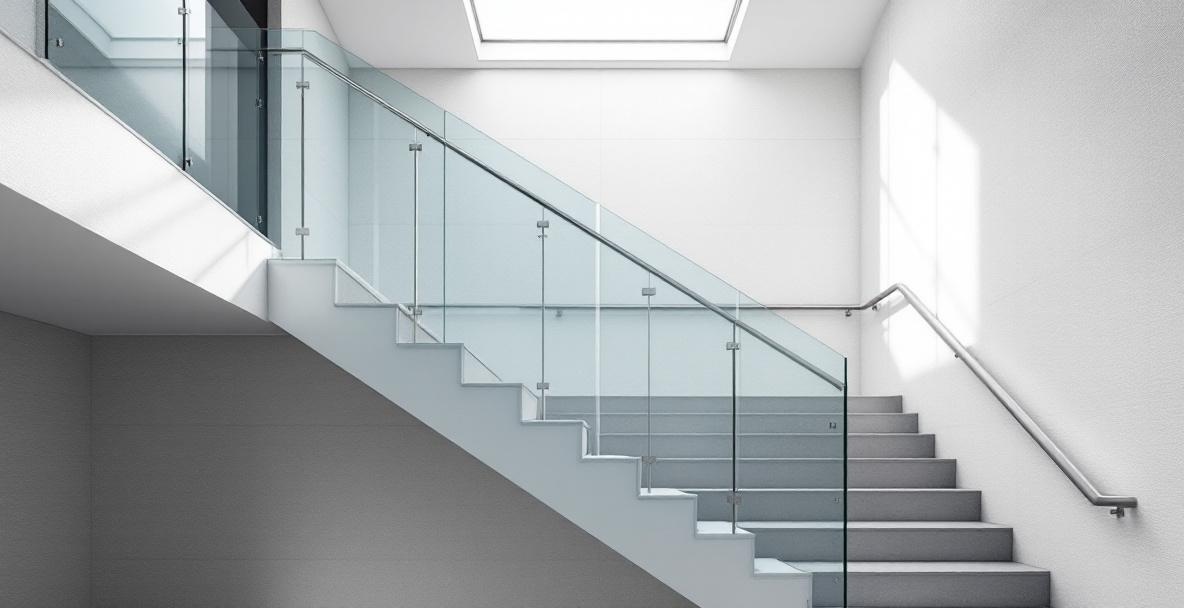
Glass stair railing installation in Dallas costs $200–$500 per linear foot installed, depending on system type, glass thickness, and whether the stair is interior or exterior. Frameless systems with a top handrail and aluminum base shoe are the most popular for residential DFW applications; post-mounted and standoff systems are common in high-end custom homes and commercial projects. Texas building code requires tempered safety glass with a minimum 3/8 in. panel thickness for stair railings in residential construction.
Glass stair railings have become the default upgrade for any Dallas home or commercial space where the staircase is a visible architectural feature. Unlike traditional iron balusters or wood pickets, a glass railing keeps sightlines open, lets daylight travel between floors, and reads as a single architectural surface rather than a row of repeating parts. For open-concept homes in Frisco, University Park, Highland Park, and Southlake — and for mezzanines and lobby stairs across DFW commercial projects — it is almost always the specified choice on modern and transitional designs.
This guide walks through the system types, glass specifications, IBC and IRC code requirements applicable to stair applications in Texas, cost ranges, and the installation process so homeowners and project managers know what to expect before work begins. Staircases are a core application of our glass railing systems.
Why Glass Stair Railings Are the Top Choice for Modern Dallas Homes
Glass stair railings are chosen on modern Dallas projects because they preserve sightlines, multiply natural light, and read as a single architectural surface instead of a row of balusters. They work with virtually any stair material — wood treads, concrete, stone, or steel stringers — and match the minimalist aesthetic that defines current DFW residential architecture.
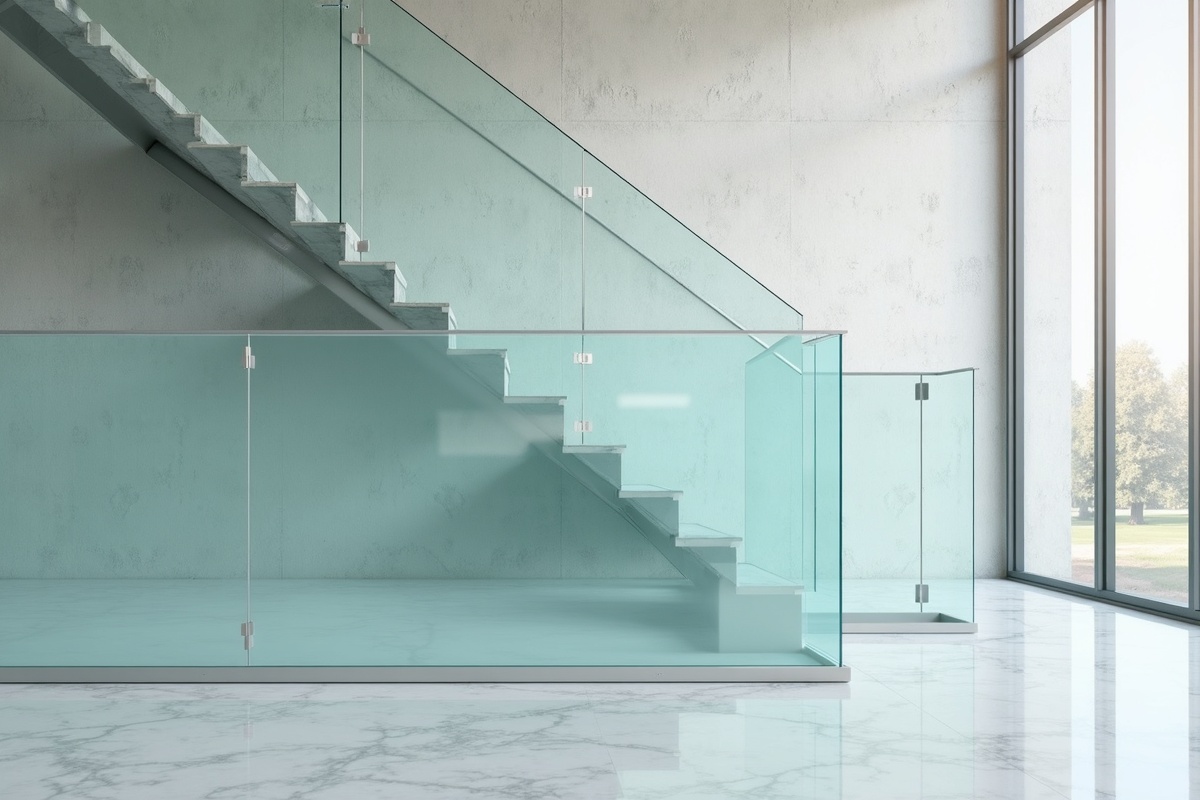
In a typical DFW open-concept layout, the stair is placed in the great room or entry — not tucked away. That means whatever railing system is used sits in the center of the home's visual field. Traditional iron or wood railings break up the space with vertical lines every four inches. A glass railing, by contrast, drops the visual weight of the staircase to almost zero: only the handrail, base shoe, and any structural posts are visible.
Secondary benefits matter as much as aesthetics on a project of this scale:
- Light transmission. Clear tempered glass transmits ~88–91% of visible light (PPG Glass Technical Data 2024), so the railing does not cast baluster shadows across the floor below.
- Easier view of children on the stairs. Parents can see the full height of the stair from any angle — no spindles obscuring the view.
- Easier to clean than iron balusters. A full glass panel wipes down in seconds; ornamental iron has dozens of surfaces that collect dust.
- Resale signal. Glass railings are visually associated with higher-end construction and appear in 70%+ of DFW new builds priced above $1.5M (NAHB 2025).
$200–$500
per linear foot installed — glass stair railing cost range in Dallas depending on system type and glass specification
Types of Glass Stair Railing Systems Available in DFW
Three glass stair railing system types are commonly installed in DFW: base shoe / channel systems (aluminum U-channel anchored to the stair, glass set in channel), post-mounted / spigot systems (glass panels supported by stainless steel spigots bolted to the stair stringer), and standoff / point-fixed systems (glass panels supported by through-glass hardware). Each offers different aesthetic and structural profiles, and cost varies by system.
Base shoe / channel systems — Aluminum U-channel anchored to the stair tread edge or stringer. Glass panels drop into the channel with rubber setting blocks and are secured with structural silicone or wedge-lock inserts. A continuous top handrail runs along the top of the glass. This is the most common system for DFW residential stairs because it supports the full panel edge, simplifies engineering, and is the most cost-effective.
Post-mounted / spigot systems — Stainless steel spigots (small cylindrical or rectangular hardware pieces) are anchored through the stair tread or stringer. Each glass panel is held between pairs of spigots. The effect is a "floating" glass panel with the base shoe completely removed from view. Common in transitional and contemporary custom homes.
Standoff / point-fixed systems — Glass panels are supported by cylindrical standoff fittings bolted through holes pre-drilled in the glass. Standoffs attach to a structural wall or post running alongside the stair. Maximum transparency, no visible base channel, but requires precise structural coordination — the glass must be fabricated to exact drilling tolerances.
What Glass Thickness Is Required for Stair Railings in Texas?
Texas stair railing code requires tempered safety glass with a minimum thickness of 3/8 in. (10mm) for residential applications and 1/2 in. (12mm) or laminated glass for commercial applications. All glass used must meet CPSC 16 CFR 1201 Category II safety glazing standards. For taller panels and standoff / point-fixed systems, laminated tempered glass is often specified regardless of application type for redundant load resistance.
Standard glass specifications used on DFW stair railing projects:
Residential stairs (IRC):
- 3/8 in. (10mm) tempered glass — base shoe systems with continuous top handrail
- 1/2 in. (12mm) tempered glass — taller panels, long unsupported spans, or post-mounted / spigot systems
- Laminated tempered (two layers bonded with PVB or SentryGlas interlayer) — standoff / point-fixed systems or premium residential applications
Commercial stairs (IBC):
- 1/2 in. (12mm) tempered glass — minimum for most commercial stair railings
- Laminated tempered required where the glass serves as both the barrier and the top rail load element
- CPSC 16 CFR 1201 Category II compliance required for all glazing in guard railing applications (CPSC 2024)
Frameless vs Post-Mounted Glass Stair Railings: Which Is Best?
Frameless base shoe systems are the best value for most DFW residential stairs; post-mounted spigot systems are the premium choice when the stair design calls for the glass to appear to float. Frameless base shoe systems are lower cost, simpler to install, and match a wider range of architectural styles. Post-mounted systems are more architectural — they remove the continuous base shoe from view and create the impression of individual glass panels suspended in air.
| Cost per linear foot |
| Visual weight |
| Top handrail required |
| Glass thickness |
| Installation complexity |
| Best for |
For most projects, the base shoe frameless system gets specified because it combines minimalist aesthetics with the lowest per-linear-foot cost and the simplest structural engineering. Post-mounted and standoff systems get selected when the stair is meant to be the centerpiece architectural element — typically in custom homes priced above $2M or in commercial lobbies.
How Much Does Glass Stair Railing Installation Cost in Dallas?
Glass stair railing installation in Dallas costs $200–$500 per linear foot installed, plus project minimums and engineering fees when required. A typical 12 ft residential staircase with a base shoe frameless system runs $2,400–$4,200 installed. A premium post-mounted or standoff system on the same stair runs $4,000–$6,000. Commercial projects typically carry additional engineering fees for stamped shop drawings.
Cost factors that drive the final quote:
- Linear feet of railing. Measured along the run of the stair plus any landing guards.
- Number of panels and corners. Each corner or return requires additional fabrication and fitting.
- Glass thickness and type. 1/2 in. tempered is ~30% more than 3/8 in.; laminated tempered is ~40–60% more than monolithic tempered (HomeGuide 2025).
- Hardware finish. Mill / brushed aluminum is standard; polished stainless, matte black, and custom anodized finishes add 15–25%.
- Site access. Stairs with restricted access (narrow entries, upper floors without elevator) add labor time.
- Permit and engineering. Commercial projects and most residential custom builds require a stamped structural letter — typically $300–$800 per project.
Texas Building Code Requirements for Residential Stair Railings
Texas residential stair railings must comply with the International Residential Code (IRC) as adopted with state and local amendments. Minimum guard height is 36 in. for residential stairs above 30 in. drops. Handrails on stairs with four or more risers are required at 34–38 in. above the tread nosing. Guards must be designed so that a 4-inch sphere cannot pass through any opening, which in practice means continuous glass panels with gaps under 4 in. at the top, bottom, and between panels.
Key code items that determine how a glass stair railing is fabricated and installed:
- Guard height: 36 in. minimum (residential) measured from the walking surface to the top of the guard (IRC 2024)
- Handrail height: 34–38 in. above the tread nosing for stairs with four or more risers
- 4-inch sphere rule: no opening in the guard may allow a 4-inch sphere to pass through. This applies to gaps at the base shoe, gaps between panels, and the space below the handrail on some configurations
- Load: 200 lb concentrated load applied to the top rail at any point, 50 lb/sq ft distributed load on the infill (the glass panel itself)
- Glazing: tempered or laminated safety glass meeting CPSC 16 CFR 1201 Category II
- Continuous graspable handrail: required on at least one side of stairs with four or more risers — the handrail must return to a wall or post at each end and be graspable (1¼ in. to 2 in. diameter for round handrails)
City of Dallas, Plano, Frisco, Southlake, and most DFW municipalities have adopted IRC 2021 or IRC 2024 with local amendments. Always confirm the adopted code version with the Authority Having Jurisdiction before fabrication.
How Is Glass Stair Railing Installation Completed?
- 1
Site Measurement and Stair Survey
A technician measures the stair runs, landings, and any returns. Tread heights and nosing dimensions are recorded. Wall conditions, stringer material, and anchor locations are noted so the base shoe or spigots can be properly specified. - 2
Shop Drawings and Engineering
A fabrication drawing is produced showing each glass panel with exact dimensions, hardware locations, and edge treatments. For post-mounted or standoff systems, a stamped structural letter is typically produced at this stage. - 3
Glass Fabrication
Each panel is cut to size from tempered glass stock, edges are polished, any holes for standoffs are drilled, and the panels are heat-treated to full tempering. Lead time is typically 10–14 business days for standard panels. - 4
Base Shoe or Spigot Anchoring
On installation day, the aluminum base shoe or stainless spigots are anchored to the stair treads, stringer, or landing substrate using appropriate structural fasteners. - 5
Glass Panel Setting
Glass panels are lifted into place, set with rubber blocks, and secured with structural silicone, wedge-lock inserts, or spigot clamps depending on the system. - 6
Top Handrail and Finish Trim
The top handrail is installed onto the glass panels or mounted separately. Final trim caps are fitted to the base shoe. All anchor points are sealed and any silicone is tooled smooth.
How to Maintain and Clean Glass Stair Railings in DFW
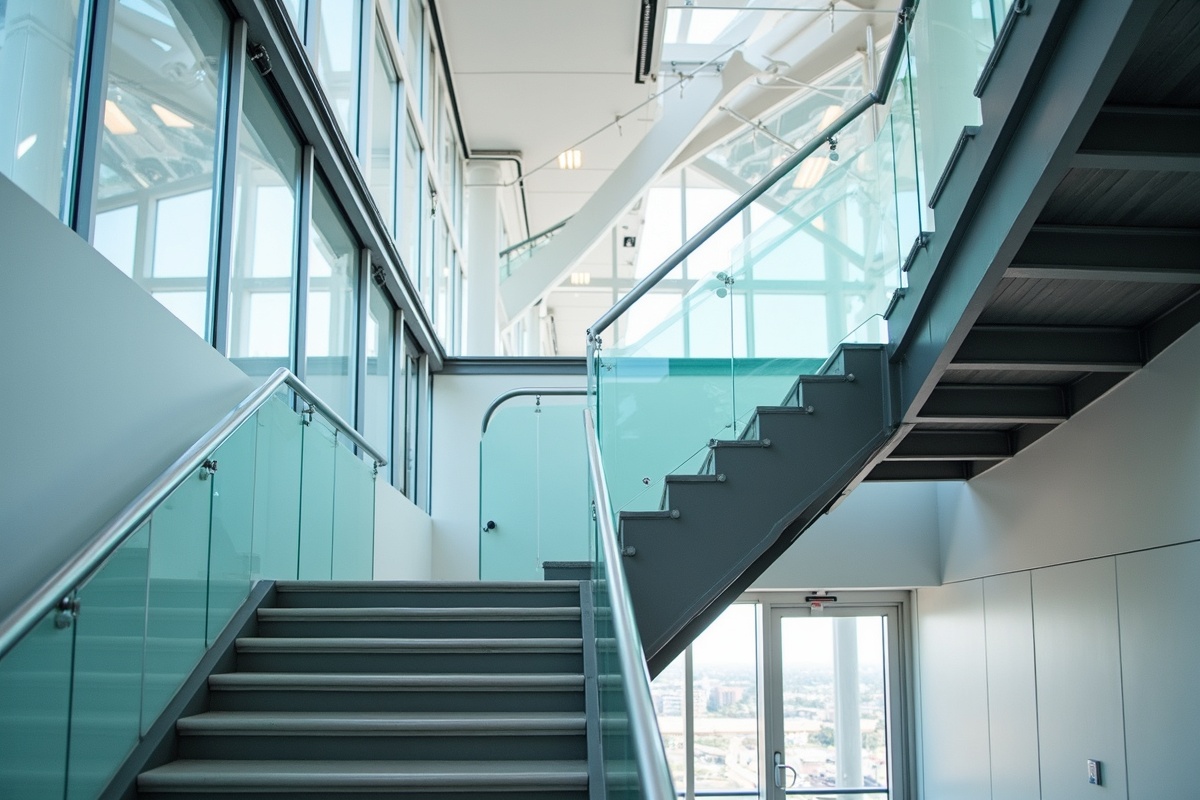
Clean glass stair railings every 2–4 weeks with a soft microfiber cloth and a streak-free glass cleaner. Avoid ammonia-based cleaners on laminated glass (ammonia can degrade the PVB interlayer over time) and avoid abrasive pads on polished edges. Check the base shoe channel annually for debris and drain points. Top handrails and hardware should be wiped down with the same cleaning schedule as the glass.
Simple two-step maintenance routine:
- Dust with a dry microfiber cloth first to remove surface particles. This prevents scratching on the wipe-down pass.
- Spray glass cleaner on the cloth (not the glass) and wipe in straight vertical strokes. Finish with a dry microfiber buff.
For fingerprints and skin oils that are common on stair railings — because people naturally touch the top rail and glass while climbing — a 1:1 water and white vinegar solution with a drop of dish soap works well and leaves no residue.
Frequently Asked Questions About Glass Stair Railing Installation in Dallas
What glass thickness is code-required for Dallas stair railings?
Texas residential stair railings require tempered safety glass with a minimum 3/8 in. (10mm) thickness under IRC 2021/2024 as adopted across DFW municipalities. Commercial stairs under IBC typically require 1/2 in. (12mm) tempered glass, and some jurisdictions require laminated tempered glass for any railing where the glass serves as a load-bearing element. All glass must meet CPSC 16 CFR 1201 Category II safety glazing standards. Always verify the adopted code version with the local Authority Having Jurisdiction before fabrication.
Are glass stair railings safe for homes with children?
Yes. Glass stair railings are engineered to meet the same 200 lb concentrated top-rail load and 4-inch sphere opening limits as any other code-compliant guard. Because tempered glass breaks into small granular pieces rather than sharp shards, a failure is less dangerous than a fall through a gap in a traditional baluster system. Many parents of small children actually prefer glass because the full stair is visible at all times — no spindles block the view of a climbing child.
How do glass railings compare in cost to iron or wood stair railings?
Mid-range iron baluster railings typically run $80–$160 per linear foot in DFW. Custom wrought iron can exceed $300 per linear foot. Solid wood balusters run $60–$120 per linear foot. Glass railings at $200–$500 per linear foot are in the premium tier, but the per-foot cost is often comparable to custom ironwork at the higher end of a mid-range project. For most clients, the glass railing is chosen for aesthetic fit rather than cost.
What permits are required for stair railing installation in Dallas?
A permit is typically required whenever the stair railing replacement is part of a larger remodel or new construction. For a like-for-like railing replacement on an existing stair with no structural changes, some municipalities do not require a separate permit. Always confirm with the City of Dallas, Plano, Frisco, Southlake, or whichever jurisdiction the project is in. Commercial projects always require permits and often require stamped structural engineering.
How difficult is it to keep glass stair railings clean in DFW?
A glass stair railing takes 10–15 minutes to wipe down on a 12 ft run — significantly less time than cleaning between the balusters of an ornamental iron railing. DFW has hard water and high pollen counts in spring and fall, so plan on cleaning every 2–4 weeks. A simple microfiber cloth and streak-free cleaner handles the full panel. Hardware and top handrails wipe down at the same time with the same cloth.
Also see our guides to glass balcony railing installation in Dallas, glass railings installation in Texas, and commercial glass installation in DFW.
Ready to plan a glass stair railing installation for your Dallas home or DFW commercial project? Contact Infinity Glass & Glazing for a site measurement and custom quote. We fabricate and install frameless, post-mounted, and standoff glass stair railing systems across the DFW metroplex from our Corinth, TX shop.
Related reading: